Comparing MOOCs
Even in the
last five years, definitions of MOOCs (Massive Open Online Courses) have evolved. I say definitions because I think it is
widely agreed that there are different types of MOOCs, serving different
purposes for the users and for providers. Originally, since the early part of
the 21st century (though some will argue that MOOCs existed before then), most
observers could probably agree that a MOOC was a course provided through an online platform, using tools
such as videos, and discussion forums, and with the emergence of web 2.0 apps, the
ability to integrate with social networks.
Some of the main characteristics of a MOOC were that they were often provided
free, open to anyone and were offered by internationally known institutions
or their faculty and did not offer a formal accreditation system.
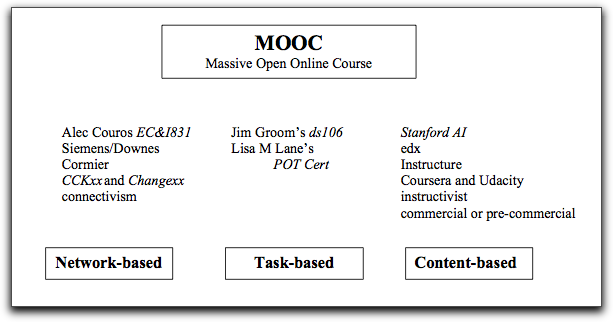
cMOOCs
(including task-based and networked-based)
Prior to 2015,
we had seen the emergence of two major strands of MOOCs: cMOOCs and xMOOCs. The
theoretical basis of cMOOCs was seen as “connectivism, openness, and
participatory teaching” (Jacoby, cited in Veletsianos and Shepherdson 2016, p. 199-
200), emphasizing the active part learners play in knowledge creation, through
their connections with other learners and their learning environment via networks
facilitated by online technology. Canadian researchers George Siemens, Stephen
Downes, and Dave Cormier based their MOOCs on the connectivist principles that everyone
should determine their own learning goals, and structure and manage their own
learning via personal learning networks.
The learner is free throughout the whole learning process. These principles are still followed through
in the task-based (Lane,
2012) MOOC, d106 facilitated by Jim Groom and
Rhizomatic
15 by Dave Cormier, both supported by leading lights in connectivism theory. Cormier describes Rhizomatic as ‘a story for how we can think about learning and
teaching’ where the learning community is the ‘curriculum’ or ‘challenge’.
He asks participants to think of the learning environment as ‘’a research lab’,
in which where participants are ‘researching along with me’. In
terms of technology, the emphasis on social networking tools is clear when he
talks about his communication with learners: ‘I’ll post it in the newsletter, I’ll tweet it …
I’ll post it in the Facebook group and I’ll post it on the
course blog.’ Similarly,
d106 is described as 'Digital
Storytelling’ where ‘you can join in whenever you like and leave whenever
you need’ and describes how they ran a course ‘where… there was no teacher’. Communication is via a blog feed. Due to their open nature (where is no
set ‘curriculum’, learners define ‘success’ and learning path, it is difficult
to formally assess a learner’s progress and therefore to acquire monetary gain
from these types of MOOC.
xMOOCs (including
content-based)
In
contrast to cMOOCS,
xMOOCs follow a cognitivist-behaviourist approach (Hew & Cheung, cited in
Veletsianos and Shepherdson 2016, p.199) resembling ‘traditional
teacher-directed course[s]’ (Kennedy, cited in Veletsianos and Shepherdson
2016, p.200). The number of xMOOCs delivered has been growing rapidly, whilst any
cMOOCS that still have some connectivist aspects to them (use of social media,
group tasks) have adopted more and more of the features of xMOOCs (a fixed content
is ‘delivered’ – hence the term content-based),
to the extent they can be called hybrids. The UK company FutureLearn, for
example, offers free, open MOOCS but its platforms are also used to promote fee-paying degrees with The Open University, microcredits and badges and the
courses are structured by Futurelearn to quite a large extent. FutureLearn’s free
courses also offer ‘extra benefits’ for a price, so students can gain extended
access to materials. None of these are offered for a fee on the cMOOCS
discussed above, as any course benefits are extended free of charge. The ‘open’
aspect on Futurelearn courses is more about students’ freedom to study at their
own pace, than on unfettered access to materials. In terms of technology,
however, Futurelearn has a more varied offering. On its online
educator course, students use video, interactive quizzes and polls that are
a fixed part of the course offering, as well as various social media that are
used on the cMOOC courses, ds106 and Rhizomatic.
In 2020, there
are more than 900 universities around the world offering over 11,400 MOOCs and
the emphasis is on monetary gain – accounting for the emphasis on a cognitivist-behaviourist,
where institutions can ask for payment based on the learners’ achievement of specific
goals. So, whilst, d106 and Rhizomatic,
offering free courses, make very little money each year, by contrast, Coursera's
2018 estimated revenue is around $150 million and FutureLearn
made around $10million. This means there is a corresponding focus on formal
accreditation of learning. Perhaps partly for the same reason, the concept of free
and openness, very apparent in former approaches to MOOCs, has now evolved to mean
anyone can apply from anywhere. More and
more courses are asking for formal proof of prior learning, such as a diploma or
degree and fees are being charged in return for globally recognised
certificates. However, the term ‘open’
has always been defined differently by different observers. FutureLearn course,
I can speak to all aspects of one of its MOOCs.

Hew, K. F.,
& Cheung, W. S. (2014). Students’ and instructors' use of massive open
online courses (MOOCs): Motivations and challenges. Educational Research
Review, 12, 45.
Jacoby, J.
(2014). The disruptive potential of the massive open online course: A
literature review. Journal of Open, Flexible and Distance Learning, 18(1),
73-85.
Kennedy, J.
(2014). Characteristics of massive open online courses (MOOCs): A research
review, 2009–2012. Journal of Interactive Online Learning, 13(1), 1–16.
Lane, L.M. (2012)
‘Three Kinds of MOOCs’ Blog. [Online]. Available at http://lisahistory.net/wordpress/musings/three-kinds-of-moocs/
(Accessed March 29, 2020)
Veletsianos
and Shepherdson (2016), A Systematic Analysis and Synthesis of the Empirical
MOOC Literature Published in 2013–2015.
Tags: moocs, comparing moocs, different types of moocs, xmoocs, cmoocs, online courses, connectivism, cognitivism, behaviourism

