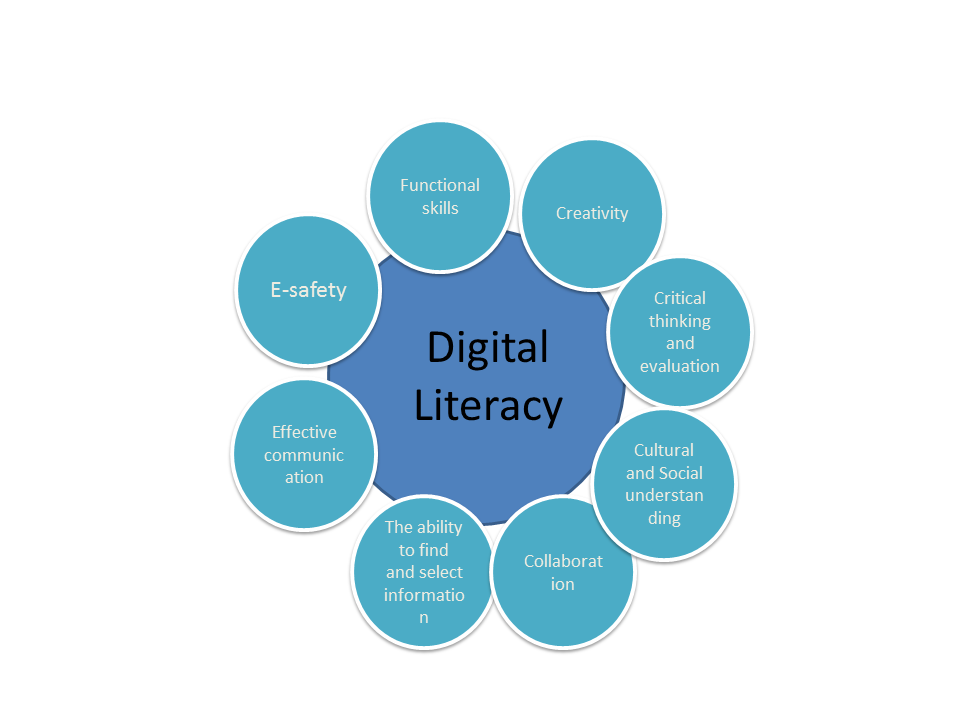
Image: 'Digital literacy disciplines' Creative Commons
Digital
Visitors and digital residents
I recall exploring
the concept of ‘digital natives versus digital immigrants’ (Prensky 2001) in a
previous iteration of my journey into open learning/teaching and education as a
now quaint idea that digital technology belonged to the millennials who grew up
as Web 2.0 was taking hold and those born to earlier generations were immigrants,
needing to pass some kind of naturalisation procedure to gain residency or full
digital-age citizenship. The ageism
aspect of it tended to go over our heads, as we realised that digital
citizenship was more a matter of exposure and interest than age. Bennett, Maton, and Kervin (2008) found as much
difference in technological know-how between those born during the coming of the
full-on digital age of the late 90s to early 21st century as between
those born earlier. Take my students, born in conservative Central Asia. My impression is there is a technology gap
between girls and boys and between my students and western students of UK, US
and Australia, as my region, emerges from its post-soviet isolation – very rapidly
I might add. Kazakhstan ranks highest in terms of internet access of all
Central Asian countries, however, behind Russia and much of the world. Internet
only appeared in 1994 in Kazakhstan, but it ranks 61st place out of 177
countries for broadband Internet speed.
The
concept of ‘digital natives versus digital immigrants’ has since been
modernised and now the terms ‘digital visitors’ and ‘digital residents’ (White and
Le Cornu 2011) are in currency – those that only occasionally use a technology and
who have not developed much expertise in its use and those who use a tech often
and who developed some expertise in its use.
White on his website, and in an
accompanying video describes his approach
to mapping an individual’s level of acculturalisation to a technology,
including the use of his openly
licenced software.
I decided
to map my own level of engagement with different technologies using White and
Le Cornu’s ‘Visitors and Residents’ concept (e.g. including my use of, VLEs,
blogs, Facebook, Skype, etc.), cross-referenced with my adaptation of their
personal/institutional axis (I break it
into social, professional and educational) as well as the visitors/resident
one. I used Miro,
the online collaborative whiteboard platform to create my grid. Click on
this link to see my visualisation:
Henry’s Visitors and Residents’
concept (public)
Henry’s
Visitors and Residents’ concept (course members – editable)
If
you can, feel free to adapt the model I created in any way you please and send
me an image or link of your version of the model!
I found it
a useful way to reflect on my current use and to consider other technologies I
do not use, especially when comparing my grid with others’ on my course, whose
were often very different, based on their jobs, experience etc.

References
Prensky,
M. (2001) ‘Digital natives, digital immigrants part 1’, On the horizon, 9(5),
1–6.
White, D.
and Le Cornu, A. (2011) ‘Visitors and residents: a new typology for online
engagement’, First Monday, vol. 16, no. 9, 5 September 2011 [Online]. Available
at http://firstmonday.org/ojs/index.php/fm/article/view/3171/3049 (Accessed 21
October 2019).
Tags: digital residents, digital visitors, technology, e-technology, web 2.0, social media, open educational resources, oer, digital literacy

