OU blog

Personal Blogs

Design Museum

The Art of Getting Lost: From Oxford Libraries to AI

Visible to anyone in the world
Edited by Jonathan Vernon, Sunday 15 November 2026 at 09:02

A mindburst: A billion ping-pong balls ricocheting through the nuclear reactor of my imagination, as human curiosity encounters artificial intelligence.

What twenty-first-century technology has taught me about the learning theories I studied at the Open University.

What do I miss from the old days?

Not much, as it happens.

I’ve lived through the Moon landings, the arrival of personal computers, the Internet, the World Wide Web, smartphones and now artificial intelligence.

I’m 65, and I hope to witness another thirty years of extraordinary technological change.

But there’s one experience I remember with particular affection.

Getting lost in a library.

As an undergraduate at Oxford, I could spend days following a question through the Bodleian, the Science Library, the Map Room, the Rhodes Library and the reading rooms containing historical newspapers.

One reference led to another.

A journal suggested a map. The map raised another question. A footnote sent me searching for something entirely unexpected.

I loved it.

One particularly memorable expedition involved an essay I’d chosen to write about breastfeeding.

I wanted to investigate its historical, anthropological, physiological and educational significance.

How did mothers and infants learn to breastfeed? How did the experience differ across cultures? What did biology determine, and what was socially learned?

It sent me everywhere.

Among my discoveries was the hormonal mechanism through which breastfeeding could delay ovulation.

Several years later, in April 1988, I was back in Newcastle, working as a television producer.

My sister had a six-month-old baby boy.

Naturally, I enthusiastically shared what I’d learned about breastfeeding and fertility.

I must have been convincing.

The following February, she gave birth to a daughter.

She’s blamed me ever since.

Apparently, she had understood my explanation to mean that breastfeeding would reliably prevent another pregnancy.

It doesn’t.

My sister went on to have five children and now has seven grandchildren.

But I still get the blame.

Quite a result for an undergraduate essay.

From library shelves to learning theory

When I began studying for my Masters in Open and Distance Education at the OU, I became fascinated by the theories that might explain what was happening when we learned.

Constructivism. Social constructivism. Situated learning. Communities of practice. Activity theory. Metacognition.

I devoured them.

Looking back, my Oxford library expeditions provide an interesting example of several of these ideas in practice.

I wasn’t simply receiving information.

I was actively constructing an understanding, drawing connections between disciplines, testing explanations and discovering that each answer generated further questions.

The libraries, catalogues, books and maps were tools.

My tutors and fellow students were part of a community.

The academic disciplines had their own conventions, assumptions and expectations.

And I was trying to produce something meaningful from the interaction.

Sound familiar?

Engeström enters the room

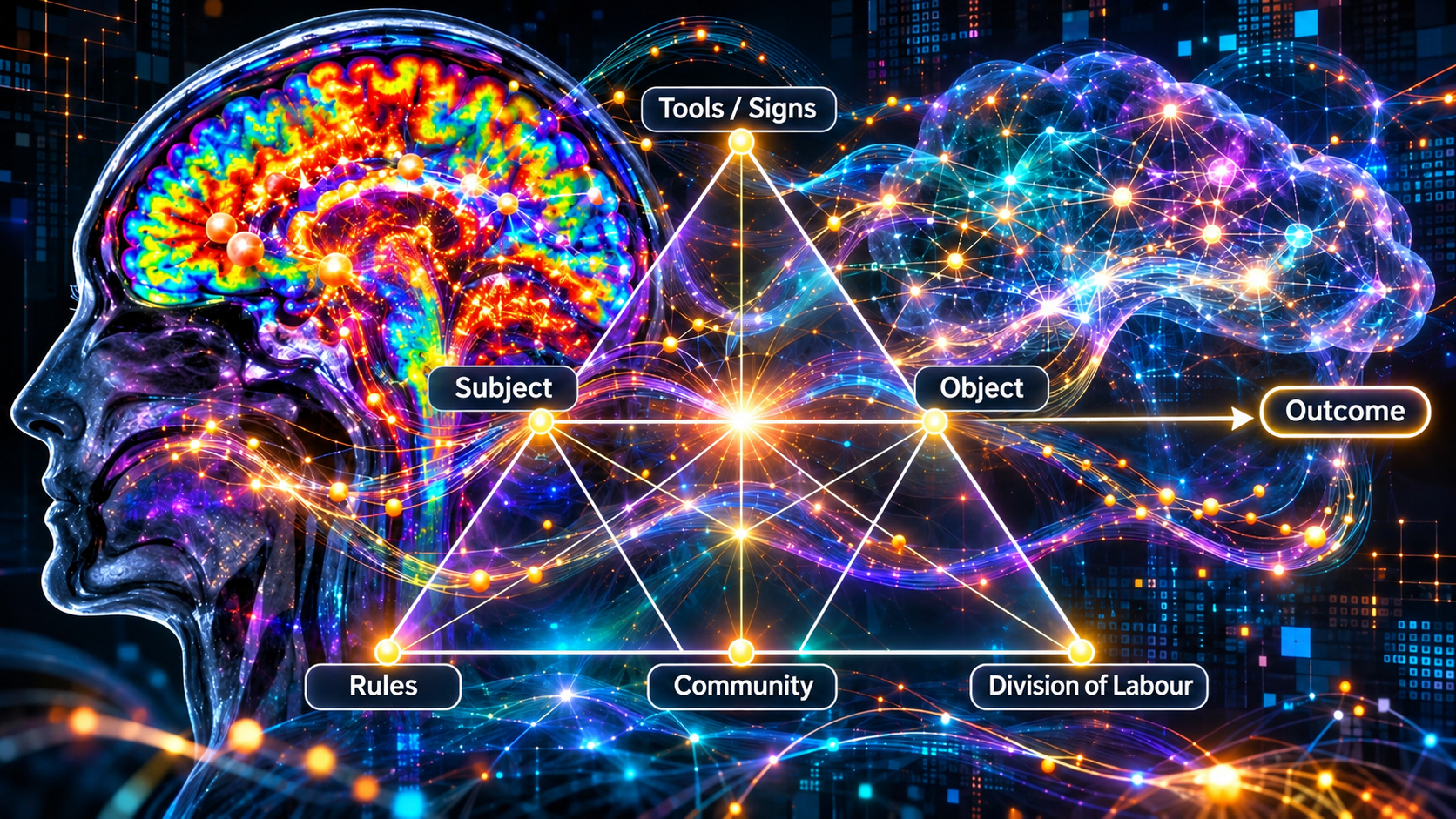
Yrjö Engeström’s Activity Theory model particularly appealed to me.

It offered a way of understanding learning not simply as something happening inside an individual’s head, but as an activity mediated by tools, social relationships, rules and shared objectives.

The familiar triangle had its subject, object, tools, community, rules and division of labour.

I could use it to examine my undergraduate research.

And I can use it again today.

Only the tools have changed.

Instead of searching catalogues and travelling between libraries, I might begin with a question to an AI.

The AI retrieves, explains, compares, challenges and suggests connections.

I respond.

It responds.

Another question emerges.

And off we go again.

Except that Engeström’s model also encourages us to consider contradictions.

A tool that gives me immediate access to information might also encourage me to accept an answer before properly examining it.

Something that makes research easier might make certain intellectual shortcuts more tempting.

An AI capable of proposing a plausible explanation might also produce one that is completely wrong.

The tool changes the activity.

And the activity changes how I learn.

The curious case of my AI companion

Here’s something that made me smile.

I’ve recently been using AI to explore an archive of more than 3,750 entries from my OU student blog.

In March 2013, I wrote a post titled:

“Right now I need an AI Companion.”

Thirteen years later, here I am.

I have one.

Well, something approaching what I imagined.

And I find myself returning to questions I was asking during my MAODE studies.

What constitutes meaningful interaction?

Can a machine provide useful scaffolding?

Where does the learner’s agency reside?

What is the relationship between receiving an explanation and developing an understanding?

When does reflection become learning?

What happens when the technology can participate in something resembling a tutorial dialogue?

And perhaps most importantly, how do I know when I’ve actually learned something?

A billion ping-pong balls

Early this morning, I was discussing these ideas with an AI.

One recollection prompted another. I remembered my grandfather learning to fly in 1918, my Oxford libraries, my sister’s unexpected baby, the educational technologies we experimented with during my Masters, and the extraordinary possibilities of AI.

My brain felt as though a billion ping-pong balls were ricocheting around a nuclear reactor hall.

Ideas everywhere.

Connections forming.

Questions multiplying.

I was having a wonderful time.

And suddenly I recognised the experience.

It was remarkably like getting lost in those Oxford libraries.

Not identical, of course.

There’s no substitute for the physical presence of other people, the unexpected conversation, the tutorial, the argument over a whiteboard or the sensory experience of books and places.

But the intellectual excitement was familiar.

It also made me reconsider the educational technologies we experimented with during the MAODE.

Some now seem almost comically crude.

Yet the questions we were asking about learning design, social interaction, learner autonomy and the mediation of learning remain remarkably relevant.

Perhaps more relevant than ever.

What comes next?

I’ve begun imagining a new kind of library.

Not simply shelves of books, but galleries, archives, studios, music, games, laboratories, swimming pools, places to eat, and spaces for conversation and argument.

Somewhere people could learn through every available medium.

A physical community connected to an almost limitless digital world.

A place where an unexpected encounter might lead to an entirely new intellectual adventure.

It’s beginning to look suspiciously like the Oxbridge campus I enjoyed so much.

But I’d want it to be open to everyone.

And perhaps that’s the most important connection to my Open University experience.

The opportunity to participate in learning shouldn’t depend upon age, background, income or whether you’ve ever attended a university.

Technology can widen that opportunity.

But technology alone doesn’t create a learning community.

People do.

So what do I miss from the old days?

The pleasure of getting lost in knowledge.

Except that I haven’t really lost it.

I’ve simply found another way to wander.

And I’d love to know whether other OU graduates feel the same.

Has technology fundamentally changed the way you learn, or has it simply given your curiosity new places to explore?

References and further reading

Engeström, Y. (1987). Learning by Expanding: An Activity-Theoretical Approach to Developmental Research.

Engeström, Y. (2001). ‘Expansive Learning at Work: Toward an Activity-Theoretical Reconceptualization.’ Journal of Education and Work, 14(1), pp. 133–156.

Vygotsky, L. S. (1978). Mind in Society: The Development of Higher Psychological Processes.

Related reading: The Art of Getting Lost — the longer, personal version of this story on JVernon.blog.
Permalink Add your comment
Share post
Design Museum

Learning, Curiosity and the Arrival of AI

Visible to anyone in the world

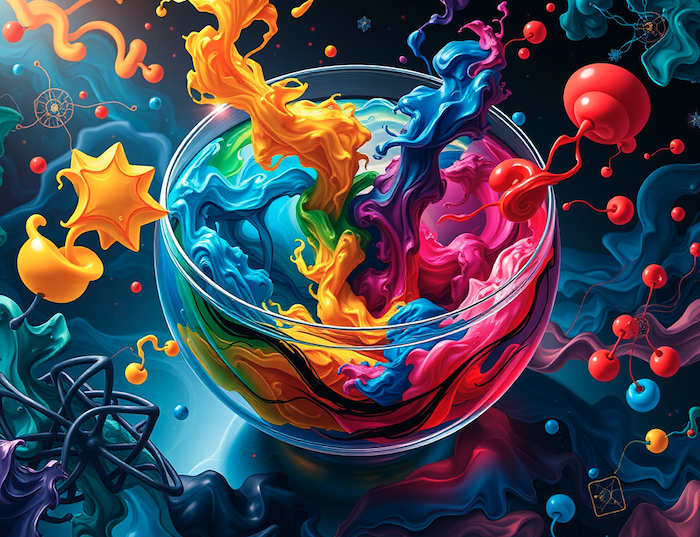
Colour inks aggittated in a bowl as a metaphor for learning

I’ve always been fascinated by how we learn. Look at me here! Try some of the hundreds of links. 

Twelve years ago, while studying for a Master’s in Open & Distance Education with the Open University, I tried to impose some order on the chaos of learning theory. I drew up lists of behaviourists, constructivists, activity theorists and communities of practice > Learning Theories in a Mind Map. I remember thinking that the field resembled a large bowl of water into which someone had dropped twelve different coloured inks. Each theory diffused through the water, overlapping and interacting with the others.

At the time, neuroscience was only just beginning to open the lid on what was actually happening inside the brain during learning. Today we have far richer pictures from brain imaging, cognitive science and network theory. What strikes me now is that the metaphor still holds: learning isn’t one process. It’s an ecosystem.

And now, of course, AI has joined the bowl.


Theories of Learning (and Why There Are So Many)

When I first encountered the literature, it seemed as though every decade produced another theory explaining how humans learn.

There were the behaviourists, like Skinner, who treated learning as a pattern of stimulus and response.

Then the cognitive theorists, such as Piaget and Bruner, who focused on how the brain processes information and builds mental models.

Constructivists argued that knowledge isn’t transmitted but built by learners themselves, often through collaboration.

Social learning theorists like Bandura showed how much we learn simply by watching others.

And then there were frameworks such as communities of practice, activity theory, and organisational learning, which explored how learning emerges inside social systems.

At first glance, the field looks fragmented. But the longer I’ve spent thinking about it, the more it seems that these theories are simply looking at the same phenomenon from different scales.

Some focus on neurons.

Some individuals.

Some on social systems.

But all are describing learning.


My Favourite Theory: Resistance to Learning

One theory that always amused me was Knud Illeris’s idea of defence learning.

Sometimes people simply refuse to learn.

I can decline Latin verbs like amo, amas, amat somewhere in the recesses of memory, yet if you asked me what half of it means today I would struggle. Nine years of Latin education achieved very little.

The same was true of early French lessons and much of my school chemistry. Weekly tests, boxes ticked, grades achieved. A perfectly efficient system for passing exams.

But not necessarily for learning.

Ironically, French came alive later through a completely different route: a French exchange, hitchhiking through France with people who spoke no English, and eventually working there. The “holistic” version of learning worked instantly because suddenly the language mattered.

Learning, it turns out, has a lot to do with relevance.


What Neuroscience Now Suggests

In the years since I studied learning theory, neuroscience has simplified the picture dramatically.

Beneath all the theories, learning seems to rely on three fundamental processes in the brain:

Prediction – the brain constantly builds models of the world.
Error correction – when reality differs from prediction, the brain updates the model.
Social modelling – humans accelerate learning by observing other humans.

Prediction → feedback → adjustment → improved prediction.

This loop operates constantly.

When a swimmer adjusts a stroke.

When a gardener learns how soil behaves.

When a cook experiments with flavours.

When a writer revises a paragraph.

The theories I once catalogued—constructivism, behaviourism, communities of practice—are really descriptions of different parts of this loop.


Learning Beyond the Classroom

The other thing that became clearer over time is that learning doesn’t really belong to schools or universities.

Much of the most powerful learning is experiential.

Coaching swimmers taught me this. Technique improves through repetition, feedback and observation. No textbook can substitute for the feel of water moving past the hand.

Relief printing works the same way. You cut, print, adjust pressure, print again.

Gardening is an endless dialogue with soil, weather and plants.

Cooking involves constant experimentation.

These are embodied forms of learning: knowledge living in the body as much as the mind.

In other words, the bowl of coloured inks contains physical experience too.


The Shift to Networked Learning

When I wrote about learning twelve years ago, Web 2.0 was already changing the landscape.

Information was escaping institutional silos.

Instead of learning only through teachers and textbooks, we could go directly to the source: experts, papers, videos, forums, and communities.

I began to think of learning less as belonging to a “community of practice” and more as a community of ideas.

Today, that shift has accelerated dramatically.

The network itself has become the classroom.


Where AI Fits

This is where AI becomes interesting.

AI is not simply another information source. It behaves more like a thinking partner.

Historically, learning tools extended our memory: books, libraries, notes.

AI extends something different.

It extends thinking.

I use it constantly.

For writing and editing prose.

For sports science questions in swimming coaching.

For drafting council reports or exploring policy issues.

For relief printing techniques.

For gardening advice, cooking ideas, health questions, even mental health reflection.

What AI does particularly well is accelerate the learning loop:

It helps build models by explaining complex ideas.

It provides feedback by analysing questions or arguments.

It simulates expert reasoning, allowing us to observe how a subject might be approached.

In effect, AI can function as a kind of cognitive scaffolding.


Learning in the Age of AI

The most interesting shift may be that learning is no longer primarily institutional.

For centuries the path looked like this:

School → University → Career.

Now it looks more like this:

Curiosity → Exploration → Network → Iteration.

Learning becomes continuous.

AI simply makes the network more responsive.

Instead of waiting for a lecture, we ask a question.

Instead of searching blindly through information, we explore ideas interactively.


The Thread That Runs Through It All

Looking back, the most important ingredient in learning wasn’t any particular theory.

It was curiosity.

As a child I was constantly asking questions. I wanted explanations. I wanted conversations. I wanted to know how things worked.

Sometimes that enthusiasm was welcomed.

Sometimes it wasn’t.

But curiosity is what drives the prediction–error loop that sits at the heart of learning. The brain wants to resolve uncertainty.

And in many ways AI is simply a new tool for satisfying that ancient human instinct.

We are still doing the same thing we have always done.

Trying to understand the world.

The bowl of coloured inks has just become a little richer.

Permalink Add your comment
Share post

This blog might contain posts that are only visible to logged-in users, or where only logged-in users can comment. If you have an account on the system, please log in for full access.

Total visits to this blog: 22994156