- Pay attention to the
author’s method for teasing out theoretical concepts about self-fashioning
from Holbein’s painting, as well as to the fact that the primary topic of
his book is English literature (note the book’s subtitle: ‘From More to
Shakespeare’).
- How
would you characterise the discussion of identity and subjectivity here?
What are the conflicts in the painting according to Greenblatt, and how do
they operate?
(1) Greenblatt does not, as such describe ‘self-fashioning’
as a theoretical concept or define it. It is rather implicit, at least in this
piece. This is characteristic of certain kinds of literary theory, which aim to
persuade that the theory used is born of empirically observable facts..
Look, for instance, at p. 20 para. 2:
o
There are, to be sure, the faces and hands of D
& S, and yet so strong is the sense of pose
as Holbein depicts them that they seem, of all the objects in the painting,
the most artificially crafted. They possess a calculated impenetrability that
suggests, in the hands, the carefully fashioned casualness counselled by Castiglione
and, in the faces, the masking counselled by Machiavelli.
The next sentence uses reference to ‘the
power of human shaping’ to characterise and summarise what is described here. Yet
where is this notion really defined or spelled out in a way that can be
challenged. In this extract it is not. Hence, the passage can elide certain
agencies. Is the ‘pose’ crafted by the two diplomats or by Holbein to allow us
to see through the imposture? That question will not be answered. This is
because Greenblatt is working from a consideration of the humanist diplomat More
to seeing Shakespeare as that artist who writes ‘character’ in ways that allow
us to see the character fashioning an ideal image of itself, whilst allowing us
to see behind that mask. This is, after all, the aim of most theatrical drama
whether that of Shakespeare’s Othello or Leontes or any of Ibsen’s characters,
including the Emperor Julian in Julian
the Apostate.
It is totally appropriate to call this a ‘teasing
out’ of concept rather than a theoretical discussion or even the application of
theory, which might require some robust inter-disciplinary thinking.
I totally agree with Greenblatt’s statement
however that this picture offers us signs for interpretation, which interpretations
(even of the question ‘what is reality in this picture?’) it then undermines. (p.
20 para 3). The problem is that like most literary critics, Greenblatt uses the
tools of his trade as if there were no difference necessitated by the cultural
object examined. Having noticed the uneasy and disturbing ‘reflection’ upon
each other of the anamorphic skull and the skull brooch that is worn by one
diplomat, he offers this ‘close reading’ as the key to his interpretation that
the picture both celebrates the human capacity to map the world and undermines
its efficacy in a world that other than the means we use to represent it. His characterisation of visual art
(presumably compared to literature) is of the former’s ‘sensuous immediacy and
simultaneity’.
This strikes me as a cliché. In an obvious
sense the process of reading literature and auditing/seeing dramas necessitates temporal as
well as spatial issues, but it is naïve to
think that visual art is processed outside of time or in immediacy. Otherwise
we can only attribute Greenblatt’s ability to see the well obscured brooch
skull as an effect of critical and special close reading. In fact I think this
is not the case. The picture, like most products of the norther, rather than
Italian, Renaissance operates very differently to the stress on ordered
perspective in say, Raphael. Yes, Greenblatt has noticed the brooch. Here it
is.
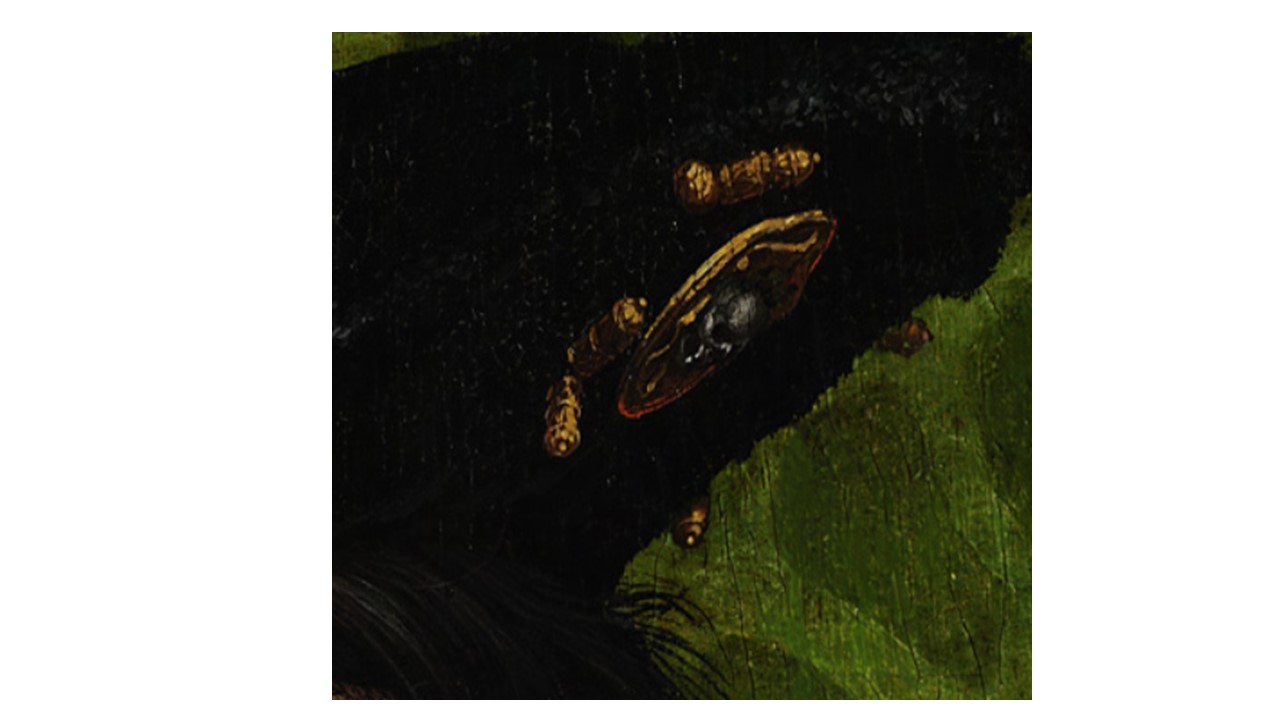
This piece of painterly virtuosity can be
noticed only with the ability of the viewer to spend time as well as critical intelligence
on the picture and it is this call to temporal attention that characterise the
virtuosity of the Northern renaissance I believe. And, in doing so, other
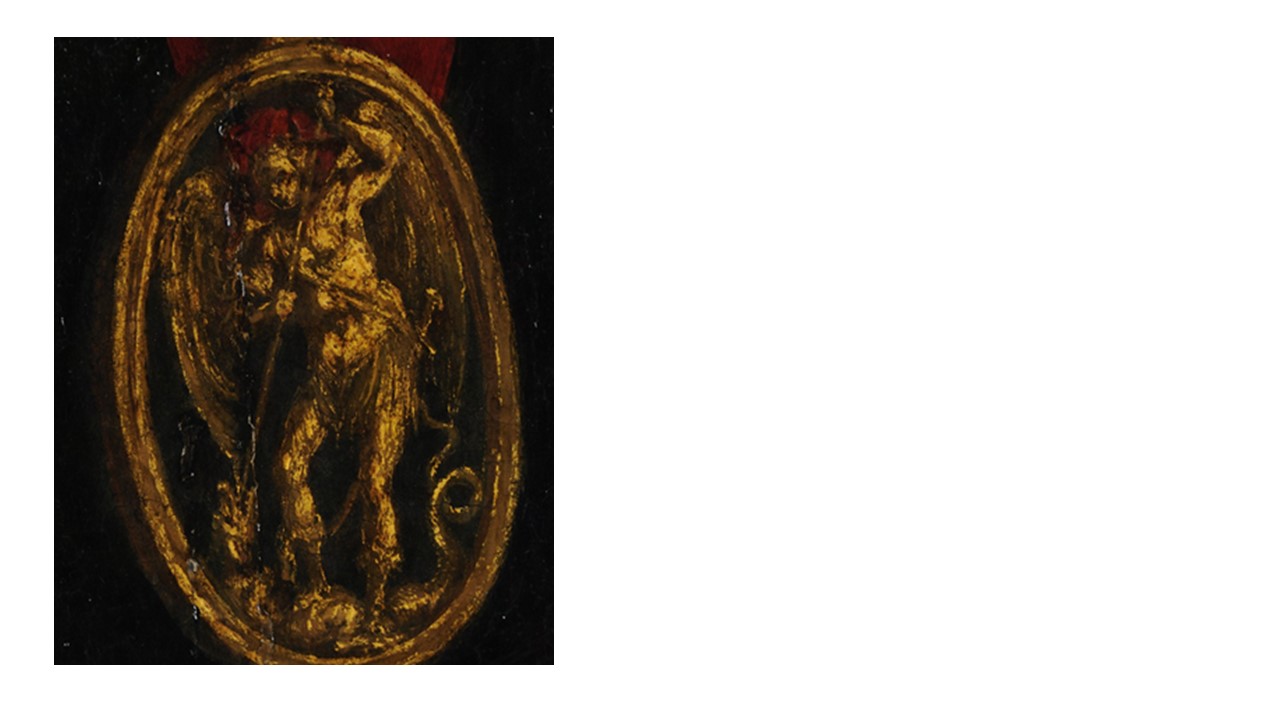
images emerge. The same diplomat wears a pendant (no doubt also a sign of
wealthy imposture) in which Satan (by Archangel Michael?) is overcome and the
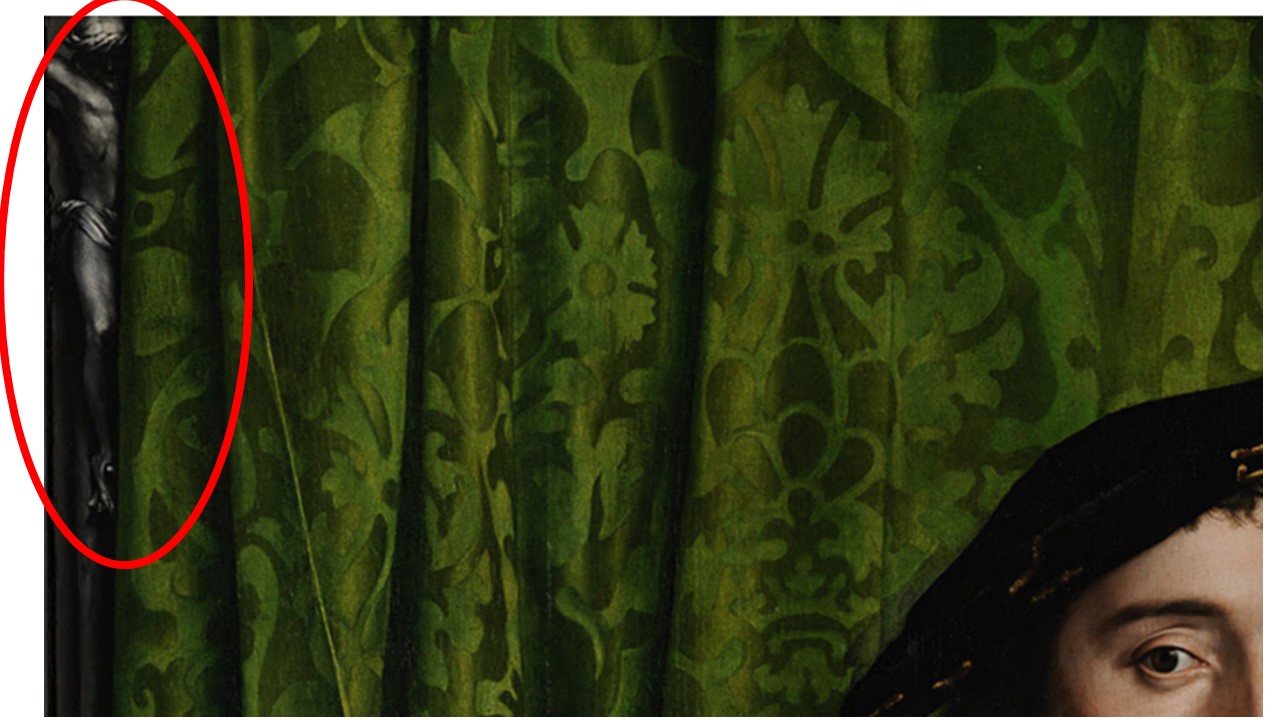
crucified Christ hovers in the extreme upper right hand of the picture (hiding,
like Polonius, behind an arras) – only seeable if you give time to the
painting. If you see all this, it may undermine the imposture of diplomacy,
science and education but it does not do so by leaving everyone merely with post-modern
angst about the lack of unitary meaning, although for me as a non-Christian it
must do so.
Hence my feeling about Greenblatt is that
sacrifices accuracy about the process of seeing visual art (and accuracy about
the different roots of the Northern Renaissance) for an attempt to wear the
cloak of the theory to cover meretricious subjectivism. Is that too harsh?
(2) Greenblatt seems to argue that while identity is
observable and readable from signs of complex and shifting meaning, it can be
distinguished from our apprehension of how the characters presented through
these signs appear subjectively to themselves. Moreover, identity and subjective
self-apprehension can clash – they can mean different and sometimes
contradictory things. We are used to dealing with Shakespeare, of course, in
this fashion, wherein we see action and character in conflict – as too in
Browning’s Italian painter monologues. We can see our diplomat as proud in the
vanity of his education, place in court and the world but open to being
undermined by the otherness of mortality and even perhaps notions of sacrifice
and redemption which go beyond the ornamental. These conrtradictions make up
our and probably Holbein’s ‘reality’. However, Holbein, in effect can afford
not to rest on the fissures between contradictory readings. If, as viewers, we
can’t, it is because the meaning of all symbols, icons and signs change
diachronically in time. Greenblatt’s reading effectively hides this basic truth
from us – merely because he insists response to visual art is about
simultaneity. I do not believe it is.
Well, that's what I thought on 22/9/17.
All the best
Steve

