 ‘To Enter
a Room’: Researching Space & Entry into Space in an
exploratory exercise by one OU Tutor preparing an online session on newly
introduced software (Adobe Connect).
‘To Enter
a Room’: Researching Space & Entry into Space in an
exploratory exercise by one OU Tutor preparing an online session on newly
introduced software (Adobe Connect).
Steve Bamlett
Image Creation
Exercise
To see the Meanings found in Production text described below, see https://learn1.open.ac.uk/mod/oublog/viewpost.php?post=198642, Open that in new window by clicking here.
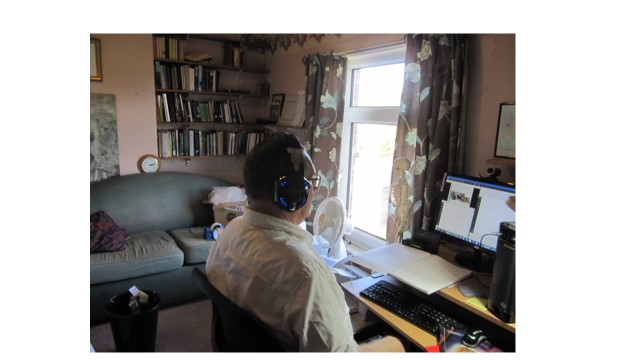
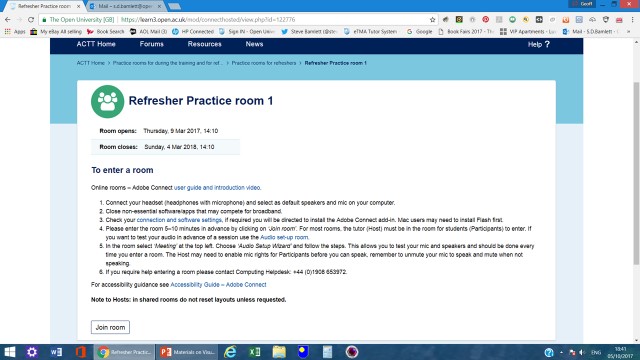
The two images I will be examining in this blog post are on
pages 2 & 3.
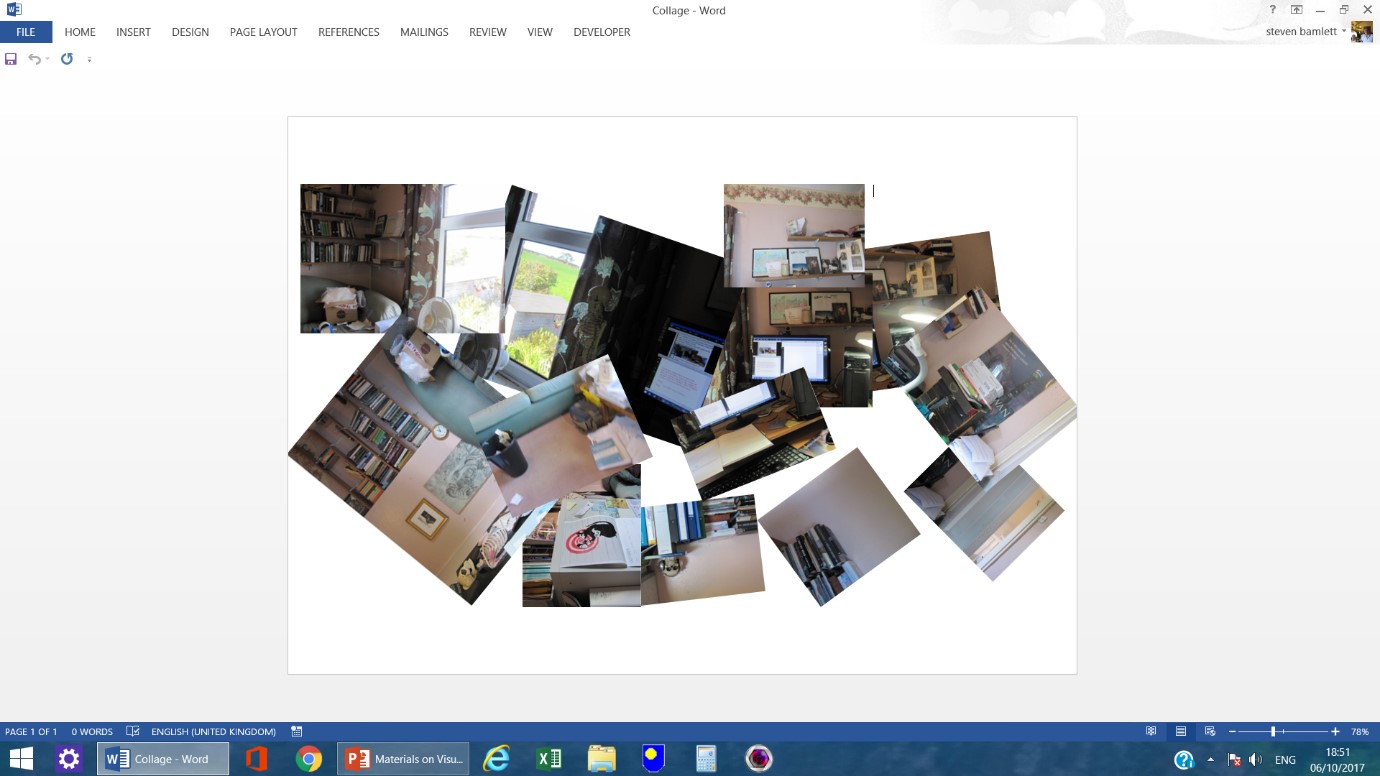
1. This
is a collage of photographs that aim to show a series of views of the room
space taken in a 360o swirl in an office chair. The room space is that in which
teaching preparation happens, including representations of offline space and
access point to online space at one point in the preparation process (p2).
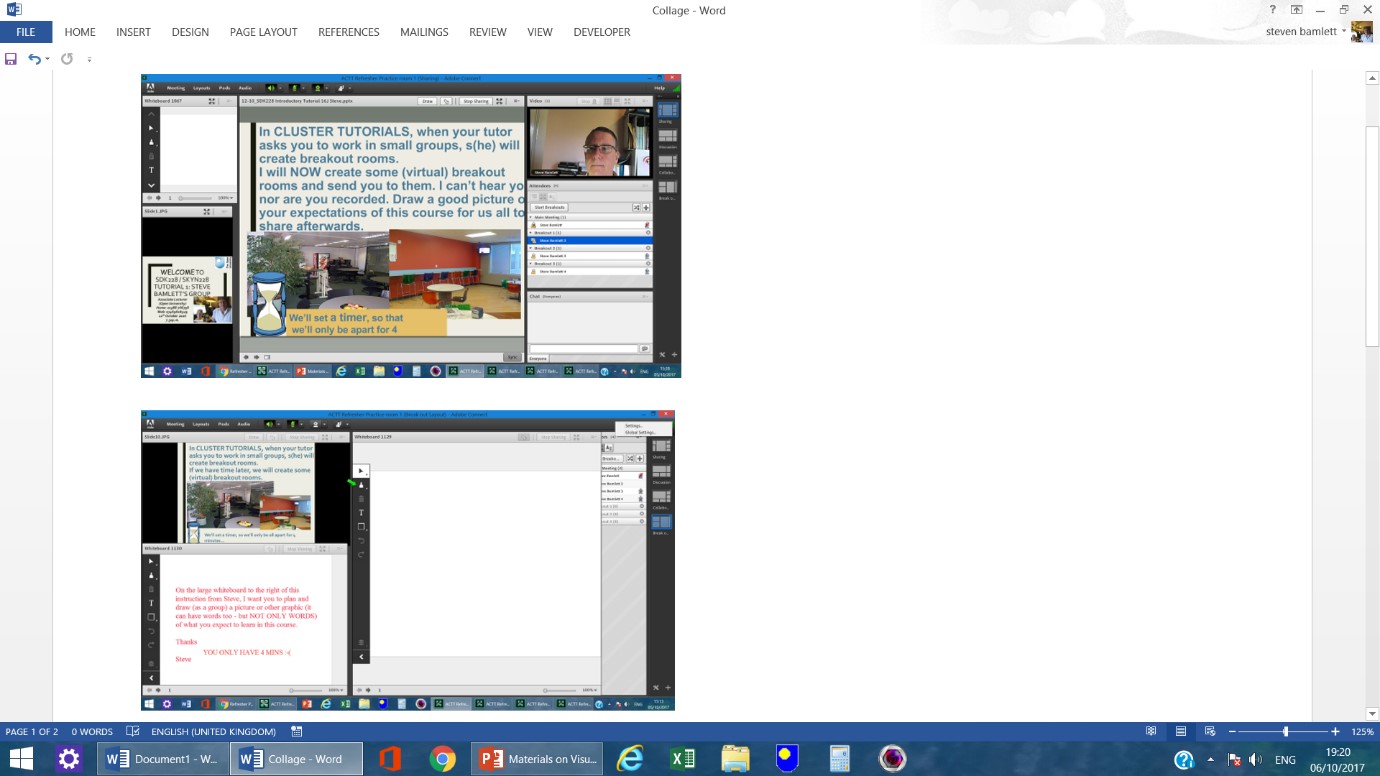
2. This
is the online space used at this same point, as well as an explanatory
online pages (p3).
The exercise took place on Thursday 5th November
2017 at 1419. Steve started work on his preparation. A random time by his
husband, Geoff, was chosen from a set of folded identical papers well jumbled. The
purpose of this ‘randomisation was so that Steve would not know which window
would be open on his computer at the point when the photographic data was
collected. Had he known this, a window could have been chosen that illustrated
a pre-determined set of meanings (at least potentially)
The
Task set & option chosen
Option 1: Collect
and analyse images. Take a tour of your workplace or your neighbourhood with a camera,
create a collage of images that represent a particular concept or theme you are
interested in exploring. Then, write a blog post about your image creation
task. Importantly, try to do some analysis of the resulting image(s).
Think about the
following questions as a way of structuring your writing:
·
What is depicted in the image(s)?
·
What were you trying to discover by creating your image(s)
·
What did the process of image creation involve?
·
What is not seen, and why?
·
How is meaning being conveyed?
·
With respect to the photographs, how might the image(s) convey something
different to your experience of 'being there'
The
Task
- What
is depicted in the image(s) – Figs 2 & 3 above?
Fig 2 is an amateur’s attempt to create a ‘joiner’
(a method of assembling overlapping photographs to represent the collision of
different perspectives to create a ‘whole’ but fragmented vision). David Hockney
(2007:102) argues that such works use theories of seeing originating in in
Analytic Cubism under Picasso, Braque & Leger. They show the participant’s
spatial environment(s) at 1419 during a preparatory session for an online
meeting with a group of 22 Level 4 learners to be held in the following week.
The method used is dependent on the viewer’s perspective during a sequence of
pauses in one 360o chair swivel the whole picture since, unlike
Hockney and others, it also involves views to the back of the participant at
1419 and are represented by a swivel of their frame in the median range of 180o.
The technique was intended to picture ‘space’ and ‘room’ (and a ‘room’)
following Hockney’s experiments (but by an enthusiast amateur with no artistic
pretension) that was, in effect ‘moving the space about’ (Hockney 007:106).
This is a deeply ‘subjective’ act but that in itself is not a problem
with the method, since it aims at capturing not measurable space but perceived
space, which may be an interaction with both filmic space – all depths are
brought to the surface in a photograph and interact with ‘illusory’ effects of
light - but also an element of potential psychological space (within any
conscious or unconscious decisions made in taking and framing the picture and
then selecting it or not for the collage).
The reason for not selecting an image (the
repertoire can be seen on the attached file), the participant – analyst believed
that these images could not technically fit on the A4 page on which cropped
versions of them were mounted. The cropping was guided, it was believed, by an
attempt at minimal fragmented continuity of the photographs.
Near the middle of the picture is the computer
screen on a computer table, which was the primary focus of this observation.
Figure 2(b) is a print screen of the new layout
being created for breakout rooms to be used in the teaching session. These are
in incomplete form but are, I think, near, completion, although the Attendee
pod will not be present. Note that attendees in this creation mode and in 2(a)
are the participant (as Host in control of dependent views available to participants).
The participants are all ‘avatars’ of the participant created by successive
room entries.
The move to the Breakout rooms in 2(b) when
completed will follow the screen in the main meeting at 2a. In each case a
photograph representing the parent screen is available in its own pod. The
breakout screens will ideally be used for instruction before participants are
despatched to breakouts – especially in introducing the drawing / writing icon
tool-bar (this is their first tutorial on the first year of AC’s introduction
to the OU). I ought to say that the latter sentence indicates my plans if this is
possible but I am not totally sure yet – more planning to do.
The screen (2b) at 1419 was in a state of near
completion. Note that since this is a HOST screen there are some icons in the
top bar not available to learners in the breakout rooms, which allow the
creation, control and destruction of this new layout by the Host.
It had been pre-planned, but not with an eye to
this project, to work on breakout rooms. I have long puzzled on the spatial /
architectural metaphors such as ‘room’ used to describe cyber-space or online
space and puzzled about them on my MA in
Online & distance education (click to open in new window).
- What were you
trying to discover by creating your image(s)
In my blog (Bamlett 2016) – link immediately above –
I quoted a sentence I removed from my EMA (which didn’t do all that well! L cheer upJ). It was:
Lucas
& Claxton (2010:99) identify ‘functional fixedness’ as a means of
disempowering learners from grasping more than the obvious affordances of
resources. They see it as endemic to cultures dependent on teaching-to-the test
rather than ‘lifelong-learning’.
I think it is possible that one means of achieving ‘functional
fixedness’ is to control the spaces that learners inhabit online and indeed
offline. What is space and what is 'a room' or 'room'? How do formal and informal definitions
of these terms impact on learners online? How do offline contexts relate to
online contexts in the learner’s conceptualisation and use of space? How do
ideas of control, order, organization, and conversely, ‘creativity’ or
individual difference – perhaps aspects of manipulations of psychological space
- interact with other formal and informal spatial definitions?
These questions are all MUCH too large and vaguely
posed. Moreover, I probably have no intention of following them through. They
are not new questions to the academy though. Collier & Collier (1986:
46ff.) example such questions in ‘visual anthropology’ as early as the 1950s.
Indeed Hall’s (1966: 97 words cited ibid: 48) seem to sum up my own study:
People who “live in mess” … are those
who fail to classify activities and artefacts according to a uniform,
consistent, or predictable spatial plan.’ (Mea culpa!!!!!!)
Together with these are much newer questions in
online education: notably those in Bayne (2008:403) who shows how some VLEs
strain to ‘render the “unknowability” of digital space knowable … in a way that
is heavily coded for stability, authority, and convention, and which limits the
sense of the information space as a domain’ from the intrusion of radical
alternatives.
There is no doubt that what I want to produce
however is only notes towards these issues. My MA in Art History has like ‘la
belle dame sans merci’ ‘me in thrall’.
- What did the
process of image creation involve?
I have detailed the process of ‘reconstructing’
images into a ‘production text’ (Fiske 1989 cited Mitchell 2017:92) above at
various points. Of course in a write-up I’d go for a fuller Methods section
here, included deeper thought on analytic methodologies – my preference though
would be a form of multimodal analysis (Bateman 2008, Bezemer & Kress
2016).
- What is not seen,
and why?
The unseen here is vast, even though the method
aims to highlight the perspectival nature of concepts of offline space. Indeed
an addition to the method may be to ask participants in open interview ‘what do
you think is missing from your collage that would help someone to understand
your experience better?’ What I think is missing here (given that I did this
quickly and as a pilot to see how to refine the instructions to myself) is that
psychologically vision is not experienced in this angular way and that gaps in
the layout appear not to be meaningful – see, for instance, how Hockney uses
gaps – and their absence – in his ‘joiners’. The kinetics and proxemics within
the space obviously also have meaning, since movement, even eye saccades, will
serve psychologically to make the objects and environment meaningful to the
person viewing them. A kind of dance animates meaning and image production.
This is even more problematic when you consider how the contents of a screen
are seen in interactions with the objects that ‘contain’ it and surround it or
are called forth by it. Some pictures could not be integrated in the collage,
yet one, showing a pile of papers on the floor, topped by my copy of Coe et.
al. (2017) obviously must have an impact on meaning production – its absence
being significant.
- How is meaning
being conveyed?
Meanings may be thought to be conventionally
attached to objects and artefacts in the ‘room’ (and indeed the room itself,
which was obviously once a bedroom – well before we moved here (why do we never
decorate?). Meaning will be an interaction between top-down stored associations
and bottom-up perceptions. Untangling what we see and what it means is
necessarily a subjective and iterative process where meanings are tried out.
Such a process will involve deep reflexivity in the process of interpretation
and contain information to help the reader find out how interpretations might
be motivated by interest (gender, sexuality, class, status and so on). What is
discovered might not be unpredictable to the viewer’s expectations as a result.
One effect of changing perspectives on a moment is its defamiliarisation,
possibly as a result of mental processing involving wider networks of
association than those usually employed.
- With respect to the
photographs, how might the image(s) convey something different to your
experience of 'being there'
My last sentence in part covers this. However, it
is also important to remember that the viewer may already have chosen a ‘meaning’
of their experience prior to having it: in order to meet the ambitions of their
academic project or for a more or less conscious reason. Hence devices to
increase reflexivity including peer involvement in analysis may well be
important.
PS I have my ideas about how, at this point, I
interpret my ‘production text’. I’m so pleased we aren’t asked to make this
analysis. Happy to discuss though.
What fascinates me are the self-images in the
created cyber-rooms shown (especially Fig. 2a). I’d like / not like to think
about that!
References
Bamlett, S. (2016) ‘Education
as Space-Travel. Referred to in H817 EMA as Bamlett (2016c)’ in ‘Steve Bamlett’s
blog: Available at: https://learn1.open.ac.uk/mod/oublog/viewpost.php?post=178400
Bateman, J.A. (2008) Mulltimodality and Genre: A Foundation for the Systematic Analysis of
Multimodal Documents London, Palgrave Macmillan.
Bayne, S. (2008) ‘Higher education as a visual
practice: Seeing through the virtual learning environment’ in Teaching in Higher Education 13 (4)
395-410 DOI: 10.1080/13562510802169665.
Bezemer, J. & Kress, G. (2016) Multimodality, Learning & Communication:
A social semiotic frame London, Routledge
Coe, R., Waring, M., Hedges, L.V. & Arthur, J.
(Eds) 2nd ed. (2017) Research
Methods & Methodologies in Education Los Angeles, Sage.
Collier, J. & Collier, M. (1986) Visual Anthropology: Photography as a Research Method Albuquerque, University of New Mexico Press.
Hockney, D. (2007) Hockney’s Pictures London, Thames & Hudson.
Lucas, B.
& Claxton, G. (2010) New Kinds of
Smart: How the Science of Learnable Intelligence is Changing Education Maidenhead,
Open University Press / McGraw-Hill Education.
Mitchell, C. ‘Visual methodologies’ in Coe, R.,
Waring, M., Hedges, L.V. & Arthur, J. (Eds) 2nd ed. Research Methods & Methodologies in
Education Los Angeles, Sage. 92 – 99.

