A queer approach to
sexual preference labelling in art-history (Queer theory and Interdisciplinary
Histories): Intermezzo. Reflecting on: Callen, Anthea
(2018) Looking At Men: Anatomy,
Masculinity and the Modern Male Body. New Haven & London, Yale University Press
Coming across this kind of excellent scholarly work
necessitates a pause and reconfiguration in one’s thinking. This ticks many
boxes for me.
First, it locates queer theory in interdisciplinary historical
discourses – those namely of medicine, art-education, psychosocial norms,
especial of masculinity class and race, although many more art-historical
narratives impinge – issues relating to the definition of image and its
relation to meaning (iconographic , naturalistic, conceptual and
formal-historical), proportionality & aesthetic form and formlessness, ideologically
contextual as opposed to positivistic theories of the ‘ideal’, notions of self,
identity and diversity, the history of discourses of sports and war and, of
course, the shift to a multi-disciplinary grasp of ‘anatomy’ in the nineteenth
century.
This will be a necessary struggle for me however I begin to
focus in on a topic, since the nude throughout the nineteenth and twentieth
century requires this grasp of different disciplines which shape its meanings.
But then so does ‘queer theory’ since it
depends on an awareness of the specificities of the binaries which shape gender
in any culture in space and time and the means by which these binary
explanations of reality are established, maintained, challenged and survive challenge.
The homosocial is made up from historical disciplines which in the nineteenth century
mean things like the definition of concepts like ‘professionalism’ as well as
normality and ‘appropriateness’ to norms. Of course however much I focus, that focus
will be on a work, works, movements or artists or an artist but these questions
will remain multiple ones and require attention, or, at least, awareness.
Callen’s book tries to look at the shift from the male nude
as classical ideal (and the role of the Academies therein pace Edward Lucie-Smith) to naturalist ambitions to draw a
statistical norm based on a theory of body economy (and its side-kick) efficiency
which animated the work of art theorists and practitioners, as well as masters
of male, health and physique and, of course, theorists of eugenic improvement.
She looks at works I see as central – Bonnat’s and Caillebotte’s
nudes and briefly at Cezanne’s and other ‘bather’ motifs – but never really centrally
to her argument. There are however
very fine readings of paintings, whose importance I had not realised or guessed
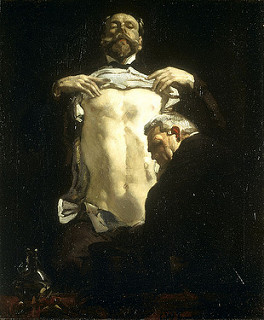
(or perhaps been even remotely aware of) such as Francois Sallé’s The Anatomy Class at the Ėcole des Beaux-Arts
(especially in the brilliant reading that traverses pp. 130 – 139). Here
class, the homosocial, age, profession, class, sexuality, envy and desire
discourses intersect each other in a way that can ONLY be admired..
Yet love this book as much as I do, it sits and stares with
a Sibyl-like stare at the dangers it flirts with of a discourse that doesn’t
quite add up to a single thesis, however
many fascinating (established and novel) arguments it sets running. I look
sometimes for more links between the excellent historical writing and research –
on the modes of capturing dynamic motion in photography for instance in science
and art schools (a lot to learn here) – and the main tenor of the argument.
Likewise the book keeps returning thinly to the representation of women in
homosocial contexts in ways that don’t seem to have space to be made solid.
On the other hand some comparisons seem profound despite
being met en-passant, such as the
brilliant comparison of the labouring bodies of coal carriers in Gervex and
Monet, for instance (179f.), whilst other art-objects definitely needed more
definition (such as Dalou’s La Fraternitie
from the 10th arrondisement
Marriage Hall – the most perfect kiss (p. 181) between two male nudes I have
ever seen (in art or out of it). I also wanted more awareness of just how ‘queer’
(antagonistic to norms) is George Lambert’s Chesham
Street (1910 - corrected. Thank you Ekaterina) on p. 123 but little is said. This is an image everyone must
puzzle over.
Queer theory often liberates from intentionalism and the ‘intentionalist
fallacy’ but this is not the case when Callen speaks of Etty’s Wrestlers (a painting I love (p. 87)),
which to me is full of much more ambivalence about ‘racial’ categories than she
allows as well as normative mid-Victorian racism.
One of the most useful bits of learning for me is the role
of the flayed nude écorché model,
which links my interests in Titian and de Ribera to their fate in nineteenth
century anatomical models – especially in holding up a light to the importance
of living over fragmented dissected bodies in anatomical knowledge.
Anyone who loves a wonderful enlightening read will love
this scholarly book because it is so well written, but to me it is going to
cause a lot of headaches. Writing with, and distinguishing oneself meaningfully
from, such excellence will be hard work. But that’s life. Thank you, Anthea
Callen, art historian, thank you!
All the best
Steve

