Regulating the View:
Who gets to go high? Looking from the Tall Building (1): The Shard
This room of our exhibition will explore pictures from a
particular high place but will focus on the work of non-professional
photographers, who Garret names ‘urban explorers’ (UE for short), whose aims in
making photography is not primarily the production of an art-object but of an
experiential record at some remove and considered as secondary and inferior to
the experience thus recorded. Indeed this goes for the word-pictures of the
experiences as well as collateral photography. This group is described by
Bradley Garrett (2013)[1]
who underwent ethnographic fieldwork with that group as a participant observer.
McKellar (2018) conceptualises
The Shard as an example of a contemporary ‘viewing platform’ (3.2.1) that has
emerged as an offshoot of the ‘blow up’ (3.3.2) of the London skyline. A
deregulated City has spawned it seems a new ‘iconography of elevation’, and
with it commercial practices that sell experience of that ‘elevation’. Hence
the existence of an enterprise that whose brand and process is deeply involved
with the ‘View from the Shard’ selling a group of commodities predicated on a
common interest on that ‘view’, especially at ‘night’ when the prices rise. We
need only vicariously experience a group of screenshots from The Shard website[2].

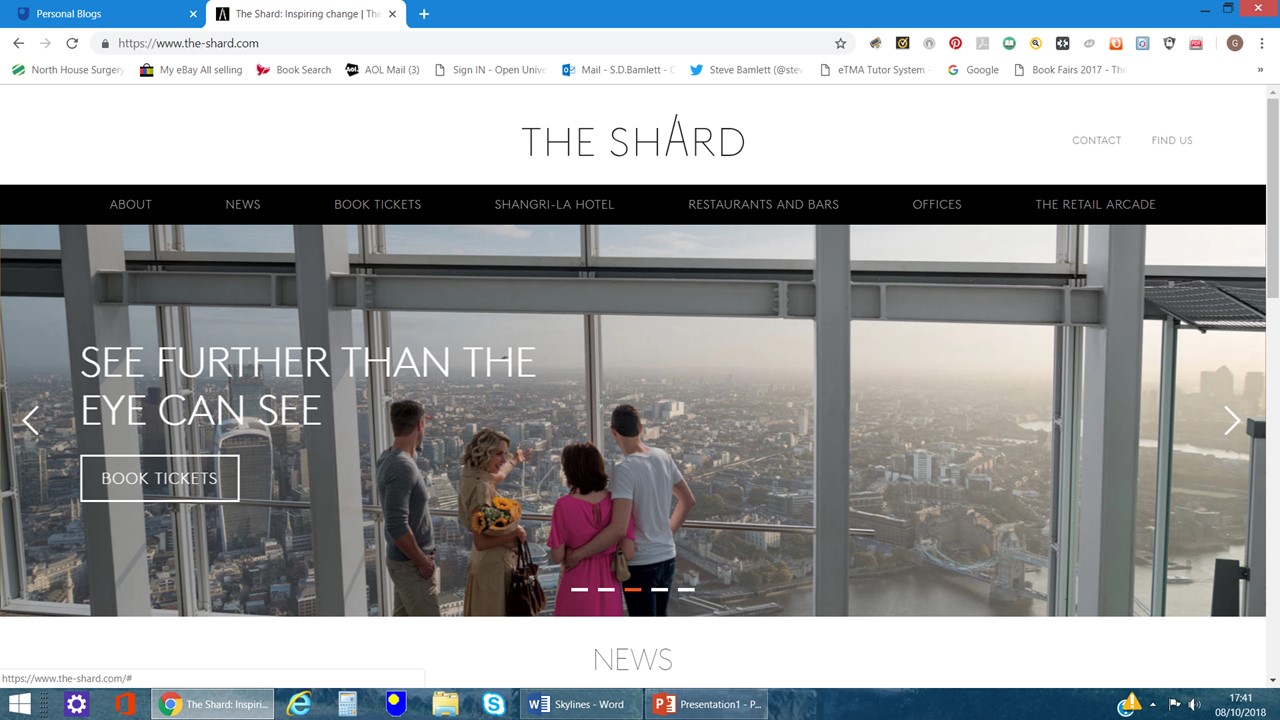

The word associations
are clear – heights, luxury and the feel of the superhuman sensation, of going
‘further than the eye can see’. Gilbert (2010) is happy to see such
experiences, together with the larger democratic potential of the internet
represented by that global conglomerate Google as accessing a new means of
satisfying the ‘pleasures of the imagination’ in an aerial vision that is freer
and more democratic than that of the past. And it may do that, in the same way
that the cult of the ‘celebrity’ in contemporary culture harnesses the
identifiably ‘ordinary’, or the identifiably ‘common’, with emotional material
that justifies the presence of hierarchy and freedom from mundane control from
the top as a phenomenon of nature. The experience is one in which the
democratic base of society justifies the experience of luxury, ‘high’ living
and great prospects as one that belongs at the top and which it sees only
irregularly and at cost and succumbs to its imaginative charm before it returns
to where it belongs, nearer the bottom.
In a sense this is the Apollonian vision – it justifies an
ordered hierarchy and sees its beauty as a reflection of the comfort at the top
they temporarily occupy. That is why it is not, as Gilbert suggests, Dionysian
– it threatens no-one and, in the end, votes to sustain the status quo. Those
walls of glass are still walls and emphasise by virtue of the reflections they
sustain an interiority that is smugly comfortable able to project its
satisfaction into the outer world and to constitute ‘aerial views’ as things of
a framed beauty. The external architecture supplies such frames which also hold
up this structure – are the means of an uncommon but temporary elevation (of
emotion and thought – ‘further than the eye can see’). From here ‘order,
organization, and visual coherence’ of the external world is provided by the
framing architecture and the comforts invisibly provided by its services. Of
course from inside to outside the supporting architecture that holds up the
curtain wall of glass must seem like a frame that protects and shelters.
This way of seeing
things is therefore in danger of losing the nuanced view of the iconography of
elevation McKellar proposes, though which she also questions as perhaps far
from ‘offering true accessibility’. To get back to nuance we might need to look
for a true Dionysian experience of a view from the Shard. I’m looking for this
in the section of the exhibition in photographs by non-professionals of
forbidden views from the top. Urban explorers as described by Garrett (2010)
are people who refuse and deny rules that restrict their access, even when
these rules are based (or rationalised depending on your attitude) by the
health and safety of the ‘public’. Urban explorers penetrate depths unseen by
others (parts of the disused Underground, sewers) and heights that take you to
fear and privation, if also excitement, rather than luxury and comfort. As an
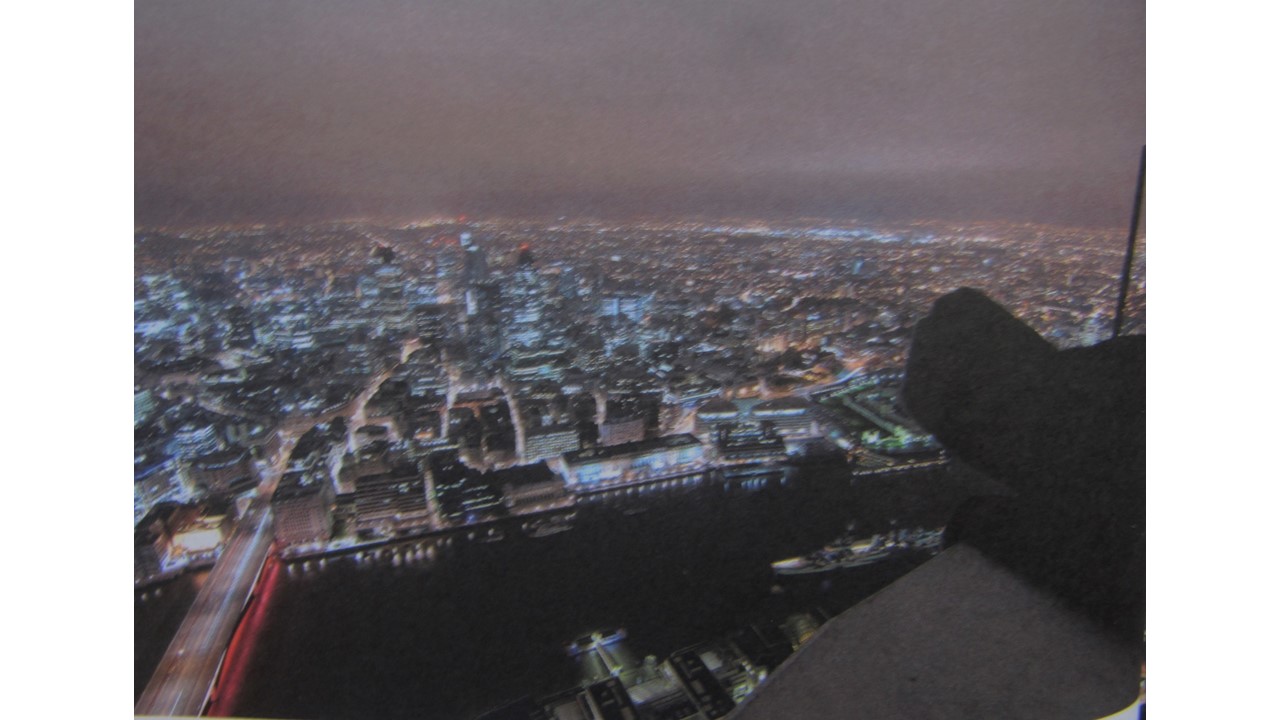
example here is a poor reproduction of an unattributed photograph showing Garret
(2018:2-4) in action as a participant urban explorer observer, pulling:
“… myself to the end of the counterweight
(on the roof of the Shard) and peered down over the edge, down to the River
Thames where the permanently docked HMS Belfast
battleship looked like a bathroom toy.
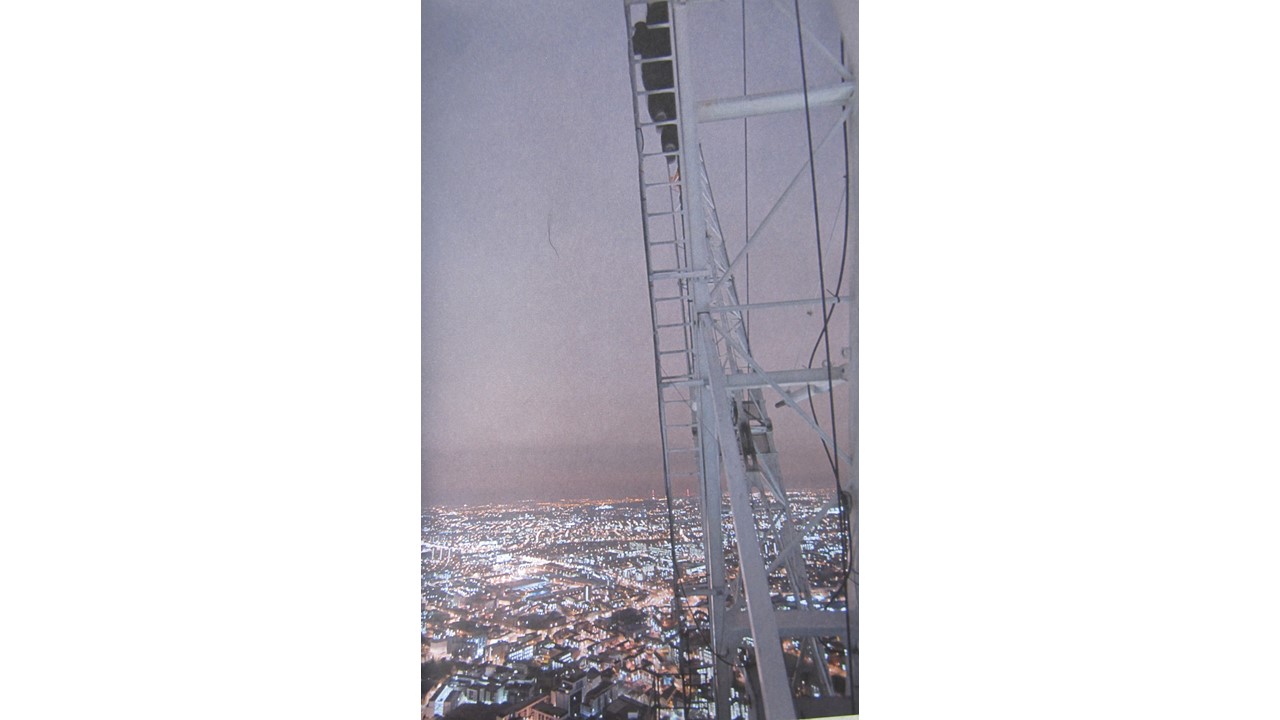
The key picture is
this one again unattributed and untitled. It shares with the other a sense of
being framed in such a way as to make its frames conscious to us – bring a
message of ‘I am just a photo inadequate to the experience I record’. This deliberate
refusal of being art suggests that the photograph of object attempts a kind of
neutrality between the viewer and the true artistic experience, unmediated
views bought at the cost of transgression, danger and hard labour. This, if
anything is the Dionysian that Gilbert only whimsically aligns with a person at
home in high flight across London on Google. This is transgressive. We have no
comfortable place from which to evaluate it as viewers.
[1]
Garrett, B.L. (2010) Explore Everything:
Place-Hacking the City London, Verso

