Exterior Space &
Internal Perspective, Masaccio’s Trinity A844 Ex 1.5.2
1. Go to Columbia Univeristy’s MCID to view a
panoramic virtual image of Santa Maria Novella
2. You want the interior
that contains Masaccio’s Trinità (Figure 1.2); this is titled
‘Interior: Nave Panorama’
3. Facing the main altar
of the church, move to the left until you are in front of Masaccio’s Trinità (Figure
1.2).
Consider how the
artist has treated space in the painting and in relation to the church
interior.
Also consider the
relationship between the individuals depicted. How is it similar to or
different from the chapels and their paintings near it?
5. Now do a search for
‘Masaccio trinity’ on ARTstor.
You will find a
number of images, including a perspective diagram that demonstrates how Masaccio
created the perspective.
Discussion
Masaccio incorporates
the use of perspective in the painting to create the illusion of a chapel and
to create different architectural zones or planes (Richardson, 2007, pp.
68–72). A brief description of the painting is
available online.
On the plane closest
to the viewer (the foreground) we see the donor, Lenzi, and his wife. In the
second, we see the Virgin and John the Evangelist, and in the third plane we
see the Trinity represented by Christ, God and the Holy Spirit (the dove). The
different planes or spaces of the painting allow the viewer to move visually
through the journey the individual must take to reach salvation: from prayer in
the earthly realm, to the saints who are intercessors, to finally reach the
Trinity. Through the use of illusion, the painting acts both as a chapel
(architecture) and as a painting.
The skeleton in the
tomb below is not the donor’s (who was probably buried on the floor in front of
the painting) but Adam’s, the instigator of the sin that Christ would die to
redeem. The presence of the donor portrait points to the need for individuals
to not only represent themselves in sacred space (which was also a public
space) – as the means for salvation – but also to assert their status, by
displaying the ability to afford a chapel and to hire a well-known artist to
complete the complicated programme.
A lot more could be
said about this painting, but for our purposes it points to the convergence of
artistic theories such as perspective with the religious doctrine of the
Trinity and salvation and with the social practices associated
with the church and donor chapels. This painting will be discussed further in
the exhibition catalogue you are required to read in Section 4.
I had a go at this exercise but rather floundered with the
prospect of using the virtual environment as a means of relating to interior
space. It made me feel that the answer could only relate to the experience of
digital space which is so disembodied. Relating to space is surely about
proxemics of a kind that can’t be equivalence in virtual tour technology – and that
includes sense of one’s own and other people’s body motion and a whole raft of
sense impressions other than just the visual. The whole idea is interesting but
has to be about the digital and virtual – where surely space is a different
phenomenon as is time and motion.
So I thought I’d
examine the pedagogy here instead – jumping to the attached Discussion and the
learning goals identified in paragraph 2. Here is a very strong reading of the
distribution of imagined space through the iconic use of perspective that is
very Panofskian. Every aspect of space in the Discussion is treated therefore
as contributory to a unitary meaning that celebrates the institutions of
church, state and private wealth – including ideologies of hierarchy and
necessary mediation. I have no doubt that this accords with contemporary
Renaissance thought patterns but it fails to teach us to look at the signs and
symptoms of space (the visual and two-dimensional ones at least available through
the exercise. So this is what I thought I would concentrate on in the interests
of my own autonomous learning.
My point generally is that course such as this MA SHOULD be
sharing and facilitating this aim rather than ending up in one-way feedback. Of
course, to be fair, this may be being done in the Forums. But I’ve chickened
out of that space of chat and enforced intellectual constriction.
The sentence that does potentially point us to autonomous
thought for me is this: “Through the use of illusion, the
painting acts both as a chapel (architecture) and as a painting.”
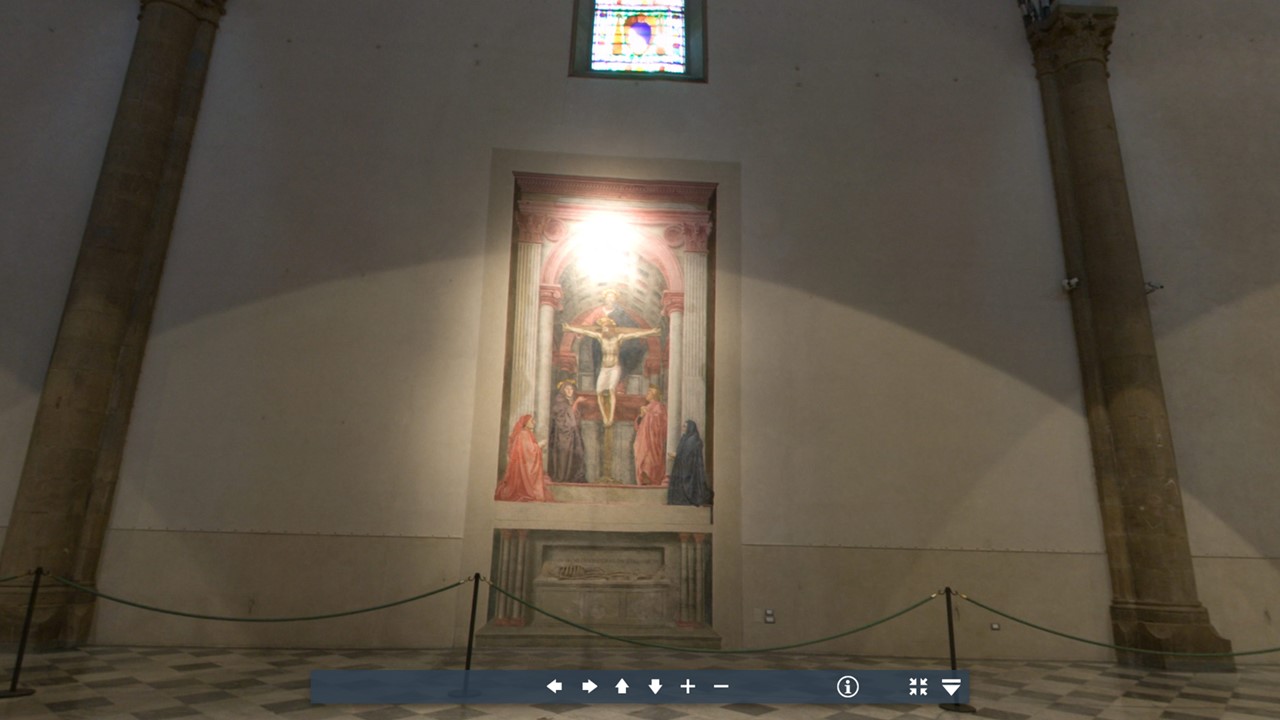
This opens up the question of space that for me is vital in comparing
visual and proxemics issues in the two stills on this page.
Of course the perspective from the virtual tour is
unusual – only one of those moving body parts take in as they assess a picture
and its spatial environment – but the contrasts are telling. The elimination of
God the Father in reflected light may be a phenomenon related to the
reproductive media, as indeed the reflection of the back-lighting in those
tremendous arches of intersecting light that frame and highlight features of
the painting. The reflected arc touches the smaller painted arc in the
painting and can seem visually to radiate from, rather than on, the Godhead. It
is hard to know how much this is an effect of introduced extraneous lighting
necessary to the digital performance of this tour and how much from lighting
effects that reflect circumambient everyday lighting and architecture. Moreover
in the Renaissance lighting would have been another thing altogether and
certainly not regular in the way modern lighting obediently can be in the
interests of performative meaning-making.
But what is clear is that the relation between the
artefact as a painting and its perspective-created reflection in two dimensions
of three-dimensional surrounding architecture is far from complementary (in either sense of the word). Even
the momento mori to the base insists
on this. The internal deceptive depths of the Trinity are clearly still a
picture to any gaze and this is captured by the fact that not only does its
internal architecture reflect the external but that it uses the external
architecture to emphasise its very ‘framed-ness’ as art. The parallels of frames
(arcs and parallel faux columns make Masaccio’s contribution competitive with
the art of the church itself, ensuring that we attribute to Masaccio a creative
power akin to the church architects and builders together and to God the
creator with His Hands supporting the structures of pain, suffering and
acceptance so endemic to the Christian message.
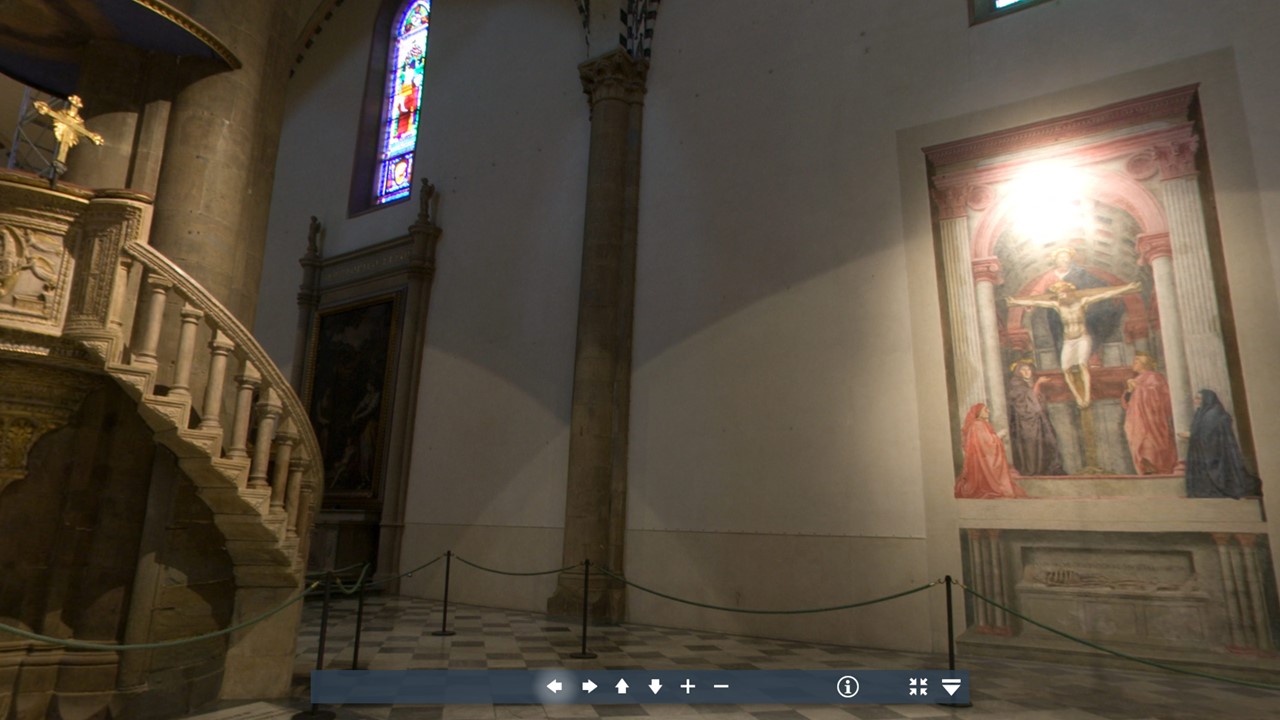
Masaccio has built and supported the crucifixion
itself, the prime sculptural architecture of this piece. The balance of hanging
from and supporting the structure of the Church is, I think, integral to the
piece. This is stressed in those wondrous painted capitals to the painted
columns. But it is not the sole meaning of the art, which depends on many
perspectives. For instance see how the Masaccio ‘human’ contrasts with the
gilded cross on the ornate pulpit in its proximity, from another less direct
perspective. My view is that Masaccio’s framed architecture questions the
pretension of its surroundings and the potential artifice in its purposes
(whether Masaccio ‘intended’ that or not).
The paragone
represented by this piece is that the painting unlike the real building
represents the spirit not just the body – the Holy Ghost almost missing from
the pictured Trinity. This is an excellent religious affirmation and honours
the Church of his day but it is also a display of Masaccio as creative genius,
using context, audience and space to ensconce and embellish his own art.
As the discussion says, “A lot more could be said
about this painting”, but the point is not increasing the volume of commentary
pedagogically but opening up debate qualitatively between learners facilitated
into autonomy, at whatever stage. These kinds of end-staged discussions,
feeding into a pedagogic system dependent on one-way feedback only, as OU is thus
dependent currently, are dangerous signs of a learning institution not looking
to its central purpose but instead to the structure of higher education
currently and uncritically.

