Evidence for
discussing interiors Exercise 3.4.3
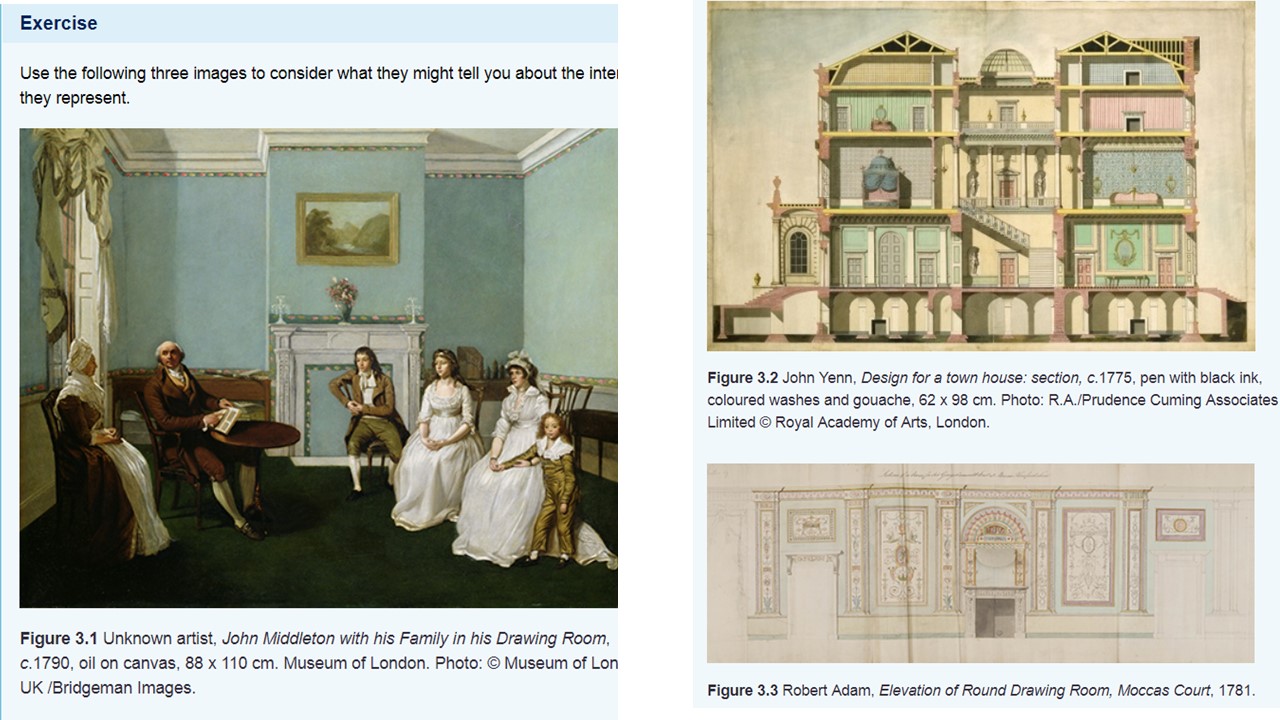
I will use this blog exercise to look at how we use visual
figures of different types as evidence in discussions of interiors. They cover
painting, architectural orthographic cross-sectional designs &an
architectural (Adam) ‘elevation’.
The discussion in the text refer to the dangers of using
paintings as evidence since we know that the representation of detail following
design issues related to the use of a flat painted surface that always
predominated over issues of mimesis. This will not be even intended as an ‘accurate’
representation.
If anything, it represents a reflection to the family of
family ideology. The central placing of father and son across a ‘hearth’
records the import of family as a scheme of patrilineal ownership descent,
which side-lines the wife who looks towards the men, and daughters and younger
son. The son in fact sits ahead of the hearth and the hearth clearly is
symbolic of the trans historical home he will inherit, together with
responsibilities to family. Land is represented as an ideal in a landscape hung
over the mantel.
The family circle an empty space in which the ‘conversation
space’ glories but I don’t sense communion here rather the display of
communication as a feature of home and a theory of intimacy, which is rather
theatrical – perhaps the veneer Dickens is in the 19th C to satirise
in the Veneering family. What we notice about space is its emptiness. The whole
of the area of the painting above the mantelpiece excludes the figures who sit
in much darker space. Light is used to emphasise the palatial space of high ceilings
that almost transcends the space inhabited by temporal figures. Here is patrimony
– its focus the hearth-breast.
The cross-sectional design offers evidence of the use of
varied room-heights in terms of importance and ‘intimacy’ of the rooms – public
rooms and staircases being central. Again a house for show with showing
entrance, grand-staircase, classically decorated rooms below, fading into those
with more patterned colour where women might hold some limited power - children’s bedrooms less still with less
imposing and less ‘antique’ furniture and decoration. Presumably lowly attic
rooms housed servants but, as in the painting, they are present through their
absence. I cannot find the ‘service’ staircase.
The Adam elevation bruits a Renaissance feel – an attempt to
aggrandise English families with the effects of the palazzo. Again the hearth
is very important and the breast above the fireplace with its Roman arch. Doors
too are grand. One could go on.

