This post will be much, much longer than the ones that succeed it because it lays out my approach to recording my day to day experiences on my H817 course. For the time being, I'll be following my interpretation of Gibb's (1988) reflective cycle approach. The model is pictured at the bottom of this post.
Step 1 Description
This week I started my new
course called Openness and innovation in eLearning, which is
a module that can lead to the PGCert, Diploma or Masters in Online and Distance
Education. The course is populated mainly by educational and training
professionals and technologists who want to develop their confidence using
different technologies in whatever area they work in. It’s worth
remembering this because this blog mainly comes from my own viewpoint,
basically as a teacher of English whilst participants come from varied
backgrounds, are mainly motivated by professional development but also by
purely personal self-development, which could be applied later in their work or
studies.
Straight away this week we were into
the content side of the course, learning (or re-learning) the power of critical
reflection, from my viewpoint for students and teachers. To this end, we
revised the general concept, e.g. Park (2003) whose research was in education
and specifically the use of journals and we looked at a general model for
reflection (Gibbs, 1988). One of my fellow students, Jennifer Mattschey pointed out how Kolb
has written a lot on this subject. I found an image of Kolbs cycle on Pinterest.
It is worth keeping a copy of the
reflection questions from the UoE website, that was very kindly drawn to our
attention by Coral Condeco-Dunachie on our course:
………………………………………………………………………………………………….
Description
•
What happened?
•
When and where did it happen?
•
Who was present?
•
What did you and the other people do?
•
What was the outcome of the situation?
•
Why were you there?
•
What did you want to happen?
Feelings
•
What were you feeling during the situation?
•
What were you feeling before and after the situation?
•
What do you think other people were feeling about the situation?
•
What do you think other people feel about the situation now?
•
What were you thinking during the situation?
•
What do you think about the situation now?
Evaluation
•
What was good and bad about the experience?
•
What went well?
•
What didn’t go so well?
•
What did you and other people contribute to the situation (positively or
negatively)?
Analysis
•
Why did things go well?
•
Why didn’t it go well?
•
What sense can I make of the situation?
•
What knowledge – my own or others (for example academic literature) can help me
understand the situation?
Conclusions
•
What did I learn from this situation?
•
How could this have been a more positive situation for everyone involved?
•
What skills do I need to develop for me to handle a situation like this better?
•
What else could I have done?
Action plan
•
If I had to do the same thing again, what would I do differently?
•
How will I develop the required skills I need?
•
How can I make sure that I can act differently next time?
………………………………………………………………………………………………….
Step 2 Feelings
I agree with my course colleagues that
it is worth trying both the Kolb and Gibbs models for reflective writing in our
learning journals whether we use our blogs or some other medium. I’ve headed
this section of my blog ‘Step 1 description’ because I decided to use the Gibbs
model (below) for this post. Hence, the headings for the remainder of the post.
Also, that I should use a shortened version of the Gibbs model, which I think
also makes sense, as my aim is 3 posts per week, which a cursory look at the research
on maintaining a balance between widening your audience and burning out seems
to suggest.
On my feelings about the course as a
whole, I was apprehensive about what new challenges the course would bring, but
I gained a lot of confidence from the successful start of my journey to the
masters (I completed my first module last August), so the only thing that
really concerns me is the workload. I now know how much you have to put in
to get the most out of it and to really feel up with the rest of the ‘team’,
some of whom may be studying full time, without work commitments. I won’t try
to follow them all or in too much depth this the first time, but generally, I
will use them as a guide in all my future posts. At this stage, I’m going to
speed up because one of my feelings in this first week is if I don’t speed up,
I’m going to get left behind, and that I feel the pressure of making a good
first impression and impact. I am sure many others are feeling the same about
the situation and the course workload and wondering how to cope, whilst others
will have few qualms except whether they can get by
focussing on the crucial assignments, which is not my approach. I want
to get the most from the course according to the learning
outcomes but working more economically than
previously. My worry is if I can do that. I will reflect more on that after a
week, not now.
Step 3 Evaluation
To begin to conclude, what has been
good so far is getting to know people, but I am still going through the
introductions, one or two people have responded to me online. I have
learned the basics of blogging – a major aim of mine and key as one aspect of
openness. That and my coping with the tech has gone well. Any bad experiences? No. I am happy with the contribution of people I have already
mentioned, and the course tutor, whose skills and experience are clear. In
addition, some others who are obviously up for working collaboratively. It’s
very early to evaluate the course but I can again see the workload is going to be
huge and I haven’t cope with that so well so far. I must force myself to
work smarter and be less verbose in everything I do in writing
Analysis
Analysing this middle part of the week,
my experience and familiarity with working online and my hardworking character
have helped. My tendency to overdo things has put stress on me.
Conclusions
I’ve learned most about myself and what
I will need to manage about myself and commitments to survive what will be a
breakout or break down year for me as it is likely I will change jobs, location
and relationships. I can’t say it could have been a more positive
situation because it is still in the learning curve and I reserve
judgment. I’ve stated I need to develop my time and prioritising skills
to handle a situation like this better?
Action plan
Looking forward to the remainder of
this and to next week, I must bear all these things in mind and act on them –
cut down on the YouTube and movies and up the gym and sleep. If friends etc come to stay, they need to buy into all this and II need to chat with
them about that sooner rather than later!
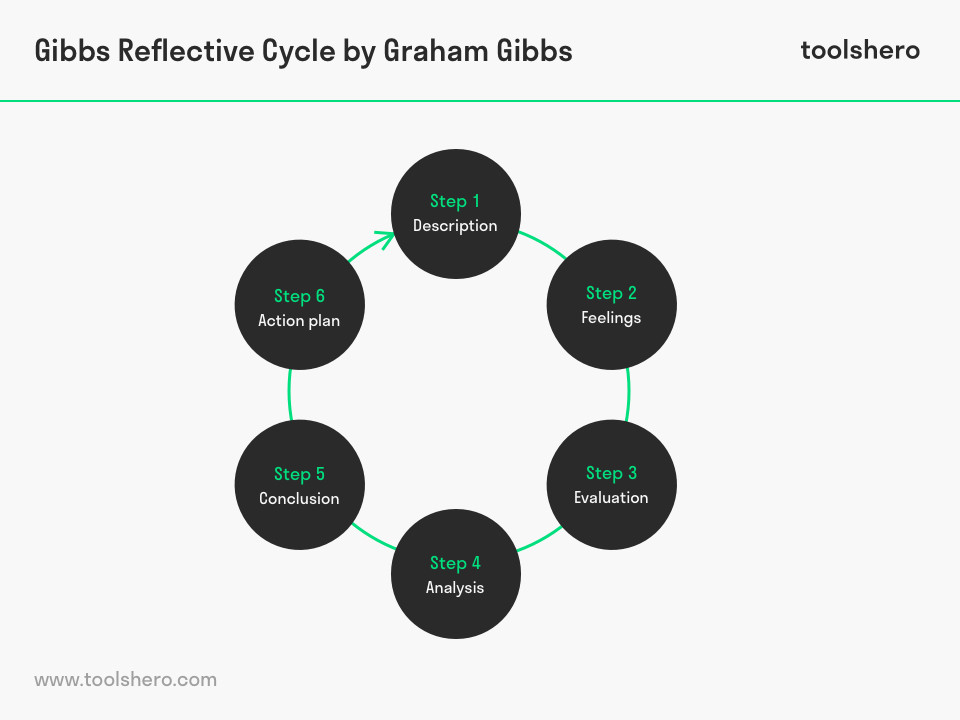
Image: Mulder (2018)

Gibbs, G.
(1988). Learning by Doing: A Guide to Teaching and Learning Methods. Oxford:
Oxford Further Education Unit.
Mulder, P.
(2018). Gibbs Reflective Cycle by Graham Gibbs. Retrieved 01 February 2020 from ToolsHero: https://www.toolshero.com/management/gibbs-reflective-cycle-graham-gibbs/
Park, C. (2003).
Engaging students in the learning process: The learning journal. Journal of
Geography in Higher Education, 27(2), pp.183-199.

