I found ths on 'Mind Your Decisions' who got it from 'CueMath' and I don't know where 'CueMath' got it. I hadn't seen it before but as is often the case I'd just been missing out, because a search shows it's in lots of places on the web. Anyway, here is my solution, I haven't looked at other answers because I wanted to solve it the way Euclid might have. It's a really nice problem.
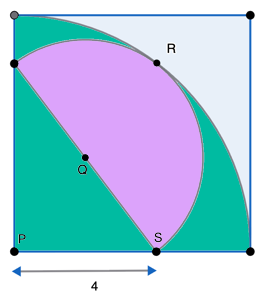
We are given a square in which is inscribed a quarter-circle and inside that a semi-crcle tangent to the quarter-circle, as shown. Length PQ = 4. What is the ratio of the portion shaded light purple (the semi-circle) to the area shaded green (the area of the quarter-circle not also in the semi-circle)?
Scroll down for solution
Keep going
The Line of Centres Theorem If two circles are tangent to one another, the line passing through their centres passes the the point at which they are tangent. [1]
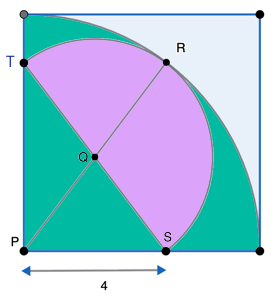
So we can draw in line PQR passing through these points.
Thales's theorem If the hypotenuse of a right-angles triangle is the diameter of a circle,
the vertex containing the right angle lies on the
circle's circumference. [2]
Since ST is a diameter of the semi-circle and P a right angle, P must lie on the circle through R, S and T. Therefore PQ is a radius of that circle and equal in length to QR which is also a radius. This makes PR, a radius of the quarter-circle, equal to 2QR, a radius of the semi-circle.
So radius of quarter-circle : radius of semi-circle = 2:1
Area of of quarter-circle : area of semi-circle = : = 1 : = 2 : 1.
So the quarter-circle as a whole is exactly twice the semi-circle, making the light purple and green areas the same. The length 4 is irrelevant, a pure red herring!
References
[1] Euclid, Elements, Book III, Proposition 11.
[2] Euclid, Elements, Book III, Proposition 31.
Tags: Thales, Euclid, Euclid's Elements, Εὐκλείδης, Thales theorem, Line of Centres Theorem

