In a triangle an altitude is a line drawn from a vertex at right angles to the opposite side. It is a classical result, known since ancient times, that the three altitudes of a triangle are concurrent; they meet at point, as seen in this diagram.
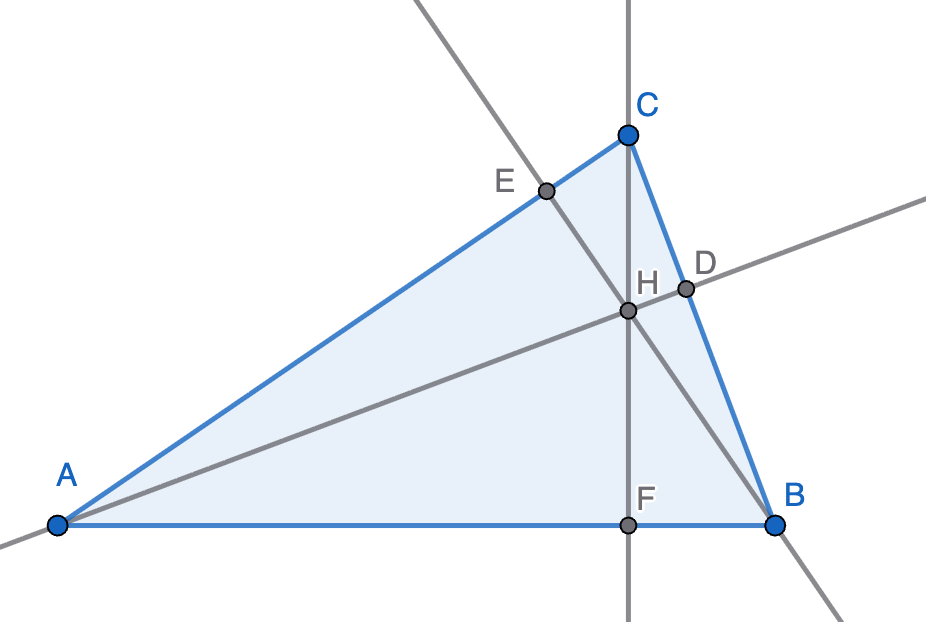
It's customary to label this point , because the German name for it is Höhenschnittpunkt, which I didn't know until I began researching this post. Broken down
Höhen = 'heights'
schnitt = 'intersection'
punkt ='point'
So this is a description of what it is but in German it gets bundled into a compound word. The Ancient Greek mathematicians did something similar, except I think they used a phrase rather than a single word, and until the modern term was coined English followed a similar path, calling it "the intersection of the perpendiculars", or some more verbose form of this. None of these terms are exactly snappy.
Enter William Henry Besant and Norman Macleod Ferrers, two mathematicians who one day in 1865 were strolling along Trumpington Road, Cambridge (only a few miles from where I am sitting at this moment!) and came up with the name, from Greek ortho-, 'straight' and centre. In the Oxford English Dictionary I found this 1866 quote from Ferrers
It may be convenient to call the point of intersection of the perpendiculars let fall from the angular points of a triangle on the opposite sides, the orthocentre of the triangle.may be convenient to call the point of intersection of the perpendiculars let fall from the angular points of a triangle on the opposite sides, the orthocentre...
Hard to disagree and the name stuck.
The fact of the altitudes being concurrent is not self-evident. Can we prove it? Yes we can! Here is a look-and-see proof which could be made rigorous without too much trouble.
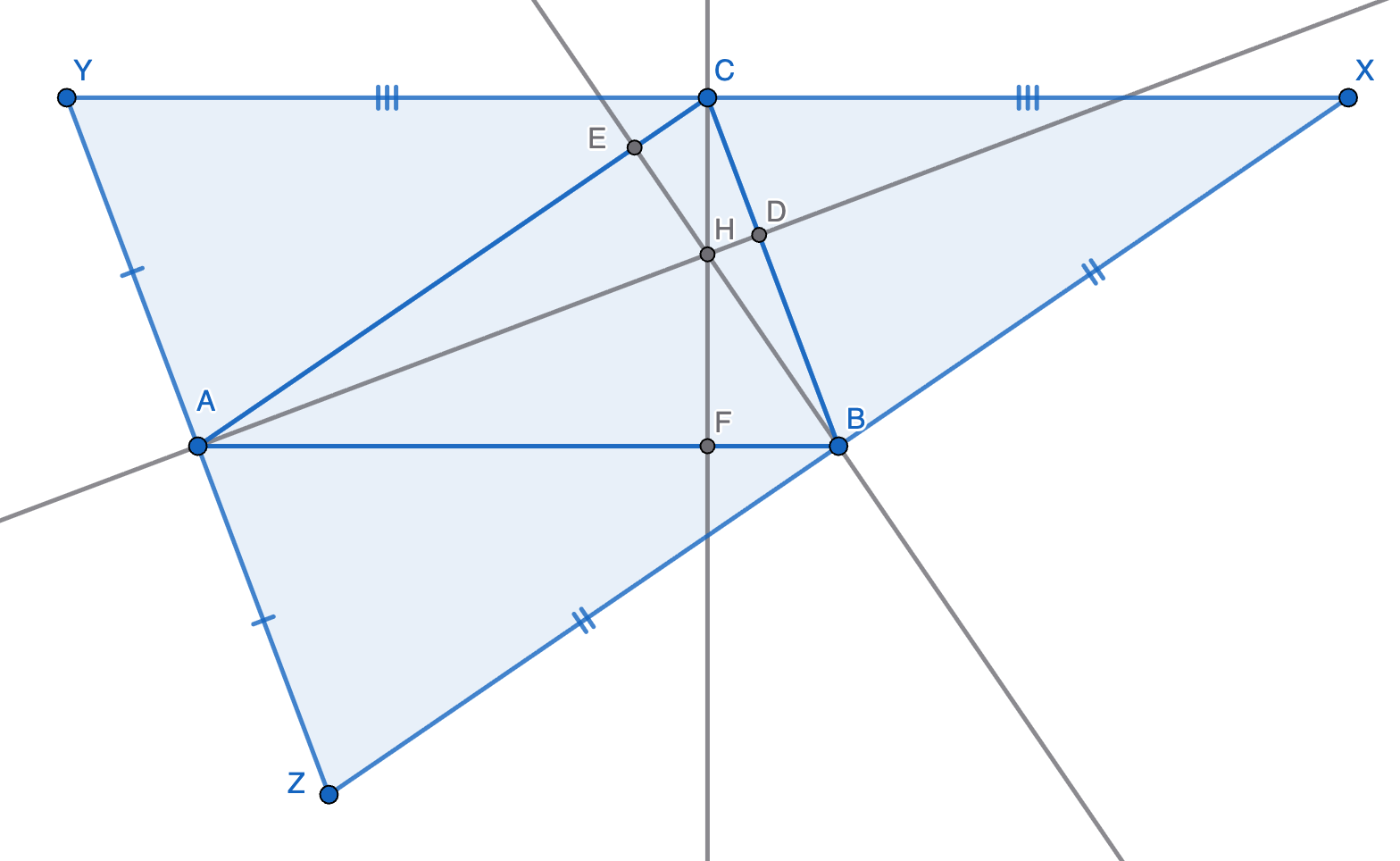
What do we see in the diagram? The original triangle has been extended by rotating it by about the midpoints of each of its sides in turn, producing a new triangle similar to the original one but with twice the linear dimensions.
We observe that
A. The vertices of are the midpoints of
B. The altitudes of are perpendicular to the sides of .
This means that the altitudes of are the same lines as the perpendicular bisectors of the sides of . It is well-known that the perpendicular bisectors of a triangle are concurrent (Euclid, Elements, Bk. IV. Prop. 5), which means we have proved that the altitudes of are concurrent, as claimed.
Here's an "ortho" joke, not sure where I heard it from
I didn't think orthopedic footwear would work for me. But I stand corrected.
Tags: altitudes, perpendicular bisectors, orthocentre, Höhenschnittpunkt, William Henry Besant, Norman Macleod Ferrers

