Pay the Piper
[ 4 minute read ]
I recently had a brief conversation about Mourning Rings and how diamonds, denoting everlasting love, set in them meant the love should extend beyond the grave. It is mostly a Victorian thing but there are examples of mourning rings going back to Shakespeare's time.
I suppose superstition becomes less fantastical when it is personal and, for me, there is always an element of hope involved; get rid of a cold or ghost; cure warts or hairloss; find a partner or lose one. Some enactments seem truly bizarre and I have to ask, what were they thinking? How did they come across a wide belief that a convoluted act with tight parameters would work any better than any variation of the act?
In the book, Encyclopedia of Superstitions by E. & M.A. Radford (1974 [1948]), edited and revised by Christina Hole (1961) there is an entry for Holed Stones.
A stone with a natural hole in it was formerly believed to have magic powers. From huge perforated rocks right down to small, holed pebbles used as amulets, awe and wonderment was elicited in people living in a world very different to our modern one today.
Who among us know what 'widdershins' means? I might suggest that before the 'fun' 1960s quite a lot of country folk knew that it meant 'against the sun', which is a directional thing that changes according to the time of day. East in the morning and West in the evening is widdershins. Fabulous in itself. To have a concept of direction that changes according to a temporal aspect is perhaps the most wonderful thing about ancient peoples; anyone who lived before the kaleidoscopic 1960s, I propose.
From the Encyclopedia of Superstitions (1974), 'The Crick, or Creeping Stone, at Madron in Cornwall healed lumbago and other pains in the back if the patient crawled through it nine times on all fours, going widdershins, or against the sun.' Why nine times? What happens if you go through eighteen times? And who was counting? Plainly the number nine was important to ancient folk. I suggest it is three times three and that is cool for the Christian-pagans; except no-one was cool before the anti-materialistic 1940s and 1950s beatniks.
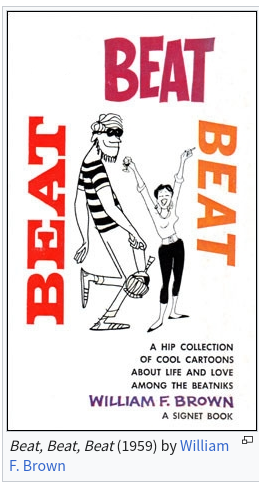
https://en.wikipedia.org/wiki/Beatnik
I think the two people in the poster (above) might have thought it fun to crawl through holed rocks nine times, 'man'. Yet, I can't help but wonder if they had back problems later which they would not have otherwise had because they violated the purpose of some kind of magical spell. If the beatniks all sloped along like the guy in the poster I should imagine they had all been to The Crick in Cornwall.
In the same area in Cornwall, mothers passed their ailing children through a large aperture in one of the group of Mên-an-Tol stones. Now then, crawling through a hole by one's one volition is one thing, but shoving an infant through a portal from one world to another is quite a different thing. Is it worth the effort to a modern mum today? I mean, if you affect the child's natural protection against spiritual and psychic attack you're probably going to spend a lot of time renewing the 'blue rope' you wrap them in or something. Just saying.
'Over to our roving reporter in Essex.'
'Hello. I am with Tina who passed Alex, when he was an infant, through the hole at Men'tol in Cornwall and now needs to regularly renew his protection. Tina, do you think blue polypropylene rope deflects evil intent?'
'Well, it has to do with the sun. The ultraviolet rays pierces the ropes and it breaks down instead of Alex's skin. He had bad skin as a child.'
'Perhaps we can have a word with Alex. Hello Alex. You are now forty-eight. How do you feel being, well, mummified?'
'I love my mum. She has saved me from harm. She can mummify me if she likes.'
'Well, there it is. We can't see his skin but I am sure he looks good under the rope and he seems very happy.'
The blue rope thing is something I picked up from reading and thinking, for quite a bit of time, about spiritual and psychic attack. It is supposed to be imagined to encase one's spirit though the mental process of coiling it around oneself. I feel, the mental process is much the same as spending some time going through a process of relaxing, except there is an intent for protection and not an intent to free oneself from stress or anxiety. In both cases there is an inherent confidence in the practitioner, a self-belief.
'In the Orkneys, a menhir called the Woden Stone could marry those who clasped hands through a hole in it and vowed fidelity to each other.' (Encyclopedia of Superstitions, 1974) 'A menhir is a large upright stone erected by humans in prehistory, often with engravings and associated with megalithic monuments.' - Wikipedia.
I openly suggest, that vow of fidelity is most assuredly witchcraft and irrevocably binds oneself to the spirit world through the portal that is the hole in the stone. To my mind, the spirit-world is really close and it is incredibly easy to breach what is really only a thin veil that separates us from it, if you consider 'us' not to already be part of it. Certainly, I would expect to see faeries and not fairies on the hillsides if I married my love in such a way.
Much as Julia Roberts as the mischievious fairy 'Tinkerbell' is cute and fun in the 1991 movie film Hook, I am pretty certain that is not what we should expect if we tear the veil. There is always a price to pay to keep harm away. Subscribe to a front row seat in a theatre of spirits and you effectively give your spiritual address to both harbingers and actors of fortune and malevolence. Obviously, we have to 'pay the piper' to keep the bad stuff at bay.
Pay the Piper: 'Pay a debt or experience unfavourable consequences, especially when the payment or consequences are inevitable in spite of attempts to avoid them.' - Wikipedia

