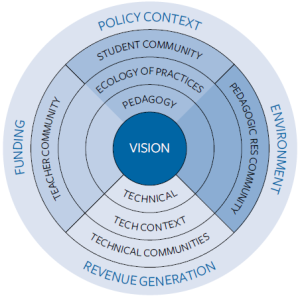
 This is Fig.1 from Scanlon et. al. (2013:29)
Coketown University Report.
Introduction.
The long-term
goal of senior managers at Coketown is to ensure that it can state and provide evidence
that ‘learning and teaching at this institution
are supported by learning analytics (LA)’. It equates this aim with a
vision for the development of LA that can be carried forward into future goals,
even ones as yet unknown. This is visionary because LA does not only aim to
support teaching and learning but to uncover data that enables its
transformation moving forward. This is why Fig 1 above has VISION at its centre.
This report, without denying
the value in potential of that vision will argue that no single and unitary
process of holistic change is likely to be possible, and that the immediate aim
should be to state that ‘learning and teaching at Coketown University is being
currently transformed by an active and ongoing process that will aim to build
its future with the fullest support of LA. That process of transformation is
shared and ‘owned’ by the university’s staff, learners, partners and funders
ensuring that change occurs within a sustainable and stable framework.’
The problems raised by change
Even when senior managers
express a vision with conviction, integrity and in the best interests of all
stakeholders in the pedagogic enterprise, they have to face the realities posed
by change, especially in an institution with the history and well-earned pride
as Coketown.
That reality can be
expressed in terms of seeing the core elements of the practices which support
vision in terms of the strong communities which engage these practices and a
long history of having successfully done so, We can (as in Fig. 1), express the
university’s practices under 3 headings of practice necessitated by maintain and
sustaining the university over time:
1. Policy creation, update and revision
2. Management of the Environment (including a wide
range of resources from buildings, open or dedicated spaces and core equipment).
3. The generation and maintenance of revenue in
terms of the relationship between the university’s income and expenditure,
including non-returnable funding from partners in government, business &
the 3rd sector (I have chosen not to make these appear two headings
as might be suggested in Fig. 1).
Under this mantle exist 4
communities of variable distinctness. Some of the changes we envisaged involve
working with current best practice of successful and evidence-based interactions
between these communities and supporting their semi-independent growth outwith
the constrictions of a single vision.
These elements of
co-produced change will form the patches of the bricolage which will build to
our ultimate vision.
At base these communities
are those based in pedagogical and technological practice.
1. Pedagogical communities with different
traditions and structures (and sometimes apparently different goals) include:
1.1. The Student Community, with a clear stake in successfully
applied pedagogical practice, which we have found to be best supported by involvement
in those practices.
1.2. The Teacher Community, sometimes divided into
subject-discipline departments with different traditions but a common aim. Our
aim is to build on that commonality.
1.3. The Pedagogical Resource Community, including
administrators, rooming, catering as well as educational equipment. And;
2. The Technical Communities, often apparently
operating in (what appears to others) an impenetrable world of technological
knowledge, skill and linguistic exchanges. Thus while we often speak of an ‘ecology
of practices uniting the pedagogical community, the context of technology is in
practice often seen as remote from those practices – a fact revealed in
Macfayden & Dawson’s (2012:157) finding that in one sister university 70%
of teaching staff made no use of the university’s LMS.
Clearly one major aim is to
bring the technical context within the embrace of the ecology of practices that
currently sustain community alliances in Pedagogical matters. This is easier envisioned
than brought about and we see change as occurring piecemeal (or so it might
appear) but under the aegis of a persistent intent to turn co-construction of
new practices (and the community alliances involved) under one umbrella.
In the mean-time, though our
umbrella may look to the aspirant like a leaky patchwork, we endeavour to
achieve stability in stages (often uneven stages, of discrete development
overseen by senior managers. This is the process Scanlon et. al. (2013:33) call
‘bricolage’. When ‘vision’ appears to everyone except senior managers as a
potential imposed ‘nightmare; we agree with Scanlon et. al (2013:33) that:
Vision
often emerges and evolves through exploration, through networking and through
active engagement in research, development and educational practice.
RECOMMENDATION
Hence our recommendation
that policy and advertising material bear the statement:
‘Learning and teaching at Coketown University is
being currently transformed by an active and ongoing process that will aim to
build its future with the fullest support of LA.
That process of transformation is shared and ‘owned’
by the university’s staff, learners, partners and funders ensuring that change
occurs within a sustainable and stable framework.’
One example from our current
‘bricoleur’ activity is the Life-Long Learning Advisory Project, PEAR.
All I can do for now.
All the best
Steve
Macfayden, L.P. and Dawson,
S. (2012) ‘Numbers are not Enough. Why Learning Analytics Failed to Inform an
Institutional Strategic Plan’ in International Technology & Society,
15 (3), 149 – 163.
Scanlon, E., Sharples, M.,
Fenton-O’Creevy, M., Fleck, J., Cooban, C., Ferguson, R., Cross, S. and
Waterhouse, P. (2013) Beyond Prototypes: Enabling Innovation in
Technology-Enhanced Learning. Technology-Enhanced Learning Research Programme;
also available at http://beyondprototypes.com/ (accessed 15 June 2016).

