

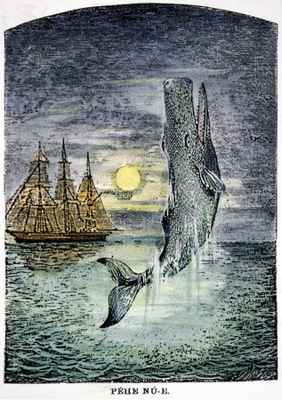
Moby Dick breaches in the moonlight in sight of Captain Ahab's Pequod (Britannia Images)
On the anniversary of the publication of Herman Melville's Moby Dick in 1851, the House of Commons begins Committee Stage of the European Union (Withdrawal) Bill.
As the Explanatory Notes to the bill tell us:
"The Bill ends the supremacy of European Union (EU) law in UK law and converts EU law as it stands at the moment of exit into domestic law".
In the background some earlier inter-state arrangements are being reviewed.
Currently submerged legal instruments are being revealed as the EU tide ebbs.
One such instrument is the London Fisheries Convention signed on behalf of the Government of the United Kingdom and Northern Ireland in 1964 by Rab Butler, Conservative Minister and MP for Saffron Walden.
The London Fisheries Convention regulated the use of territorial waters for fishing.
"The London Fisheries Convention, signed in 1964 before the UK joined the European Union, allows vessels from five European countries to fish within six and 12 nautical miles of the UK's coastline. It sits alongside the EU Common Fisheries Policy (CFP), which allows all European vessels access between 12 and 200 nautical miles of the UK and sets quotas for how much fish each nation can catch."
https://www.gov.uk/government/news/uk-takes-key-step-towards-fair-new-fishing-policy-after-brexit
The UK Government have triggered another two year withdrawal process - this time article 15 of the London Fisheries Convention and this time the notification is to the UK Government (so Mr. Gove's denunciation will presumably have been to the Secretary of State for Environment, Food and Rural Affairs... Mr. Gove).
The UK's membership of the EEC, from 1st January 1973, did not initially bring a Halcyon calm to disputed fishing rights between states.
The Cod Wars which boiled between Iceland and the UK like a political Corry Vreckan and peaked in the mid-1970s evidence that:
https://www.britishpathe.com/video/peacetime-sea-battle/query/icelandic+sea+fishing
Iceland (not an EU member) now has an exclusive economic zone (EEZ) of 200 miles and this is accepted internationally other than in the EU where the Common Fisheries Policy takes precedence.
So the UK's withdrawal from the EU opens further dynamics of acceptance and recognition.
Indeed the issue may even bear on public opinion in Iceland regarding EU accession sentiment which, currently, opposes membership.
The doldrums
Whether a result of the adverse impact on UK fishing arising from membership of the EU or otherwise, some emollient, seemingly spread over recent decades by an invisible hand, has calmed the troubled waters which had previously kept the Cod Wars simmering for so long.
The perfect storm
However that period of stability should not be taken for granted. The UK Government's clearing the flotsam and jetsam of earlier regulation such as the London Fisheries Convention, Brexit and economic impact may create a political storm to match Poseidon's fury.
Fishing, politics, resources and law seem inevitably to be gathered in a disputatious relationship.
"But why should the king have the head, and the Queen the tail? A reason for that, ye lawyers?"
(Herman Melville, Moby Dick 1851, Chapter 90)
Comments
Layered Sovereignty: The Boundary Problem Beneath the Fisheries Dispute
Reading back through older posts for inspiration, this one is worth resurfacing. The Moby Dick frame is apt, but the structural insight is buried in the detail. The London Fisheries Convention sits alongside the Common Fisheries Policy. The EEZ framework sits alongside both. Withdrawing from one layer does not dissolve the others. It reveals them. That is a boundary problem. Sovereignty over fishing waters is not a single line. It is a stack of overlapping legal instruments, each with its own boundary, its own membership, and its own logic of acceptance. The UK triggering Article 15 of the 1964 Convention does not resolve the question of who fishes where. It exposes the fact that the question was never settled by a single authority in the first place. The Cod Wars are the clearest illustration. Iceland was not an EU member. It declared an EEZ and the international system accepted it. The EU did not, because the Common Fisheries Policy took precedence within its own boundary. Two systems, two sets of rules, two definitions of legitimate jurisdiction. Neither was wrong from within its own frame. The dispute was structural, not legal. The reference to the invisible hand is doing more work than the author may intend. The emollient that calmed the troubled waters was not designed. It emerged from the interaction of interests, exhaustion, and shifting priorities. That is a spontaneous order, not a settlement. Spontaneous orders are stable until the conditions that produced them change. Brexit is a change in conditions. The perfect storm is not a metaphor. It is a description of reinforcing loops. Political pressure feeds legal withdrawal. Legal withdrawal feeds resource competition. Resource competition feeds political pressure. Each loop amplifies the others. The system is primed for escalation not because anyone intends it, but because the structure of overlapping boundaries makes de-escalation difficult. The Melville quote about the king and queen sharing the whale is the sharpest line in the post. The law divides what nature does not. The whale is a single system. The jurisdiction is a boundary drawn across it. That is the tension underneath every fisheries dispute. And underneath every system of layered sovereignty. Regards,
Russell Larke
BA (Hons) Business Management | MSc Candidate (Systems Thinking)
Trading Beyond Charts