

"Any viable system contains and is contained in a viable system."
Stafford Beer devised the Viable System Model, based on his theory that a system is only viable by virtue of its sub-system themselves being viable.
Overview of the Model
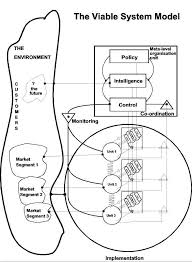
The model consists of 5 sub-systems and an environment.
- Operations - the set of activities the organisation which provides value to the environment.
- Coordination - the set of protocols that coordinate operations so that different operations do not cause problems for each other.
- Delivery - the management activities associated with allocating resources for the operations.
- Development - the management activities associated with understanding the environment and future trends.
- Policy - the balancing activities to ensure the organisation works as a system, especially balancing the decision-making between the two Delivery and Development systems.
The two most critical tensions in the VSM are:
- the tensions between the autonomy of the parts versus the cohesion of the whole.
- the tensions between the current and future needs.
Two fundamental concepts in VSM are:
- Wholeness - Attributes the systems has as a whole which the sub-systems do not have as components.
- Emergence - Attributes that emerge as necessary to manage immediate risks/opportunities in the environment.
Too much autonomy and no cohesion and the system's 'wholeness' is lost. Too much cohesion and no autonomy and emergent attributes fail to capitalise on the environmental risks and opportunities that immediately occur.
Using the VSM as a diagnostic tool, involves assembling key features into the perfect ideal situation. This 'ideal' is then compared to the perceived reality of the current VSM structure. The differences that are noticed guide action to move the perceived situation towards the ideal.
Comments
On Autonomy, Cohesion, and the Viable System Model
On Autonomy, Cohesion, and the Viable System Model The VSM is one of those models that seems simple on first reading—five subsystems, an environment, some feedback loops—but reveals its depth the moment you try to apply it. The two tensions you've identified are the key: autonomy versus cohesion, and current needs versus future needs. They're not just design trade-offs; they're ongoing dynamics that require constant attention. What's often missed is that the VSM isn't a blueprint. It's a diagnostic tool. The value isn't in mapping your organisation onto the five subsystems and declaring it "viable" or not. The value is in the comparison between the ideal and the perceived reality—and in the questions that comparison generates. Why is coordination failing here? Why is development being starved of attention there? Those questions are where the real work begins. Stafford Beer's claim that "any viable system contains and is contained in a viable system" is worth sitting with. It suggests that viability is recursive—that the viability of a system depends on the viability of its parts, and that those parts themselves depend on their own parts, all the way down. That's not just a nice observation. It's a methodological principle: if you want to understand why a system is failing, look at the subsystems. If you want to understand why a subsystem is failing, look at its subsystems. The logic repeats. One question: how do you distinguish between "coordination" and "delivery" in practice? In theory, they're distinct functions. In practice, they often blur. Is that blurring a sign of a healthy system adapting to complexity, or a sign of structural confusion that needs to be addressed? Regards,
Russell Larke
BA (Hons) Business Management | MSc Candidate (Systems Thinking)
Trading Beyond Charts