

'And the mill‑stream sang of wheat and rye,
Of the farmer’s care and pain;
Of the golden sheaves and the harvest home,
And the grinding of the grain.'Juliana Horatia Ewing — The Mill‑Stream
'Never shall I forget the sensations of awe, horror, and admiration with which I gazed about me. The boat appeared to be hanging, as if by magic, midway down, upon the interior surface of a funnel prodigious in circumference, immeasurable in depth, and whose perfectly smooth sides might have been mistaken for ebony, but for the bewildering rapidity with which they spun around, and for the gleaming and ghastly radiance they shot forth, as the rays of the full moon, from that circular rift amid the clouds which I have already described, streamed in a flood of golden glory along the black walls, and far away down into the inmost recesses of the abyss.'
Edgar Allan Poe — A Descent into the Maelström
Two very different images evoked by words — millstream and its evil twin maelström — that are doublets, sharing the same ultimate roots, in fact doubly doublets. The first element in each is from a PIE root *mele-, 'grind' or 'crush', and the second from another PIE root *sreu-, 'flow'.
The first is seen in many other modern words to do with grinding and crushing; along with mill, we have molar, mallet and malleable; and with what gets ground; emmer, meal (as in oatmeal) and millet. An emolument might have originally been what the miller got paid.
sreu- is the root of not just stream but has given us catarrh, rheumatic, rhythm and many medical words incorporating Greek rheo (ρεω), 'flow'.
So starting from common beginnings, these words have travelled along different linguistic paths and ending retaining a strong semantic connection but with vastly different connotations. The millstream is water channelled and tamed, pressed into human service to provide us with our bread; but the maelström a vast, violent and uncontrollable elemental force that would destroy us.
What did their respective journeys look like?
Mill apparently entered the Germanic languages fairly early as a borrowing from Latin molina (as in French moulin) and has cognates in other Germanic languages, e.g. Dutch molen
Stream has a more direct history. It seems there was a Proto-Germanic word strauma- that inherited directly from the PIE root. with an added 't' it would interesting to explore in another post.
So we find mylestream already in Old English. Here's an interesting snippet I found in the OED and couldn't resist, from a land charter, quite a few of which have survived (and which mention landmarks that can sometimes still be recognised today).
Of hlippen ham in to þam mylestreame, of þam mylestreame innan þa norð lange dic
AI Overview translates this as
'From the leaping-meadow into the millstream, from the millstream into the long north ditch.'
I don't know what a leaping meadow is, do you?
The compound maelström has a more striking history. It is from Dutch and was used by Dutch explorers and mapmakers in reference to a tidal whirlpool off the coast of Norway, which reputedly sucking in and destroy (grind to pieces?) any vessel ill-advised enough to approach too closely (although there may have been some exaggeration involved). It featured in an Old Norse tale of sisters Fenja and Menja, giantesses who turned an enormous millstone Grotti, the 'sea mill'. to grind out gold, peace and prosperity, which sounds handy. I'd never met this legend until researching this piece but it looks worth following up.
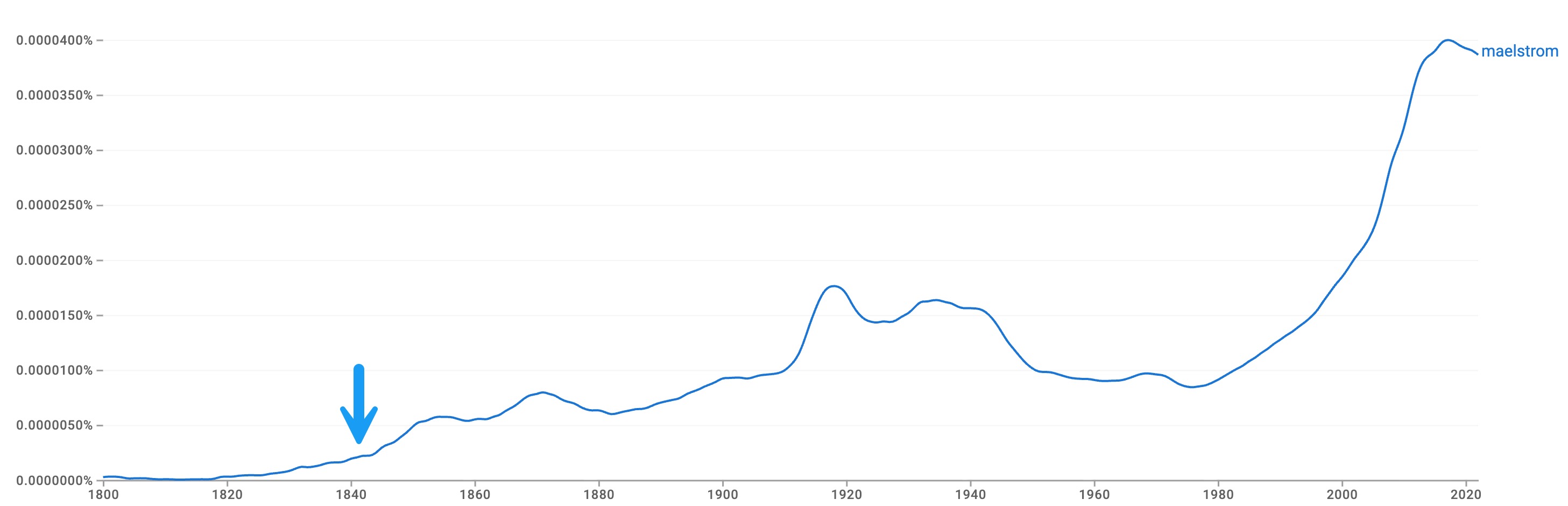
But it was Poe's story that made the Maelström famous. Published in 1841 (marked) its impact can be seen in this Google ngram.
I'll leave you with a brace of crossword clues you should find easy to solve.
La mer, most disturbed here? (9)
Times Quick Cryptic 1641 by Pedro
A little malingerer, Everyman will watch online channel (10)
Everyman 3903
Comments
New comment
The two giantesses are also called Fenni and Menni and the Old Norse Dictionary says the sea mill is near Reykjavík.