

On forums I sign myself like this
Rich 🙂
... but the platform button often suggests a different emoji
🤑
I was puzzled by this when I first saw it but eventually realised 'rich' is the link; the emoji is called 'money-mouth face', a symbol of wealth (and greed).
'But rich is a different word', I thought to myself, 'and nothing to do with my name.'
Except... I was wrong. It has, it's fundamentally the same word, but has reached us by two different routes, and thus ended up as two words with different meanings.
The name Richard means something like 'strong ruler', from Germanic words ric, 'ruler' and hard, 'strong'. We see the ric element in other names, such as Eric, 'ever ruler' and Wulfric, 'ruler of wolves'. It also survives in the sense of a domain, as in bishopric.
The ultimate origin is the Proto Indo-European (PIE) stem *reg-, which had the sense of being direct and then from that of imposing order, ruling, reigning over, leading, and so on.
The same PIE stem *reg- gave the Celtic languages rix, 'king', and modern Gaelic still has ri or righ (pronounced 'ree'). The ancient Gauls who Julius Caesar conquered spoke a Celtic language, Gaulish, and their version was rix. This was an early borrowing into Germanic and came down to us as rich.
There may have been influence from French riche (itself a borrowing from Frankish) but from early Middle English on its meaning was widened to magnificence (think 'richly dressed') and nowadays the predominant meaning is wealthy of course.
And now we come to the freedom fighter. Although familiar with the history I literally had no idea of the etymological connection until I started writing this post
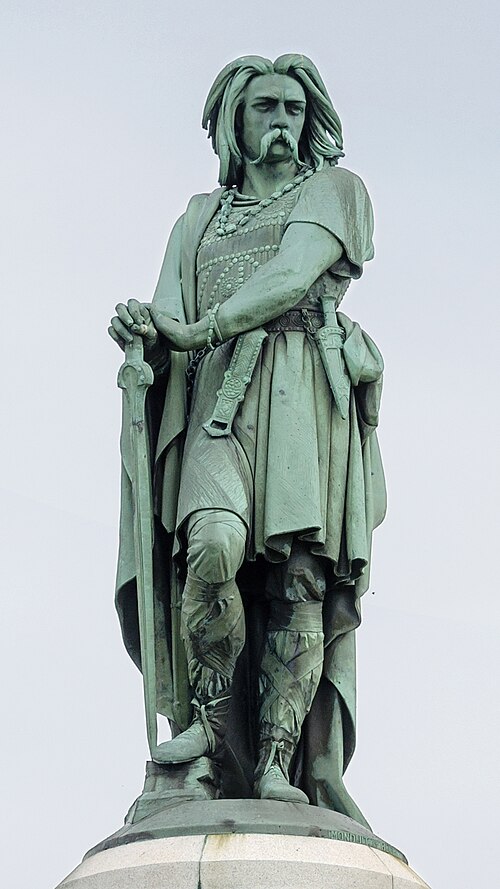
The most famous of the Gauls was Vercingetorix, something like 'great king over fighters', who led a revolt against the Roman rule imposed by Julius Caesar but in the end was forced to surrender. In the modern era he has become a symbol of French spirit and resistance to foreign invasion. Here's an iconic statue to him. See the Comments for more details.
Comments
New comment
Writing this post I consulted the OED, the Online Etymological Dictionary, the American Heritage Dictionary Indo-European Roots Appendix, Wiktionary, and Wikipedia.
The image of the statue of Vercingetorix is licencsed under Creative Commons Attribution-Share Alike 4.0. See https://commons.wikimedia.org/wiki/File:Alise-Sainte-Reine_statue_Vercingetorix_par_Millet_2crop.jpg#file