

“The streets of London have their map, but our passions are uncharted.” — Virginia Woolf
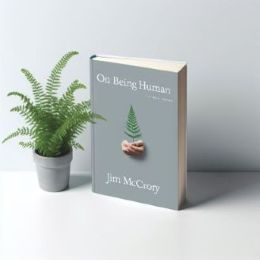
There are lines in literature that feel less like sentences and more like small revelations. Woolf’s observation about maps and passions has always struck me that way — a reminder that the inner life refuses to be surveyed, measured, or neatly explained. We can chart the streets of a city, but not the hidden terrain of longing, fear, tenderness, or belonging. And sometimes it takes stepping into a landscape far from the city to realise how much of ourselves remains unmapped.
My wife and I were climbing Mam Tor in Britain’s Peak District at the weekend when this thought returned to me. The climb was sharp at times, the path busy with weekend walkers, and the ridge ahead opened like a long invitation. As we ascended, our conversation drifted to the question of what it means to be othered in British society — how easily people are placed into categories, and how those categories can harden into distance. I know that feeling. I was othered for leaving my religion. We spoke about the quiet ways people are made to feel out of place, and the equally quiet ways belonging can be restored. I see a sinister zeitgeist corrupting our feelings toward fellow humans and causing us, in the Christian paradigm, to fail in loving our neighbour as ourselves.
Somewhere along the ascent, we decided to do something simple: speak to the people walking beside us. Not as a project, not as a performance, just as an act of human kindness. The hill was alive with voices: young Muslim women in head coverings, British-born lads with easy humour, Arab families wrapped against the sun, African students taking photos, Indian couples sharing snacks, a Lithuanian family as they sat on the grass. The diversity was not theoretical; it was right there on the path with us, breathing the same fresh air, taking in the same therapeutic view.
The conversations we had were small but vivid. One young girl caught me listening to her conversation and smiled. I jokingly said, “You cannot rant here.” Soon my wife and I were in conversation with these three Muslim girls about living in the moment and divine justice.
And so the day went. Nothing scripted. Nothing strained. Just the kind of encounters that happen when you meet people without armour, without assumptions, without the invisible lines that so often divide us.
As the landscape widened around us; the rolling hills, the long sweep of sky. Something in me loosened. The categories we had been discussing felt suddenly flimsy, like paper held up against the wind. Here we were, a collection of strangers from different backgrounds, different languages, different stories, all climbing the same hill for reasons we might never fully articulate. Woolf was right: our passions are uncharted. And yet, in moments like this, they seem to run parallel, as if some deeper current connects us beneath the surface.
At the summit, I smiled at four young Muslim girls sitting in a line that reminded me of those workers in New York having lunch in the heavens. Around me, people huddled for photos, shared flasks of tea, leaned into the landscape. There was a sense of camaraderie that didn’t need to be named. When we finally turned to leave, an Arab man stood nearby speaking into his phone. I caught his eye and smiled. He paused mid-sentence, smiled back, and in that brief exchange — no words, no explanations — the whole day seemed to gather itself into a single, quiet moment of recognition.
It struck me then that the map Woolf speaks of is not the one we hold in our hands, but the one we carry inside us — the one that tells us who belongs and who doesn’t, who is familiar and who is foreign. And perhaps the work of being human, or at least one part of it, is to redraw that map again and again, until the boundaries soften and the distances shrink.
Mam Tor didn’t give us answers. But it offered something gentler: a reminder that the world is full of people whose inner landscapes we will never fully know, yet with whom we share the same wind, the same path, the same fragile hope of being understood. And sometimes, all it takes to bridge the uncharted space between us is a smile returned on a stunning peak. As my wife and I drove back to Scotland and landed exhausted into bed, we prayed for the people embedded in our memory that day and in God’s grand eternal purpose.
"But in keeping with God’s promise,
we are looking forward to a new heaven and a new earth,
where righteousness dwells."
2 Peter 3:13
Comments
New comment
New comment
Lovely, Gill.