

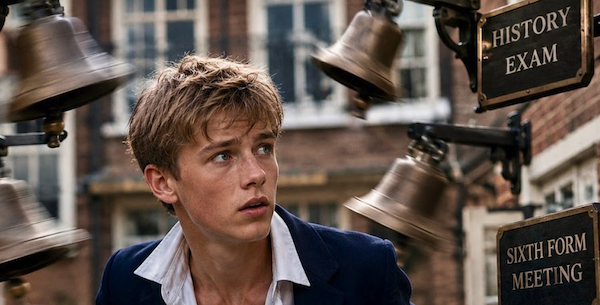
An AI-generated image of the author in his late teens was created from photographs of him as a teenager, and here he is, tortured by the ever-present school bell.
Revisiting my diaries from fifty years ago (A Collins Five-Year Diary) has led me to an unexpected conclusion: much of what I value most about history, I learned despite how I was taught at school, not because of it.
At my school in the 1970s, history was largely presented as something settled and inherited. Dates, causes, consequences, kings, treaties, essays. Knowledge flowed in one direction: teacher to pupil, textbook to exercise book. The institution valued certainty, continuity and authority. We were expected to absorb and reproduce.
What strikes me now is how little this resembles the way historians themselves actually think.
Only later, as a history scholar in the Sixth Form at the RGS Newcastle, did I encounter a different conception of history altogether. Historians such as R. G. Collingwood, E. H. Carr and A. J. P. Taylor shifted the ground beneath my feet.
History, they implied, was not the memorisation of conclusions. It was an active process of reconstruction.
Collingwood argued that history involves "re-enacting" past thought in the historian's mind. Taylor made history feel alive, contingent, human. Carr questioned the very idea of objective historical facts detached from interpretation. Suddenly, the subject ceased to be a sequence of examinable topics and became an encounter with consciousness across time.
That distinction matters enormously.
Poor history teaching presents the past as fixed. Better history teaching allows students to enter into uncertainty. Instead of simply learning "the causes of the English Civil War", students should be encouraged to ask:
-
Why did intelligent people support the King?
-
What did liberty mean to them?
-
Why did religion matter so much?
-
What assumptions about the world seemed obvious at the time?
History becomes less about answers and more about recovering mental worlds.
The irony is that I may have learned this most effectively outside the classroom.
The letters I received from girls. The novels I read. Music, television, films, magazines, conversations, walks across the fells, hours spent drawing or daydreaming. These formed a parallel education. They taught me that people are contradictory, emotional, self-deceiving, hopeful, frightened and endlessly interpretative.
That is history too.
Now, fifty years on, as I revisit my Diary entries alongside the letters, books and artefacts of the time, I realise I am approaching my own adolescence as a historian might approach any archive. The Diary entries are not "the past"; they are traces of it. A line saying "Read He & She: the mental side of it very good, how girls react etc." contains within it a whole set of tensions:
-
institutional morality versus lived experience
-
prescribed knowledge versus curiosity
-
official narratives versus private interpretation
The process has made me think hard about education itself.
At my private school, we were often being prepared for a world already disappearing: hierarchy, deference, inherited authority, moral certainty. Yet outside the classroom, the future was already arriving—through feminism, changing attitudes to sex, television culture, popular music, psychology and increasingly self-directed learning.
The institution often confused discipline with education, tradition with wisdom, coverage with understanding.
The best history teaching, I now think, does six things:
-
It tells compelling stories (I've taken a shine to the historical sagas of Ken Follett).
-
It uses primary sources
-
It exposes students to competing interpretations
-
It develops historical imagination
-
It connects the past to lived human experience
-
and it allows intellectual freedom and curiosity
Most importantly, it teaches students not simply to know about the past, but to think historically.
That means recognising that every document, every Diary entry, every letter and every memory is part of an ongoing act of interpretation. (I kept a daily Diary from 1976 to 1990).
Perhaps that is why my 'Fifty Years On' project (50YON) feels so alive to me now. I am not merely remembering my past. I am investigating it.
And perhaps the best history teaching ultimately does the same thing: not telling students what to think about the past, but giving them enough evidence, structure and freedom that the past begins to speak for itself.
Comments
New comment
As an OU student gradually working through the undergraduate history pathway it’s interesting to reflect on how teaching and learning here might measure against your six features. (critical context would also include my being in that period of mild EMA-avoidance that encourages displacement activities 😀)
Probably a lowish score on powerful narratives. They feature undoubtedly - there are often valuable life-stories included in module materials, but there is also a lot of work needed to contextualise them – so I find they sometimes get a little lost. I think there’s a question as to what the purpose of compelling stories are – my guess would be that this ties in with your emphasis on (what I’ve learned to label) ‘histoire des mentalités’, the ‘getting inside the head’ of previous minds? They also engage and inspire – and there I do sometimes find OU materials a little underwhelming (I’d happily encounter a few more enthusiastic lecturers!)
Top marks for the OU on primary sources – they are everywhere, and diverse as well, from material culture, texts, images etc. Your idea of ‘traces’ of the past is a common one to encounter.
Again OU would score high on ‘competing interpretations’ – in some units this has been central to the entire content.
‘Historical imagination’… I think much depends on what you mean by this. Limited emphasis in my view from the OU on ‘creative thinking’ and what that might require. Interestingly, level one humanities modules were always cross-disciplinary and as a student in level two I do miss aspects of that. Though of course one of the phenomenal opportunities of the OU is to tailor your degree modules – so nothing but inertia is stopping me revisiting religious studies or literature.
Back to good marks for the OU for ‘lived experience’ – social history has been core in everything I’ve encountered so far (what there is less of includes political and military history – and, as yet, little environmental history).
Finally ‘intellectual freedom and curiosity’? Yes, to the first, I’ve seen this upheld on several occasions. I wish there were greater opportunity for (officially sanctioned) curiosity-led learning, but the scope so far has been understandably limited – but probably not that much more so than in most undergraduate degrees.
Of course, I’m wondering whether I’d add or subtract from your list? Perhaps there are thorny issues of promoting judgement and critical thinking that need more emphasis – and, as it focuses on teacher rather than learner, I’d add in more responsibilities for the student – though I think that’s there in all the points you make about the need for activity in making valid historical understanding.
New comment
Hi Steven,
Your point about "officially sanctioned curiosity-led learning" is particularly sharp. In many ways, the OU's great gift is freedom, but freedom still has to coexist with assessment structures, module outcomes and the realities of mass higher education. Perhaps the best historical learning always partly escapes formal teaching and spills into self-directed reading, obsessions and intellectual wandering — the very displacement activities EMA avoidance was designed to produce 😀 The OU seems especially strong on sources and competing interpretations; perhaps its caution lies in not wanting narrative or imaginative reconstruction to drift into historical fiction. I support this, but have been told on more than one occasion that 'history is storytelling' - it is, don't make up anything that the evidence cannot support, ideally, primary sources.
Much to my surprise, I found myself invited to give an impromptu talk on an aspect of the First World War I knew something about ... the role of the British West Indies Regiment. I knew the facts, I could create stories and had names of those who lived and died. My expectations were for a 'talk with slides', but what I got was me standing in a tableau in a pop-up museum with an audience suitably riled by the history. I ditched my notes and went at it with gusto - my anger at how our ancestors treated men who were risking their lives to serve the British Army and the basic chronology of WW1 did the job. Getting this passion into an essay is the. trick, you have to take an angle.
One of my most-read posts online argues against the BBC re-airing its Great War Series of the 60s and 70s. It goes against the grain, and maybe my instinct, but I made my argument, which is what tutors wanted to see.
The joy of not studying history anymore is that I can read around a subject until I genuinely feel there is nothing left to read! That's when I feel I am ready to sit down and write.