

A convex polygon is one that has no reentrant corners, or to put it differently, has no interior angles greater than . Figure 1 below is convex; Figure 2 is not.
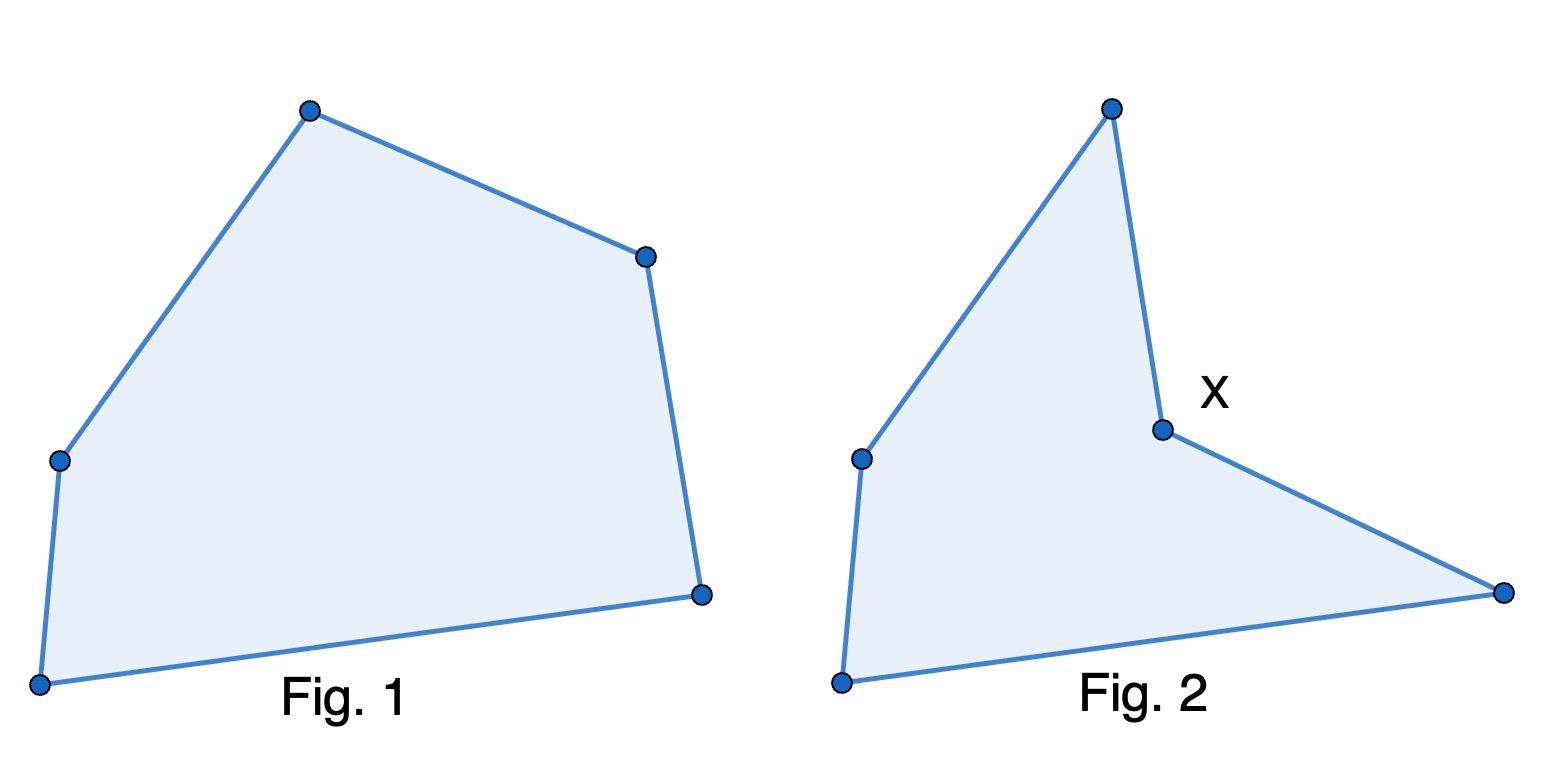
An acute angle is one that is less than a tight angle, that is, less than .
Prove that a convex polygon with sides can never have more than acute angles and that for any it is possible to construct a polygon with exactly acute angles.
For the proof, see the Comments.
Comments
Part 1
To see that a convex polygon cannot have as many as acute angles, first recall that the interior angles of a polygon with sides add up to right angles.
If the polygon had acute angle they would together use up less than right angles, since an acute angle is less than one right angle by definition.
Therefore the sum of the remaining angles would be greater than right angles and the mean average of these angles would be greater than right angles. This implies at least one angle is greater than right angles, which is impossible, because such an angle would represent a reentrant corner, contradicting our assumption that the polygon is convex.
Part 2
We can easily construct a quadrilateral with acute angles for example
Now if we bevel off vetted X, as indicated by the dotted line, we obtain a pentagon with acute angles. Bevel off one of the new vertices so formed and we will have hexagon. Continuing in this way we can construct a polygon with any number of sides and exactly acute angles.