

In his Natural History Pliny the Elder wrote of Druids venerating oak trees and and climbing them on the sixth day of the moon to harvest mistletoe with a golden sickle *.

"The druids; or the conversion of the Britons to Christianity". Engraving by S.F. Ravenet, 1752, after F. Hayman.¶
This is a vivid story and part of our stereotype of Druids, but perhaps it is just a myth. However we know the concept of the sacred grove plays a prominent part in the religions of many Indo-European cultures (see the WP article on the topic) and in Greece I once visited a holy well in the woods that felt a bit a distant echo of this tradition.
The connects with trees is also supported by the generally accepted etymology (already prefigured by Pliny). Druid seems to come ultimately from ancient PIE roots *doru-, 'tree'§ and *weyd-, 'see, know', so it would mean something like 'tree-knower'.
The word is found in Latin druides and Greek δρυΐδαι (dryidai), borrowed from Old Celtic. Old English had dry, 'magician', a direct borrowing, but Modern English druid came from Latin via French. Modern Gaelic and Welsh have cognates draoidh (dree) and derwydd (dehrooith), presumably directly from Old Celtic. A rough genealogy of these words in shown in this sketch.
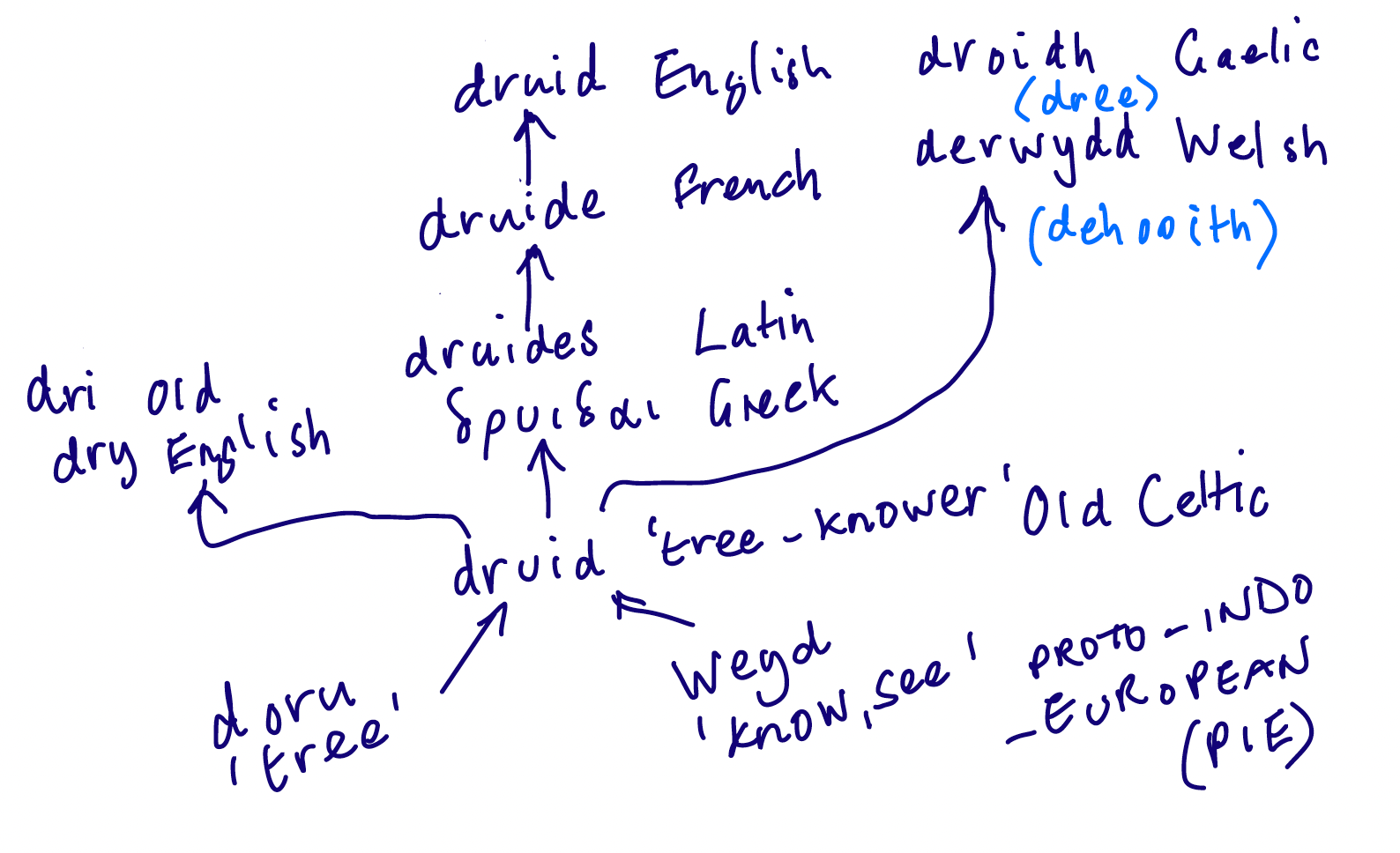
* Fans of Asterix the Gaul will be familiar with these details.
¶ Welcome Foundation ICV No 36622 Licensed under Creative Commons.
§ The first root might instead be a word meaning 'strong' or the two words might be the same (trees are emblematic of strength).
Comments
New comment
What we once understood as a wholesale displacement is giving way to a more nuanced picture. Genetics, archaeology, and place-names now suggest the Anglo-Saxon incursion was less genocide, more elite cultural transplant—a change in management on a native British population that largely stayed put. Modern English DNA averages only ~30% continental ancestry; the majority are Britons who became Angl-ish, not Germanic invaders.
The Romans held the lowlands but never pacified the Welsh highlands or the Scottish reaches. Brittonic culture survived in those refuges—the Picts were almost certainly Brittonic, and the shared Aber in Aberdeen and Aberystwyth proves a continuous Brythonic toponymic tradition across the island. The kingdom of Cumbria—Cum being the same root as Cymru ("fellow countrymen")—was among the last to fall, preserving the native identity against the Anglo-Saxon tide. So the English, in ancestry, are largely "Welsh" (Britons) who gradually adopted Anglo-Saxon ways.
(Pause to appreciate the majestic Irony of the etemology of Plaid Cymru meaning "Party of the fellow Briton)
Linguistically, however, the establishment has systematically underestimated the Brythonic substrate. The textbook "only a dozen words" relies on a methodological blind spot: defaulting to the earliest written source while ignoring the living Brittonic speech that English settlers heard daily. The etymology of druid is a perfect case. It is traced from PIE through Gaulish/Latin (druides) directly into English, skipping over the Brythonic derwydd spoken continuously in Britain for the millennium between the Gaulish texts and the Anglo-Saxon arrival. When the Angles arrived, they heard local priests called derwydd—they did not consult Caesar. This is the "skip-the-middleman" fallacy: textual attestation is not transmission vector. Phonetically, the English word aligns with Brythonic, not Latin, yet academia clings to the parchment trail to preserve a neat Germanic–Latin–Norse trifecta.
Beyond vocabulary, the deeper seepage lies in grammar: English's continuous tense and periphrastic "do" mirror Welsh syntax, suggesting Brythonic speakers rewired the language from within. Place-names, landscape terms (craig, tor, cumb), and dialect words all point to a substrate far richer than the handbooks admit.
The upshot: the Britons never left—they just became Angl-ish. And the local voice was never silenced; it was simply written out by scholars who preferred ink over the farmer's speech in the next valley.