A well-known problem that dates back to antiquity.
Find the shaded area in terms of a .
If the radii of the small circles are r sub one and r sub two respectively and the radius of the big circle cap r we must have cap r equals r sub one plus r sub two .
By the Intersecting Chords Theorem (Euclid Bk 2 Prop 35) we have two times r sub one multiplication two times r sub two equals a squared , or four times r sub one times r sub two equals a squared .
The shaded area is pi times cap r squared minus pi times r sub one squared minus pi times r sub two squared equals pi times left parenthesis r sub one plus r sub two right parenthesis squared minus pi times r sub one squared minus pi times r sub two squared
and
sum with 3 summands pi times r sub one squared plus pi times r sub one squared plus two times pi times r sub one times r sub two minus pi times r sub one squared minus pi times r sub two squared equals two times pi times r sub one times r sub two
which equals pi times a squared solidus two .


Quick Puzzle : Three Circles and an Area
A well-known problem that dates back to antiquity.
Find the shaded area in terms of .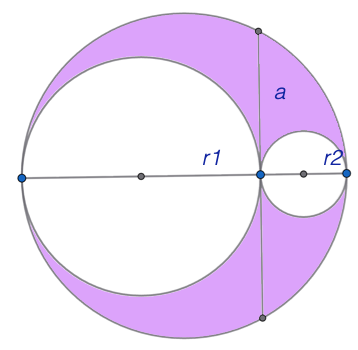
If the radii of the small circles are and respectively and the radius of the big circle we must have .
By the Intersecting Chords Theorem (Euclid Bk 2 Prop 35) we have , or .
The shaded area is
and
which equals .