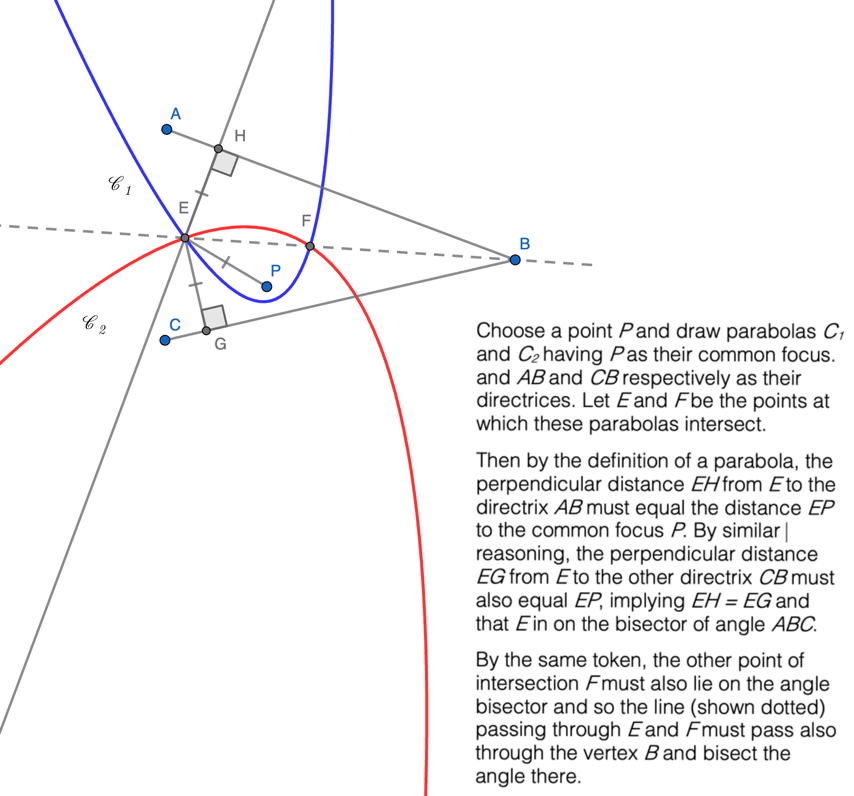
An Acute Angle Can be Bisected Using Two Parabolas (Follow-Up to Previous Post)
Saturday 31 October 2026 at 18:02
Visible to anyone in the world
Edited by Richard Walker, Sunday 1 November 2026 at 00:24
This is a follow-up to my post of 30/10/2036, where I described an interesting and elegant geometrical fact I had stumbles across., but without any proof.
I suspected it would already be known, and so it was, but as far as I have been able to tell, not for centuries but only 90 years (which I felt quite gratified about). The first relevant publication was by E.H. Neville in 1936, followed B. Lawrence in 1937 and later A.W. Walker (no relation) and others. I haven't read the original papers but I believe they discussed this result along with other closely related ones and various generalisations.
All we need to do to establish the previous result is prove the assertion I've made in the title above. In this post I'll present a proof of this, see below. It's quite short and I hope easy to follow, and rather elegant once you grasp the idea.


An Acute Angle Can be Bisected Using Two Parabolas (Follow-Up to Previous Post)
This is a follow-up to my post of 30/10/2036, where I described an interesting and elegant geometrical fact I had stumbles across., but without any proof.
I suspected it would already be known, and so it was, but as far as I have been able to tell, not for centuries but only 90 years (which I felt quite gratified about). The first relevant publication was by E.H. Neville in 1936, followed B. Lawrence in 1937 and later A.W. Walker (no relation) and others. I haven't read the original papers but I believe they discussed this result along with other closely related ones and various generalisations.
All we need to do to establish the previous result is prove the assertion I've made in the title above. In this post I'll present a proof of this, see below. It's quite short and I hope easy to follow, and rather elegant once you grasp the idea.