

I've not come across Ebbinghaus in any of the three modules of the MAODE I have thus far studied (Ivan Illich and Wendy Becker have interesting things to say too).
After some number of repetitions, Ebbinghaus would attempt to recall the items on the list. It turned out that his ability to recall the items improved as the number of repetitions went up, rapidly at first and then more slowly, until finally the list was mastered.
This was the world's first learning curve.
The effect of over learning is to make the information more resistant to disruption or loss.
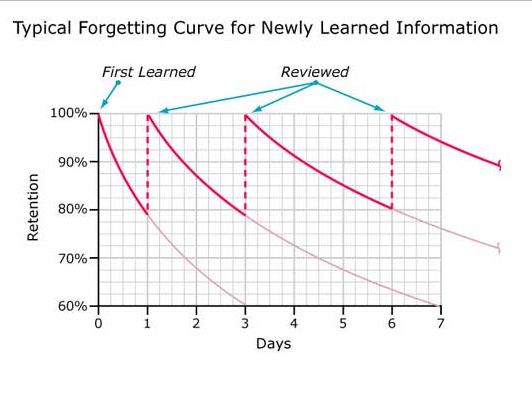
For example, the forgetting curve for over learned material is shallower, requiring more time to forget a given amount of the material.
I relate to this and having taken many exams in my life it is useful at last to have some terms to refer to it all. The only exam I have ever had to resit should have been the easiest, not the finals of a BA (Hons) as an Oxford Undergraduate (or the entrance exam which was tough enough), but a Level II Teaching Swimming Multi-choice paper that took an hour. I simply hadn’t put in the time, say six hours over as many days, repeating by writing it out and testing myself.
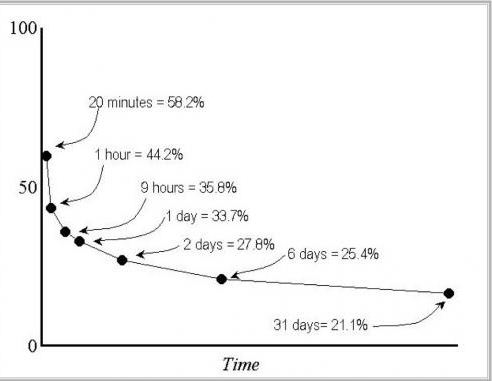
Whilst in an exam the student may forget, there are exams where you want them to retain the information: junior doctors, health & safety in a nuclear power plant, or one I was involved with 'the packing and storage of uranium trioxide'.
Savings is the most sensitive test of memory, as it will indicate some residual effect of previous learning even when recall and recognition do not.
Which is what I just did, three weeks after the event.
If I go to the website where I stored the original mind–maps and lists I know that I could quickly re–engage with the material. Like riding a bike, windsurfing or skiing? Though not recalling the lines of Mercutio from Romeo & Juliette which I performed in my late teens. I can however recite some Macbeth, but only because I have repeatedly tested myself on the lines since my mid–teens).
Comments
Overlearning as Structural Intervention: Changing the Parameters of the Forgetting Curve
Reading back through older posts for inspiration, this one is worth resurfacing. The forgetting curve is not a fixed property of the mind. It is a system output. Ebbinghaus showed that the rate of decay depends on the number of repetitions. Overlearning does not just increase the initial retention. It changes the slope of the curve itself. That is a structural intervention, not a marginal improvement. The savings measure is the most interesting part. Recall and recognition are binary. They tell you whether the information is present or not. Savings tells you how much residual trace remains even when recall fails. That is a continuous variable. It measures the system's latent capacity, not its current output. The mind-map and the list are not the memory. They are retrieval cues that lower the activation energy required to re-engage the trace. The distinction between exams you forget and exams you cannot forget is a boundary problem. The system that retains Mercutio is the same system that forgot the swimming paper. What differs is the repetition structure, not the storage. The uranium trioxide procedure is not memorised because it is important. It is memorised because it has been repeatedly tested. Importance is not the variable. Structure is.
Regards,
Russell Larke
BA (Hons) Business Management | MSc Candidate (Systems Thinking)
Trading Beyond Charts