

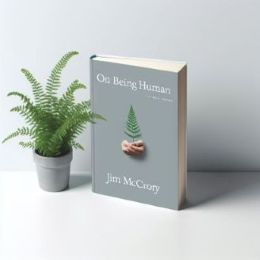
“The highest thing about a person is not finally what hepossesses, achieves or commands, but what kind of presence passes before others when he walks through their lives.”
Meanders with Virtue
Among other things this week, I was thinking about last Thursday's blog about The Man Who Removed His Cap, and at the same time trying, rather unsuccessfully, to strap down the word virtue. It is one of those words that seems simple until you begin to examine it closely, and then it starts slipping out from under the definition. That’s why I found myself imagining it while walking. Virtue is better approached in private thoughts along a path than across a desk or with the radio on. There is something about a winding track, the rise and fall of a field, the movement of light through trees, that loosens a thought and gives it room. You stop trying to capture the thing and instead allow it to accompany you for a while.
At first I thought I had it. Virtue is goodness that has become part of the person. That seemed solid enough. A generous act is good, certainly, but generosity is more than the act; it is what happens when giving begins to belong to you. Telling the truth once is an honest thing to do, but honesty is something deeper, something settled into the character. Courage, too, is not merely one brave moment but the slow formation of a person who has learned how to stand when fear arrives. We seem, in some measure, to become what we repeatedly choose.
The difficulty is that virtue cannot simply be behaviour. Two men might find a wallet lying beside the path and both return it. One notices the security camera first and calculates that keeping the money is not worth the risk. The other never sees the camera at all; he simply thinks, This belongs to somebody else. From the outside, the actions are identical, but inwardly something different has taken place. The good has been chosen because it is good. Yet good intentions alone will not quite do either. I may sincerely wish to be patient while spending the afternoon snapping at everybody within reach. Virtue has to escape from the mind eventually and enter the hands, the tongue and the habits. Conviction must somehow become conduct.
This led me to wonder whether virtue is quite different from innocence. There is something beautiful about innocence, of course, but mature goodness seems to contain knowledge. I think of Prince Mishkin in The Idiot when I consider the latter. The virtuous person knows something of bitterness and refuses to hand it on. He may know betrayal and yet remain capable of trust. She may have suffered and yet refuse to allow suffering to make cruelty seem reasonable. There is a particular beauty in goodness that has survived contact with life, a depth that could never belong to innocence alone. Virtue is innocence after it has been weathered, I wonder.
By now the path has opened beside a field somewhere in the Scottish Highlands and, as often happens when one thinks about virtue for long enough, Aristotle wanders into view. He thought of virtue as living somewhere between extremes. Courage lies between cowardice and recklessness, generosity between stinginess and wastefulness. Yet this middle is not a dull compromise, nor is Aristotle advising us to become moderately good. Rather, virtue responds wisely to what the moment actually requires. Sometimes kindness means putting an arm around somebody, while at other times it may mean telling them something they would rather not hear. It takes courage to choose that path honestly.
On one occasion, Moses asks God for something extraordinary: “Please show me Your glory.” One may have expected the answer to involve power, majesty, perhaps something almost unbearable to look upon. Instead, God's reply begins in a curious place: “I will cause all My goodness to pass before you.” I find myself stopping there. Moses asks for glory, and God speaks of goodness. Then come mercy and compassion. There is something here that our ideas about virtue need. We tend to imagine greatness in terms of strength, achievement or brilliance, while Scripture keeps directing our eyes toward goodness. This is the highest thing about a person is not finally what he possesses, achieves or commands, but what kind of presence passes before others when he walks through their lives. Does he leave fear behind him, or peace? Does she leave wounds, or healing? If virtue is goodness that has become part of the person, then perhaps human virtue is, in its small and creaturely way, the character of God beginning to leave its likeness upon us.
This is why virtue needs wisdom. Courage without wisdom can become recklessness; loyalty without justice can become complicity; confidence without humility becomes arrogance. Even honesty, separated from compassion, can become a weapon. We have all heard someone say something unnecessarily brutal and then defend it with the phrase, “Well, I’m only being honest,” when one suspects honesty itself may be innocent of the charge. Mature goodness seems to require a harmony of qualities, each one tempering and strengthening the others.
A little farther along, my thoughts drift naturally toward the Christian virtues of faith, hope and love, and to St Paul’s remarkable insistence that the greatest of these is love. That changes the direction of the whole discussion, because strength of character by itself is not necessarily virtuous. A cruel person may be disciplined, a tyrant may possess courage, and a manipulator may have extraordinary self-control. The important question is not simply whether the character is strong, but in what direction that strength is pointed. Christianity answers that, ultimately, it must be pointed toward love.
Without love, virtue itself can become another monument erected to the self, which is perhaps why humility enters the conversation so quietly. I have come to think humility is not thinking less of yourself so much as becoming less occupied with yourself. A humble person can say, “I did that well,” without needing a trumpet, and can also say, “I was wrong,” without collapsing. Humility is in my own simple way, allowing freedom to let reality be reality. There is something deeply attractive in people who can rejoice in another person’s excellence without somehow experiencing it as a diminishment of their own.
This may be why so much genuine virtue goes unnoticed. We naturally recognise the spectacular forms of goodness, but most of the moral beauty of the world is quieter than that. It is the parent getting up again in the night, the spouse who remains tender after decades, the employee who refuses to cheat when nobody would ever know, the person who could humiliate somebody but chooses restraint, the friend who listens to the same sorrow once more, and the wounded person who refuses to become a distributor of wounds. None of these things is likely to appear in a history book, yet I wonder whether they are not among the great things of the world.
And that brings me back to The Man Who Removed His Cap. Sometimes a tiny human gesture reveals something enormous. An action can last only seconds and yet suggest that somewhere inside a person a whole moral architecture has quietly been built: respect, restraint, recognition, tenderness, perhaps love itself. Nobody wakes one morning suddenly possessing a beautiful character. We are formed slowly and almost invisibly through choices so small that we hardly notice them. That is why someone you knew two decades ago may have changed, but we tend to judge by past experience with the person and our image is flawed and a figment of our own imagination. We choose patience once and then again; we forgive badly, perhaps, but we forgive; we practise generosity, restrain the sharp reply, apologise when pride would rather defend itself, and begin again when we fail.
Somewhere along this road something extraordinary may happen. What began as “I ought” slowly becomes “I want,” and perhaps one day becomes “How could I do otherwise?” The good that once felt like an obligation begins to feel natural, not because temptation has vanished or life has become easy, but because the heart itself has been educated. That may be one of the deepest mysteries of virtue: goodness ceases merely to be something we do and becomes something we are.
By then the path has turned homeward, and I still have not managed to strap down the word virtue. I am rather glad of it. Some words deserve to remain a little larger than our definitions. But I think I recognise virtue better than I did when the walk began. It is courage without swagger, truth without cruelty, strength without domination, humility without self-contempt and faithfulness when nobody is watching. It is goodness that has endured the weather and still remains good.
Above everything else, virtue is the long education of the human heart until love becomes less an occasional act and more the direction in which the whole person naturally walks.