OU blog

Personal Blogs

Jim McCrory

The Eight Billion Worlds We Have Never Known

Visible to anyone in the world
Edited by Jim McCrory, Wednesday 11 November 2026 at 13:03

sketch%20%281%29.png

The Eight Billion Worlds We Have Never Known

This morning, the beach was sitting at two degrees below. A low winter sun offered a little warmth, while a fine mist hung over the water, concealing the Island of Arran behind a veil of cloud. It was the kind of morning that invites contemplation. I found myself wondering what more I could write under the heading of my notebook, What It Means to Be Human. The subject seems inexhaustible, and the more I explore it, the more I become aware of its extraordinary depth.

One of the things I value most in life is meeting other human beings, particularly those whose cultures, histories and circumstances differ from my own. Every encounter offers an opportunity to discover something of another person's world. But as I stood looking across the water, another thought occurred to me: what about the billions of people I will never meet?

There are approximately eight billion people alive today, each possessing an interior world shaped by memories, relationships, fears, private joys, disappointments and hopes. Every person experiences existence from a consciousness uniquely their own. We can study human behaviour, explore our psychology and trace the great patterns of history, yet none of this allows us to experience the world as another person experiences it. We can know a great deal about humanity without ever knowing what it is to be someone else.

Somewhere in the world, a person is experiencing an emotion for which I have no name, attached to a memory I could never imagine, and arriving at a conclusion about life that has never occurred to me. Their understanding of existence is being shaped by experiences entirely beyond my reach. They are interpreting the same mysterious reality that I inhabit, but from a position I can never occupy.

There is something profoundly existential in this recognition. Each of us lives within the boundaries of a single consciousness, looking outwards at a universe of which we can only experience one small part. We share the same world, yet no two people inhabit it in quite the same way. Our lives intersect, our experiences sometimes resonate, and our emotions provide bridges between us, but the private experience of being alive remains uniquely our own.

This makes the human condition both intimate and mysterious. We are capable of extraordinary connection, yet there is an irreducible distance between one consciousness and another. We can listen, empathise, love and try to understand, but we cannot completely enter another person's experience. The inner life of every human being contains dimensions that may remain unknown even to those closest to them.

I find this thought less unsettling than humbling. It reminds me that humanity is far greater than the portion of it I have encountered or could ever hope to understand. Every person carries a perspective on existence that adds something to the collective human story, whether or not the world ever hears it.

As the mist continued to obscure Arran, I found myself thinking that being human involves living with this extraordinary paradox: we are each alone in the experience of our own consciousness, yet profoundly connected through our shared existence.

There are eight billion worlds of experience unfolding around us, and I have only ever known my own from the inside.

It is a remarkable thought, and one that leaves me with an enduring sense of wonder about the human family.


Now we see but a dim reflection as in a mirror; then we shall see face to face.

Now I know in part; then I shall know fully, even as I am fully known.

I Corinthians 13:12
 

Permalink Add your comment
Share post
Jim McCrory

Where No Good Meeting Ends in Goodbye

Visible to anyone in the world
Edited by Jim McCrory, Sunday 11 October 2026 at 13:15

“If the brief meeting of a stranger can awaken in us a longing that this world has no time to satisfy, perhaps we were made for a place where no good meeting ends in goodbye.”

sketch.png


Where No Good Meeting Ends in Goodbye


My wife and I were wandering around Princess Square in Glasgow with that pleasant little problem familiar to anyone surrounded by restaurants: too much choice. We looked at one menu, then another. Perhaps Italian? Maybe something light? Possibly somewhere we had eaten before? All the while, I am balancing these ordinary decisions with the reality of pancreatic cancer, so choosing what and where to eat can sometimes feel like a decision of rather more than ordinary importance.

Then, quite unexpectedly, lunch ceased to be the most interesting thing happening.

We met a family from Lahore in Pakistan who were visiting Glasgow. There was nothing dramatic about the encounter, no great event to report; we simply began talking. Yet almost immediately there was a warmth about them that caught my attention, one of those difficult-to-define moments when strangers somehow cease to feel entirely strange.

I have a custom when I leave home each day: I often pray that God will bring someone across my path. I realise that may sound unusual to some people, but I have done it for years, and remarkably often someone appears. Not necessarily someone who needs anything from me, nor someone to whom I have something profound to say. Sometimes it is simply another human being whom, for reasons I cannot entirely explain, I am glad to have met. This family was like that.

What particularly moved me were the son and daughter. They were respectful and attentive while we spoke. There was none of that sense that the younger members of the family were merely waiting impatiently for the adults to finish. They were present; they listened and participated in that quiet way. When eventually we parted, every member of the family shook our hands.

It was such a small thing: a handshake, a smile, a few words exchanged between people whose lives, until that moment, had been unfolding thousands of miles apart. Yet something had happened. For a few minutes, the categories by which we so often arrange humanity became unimportant. Pakistani and Scottish, visitor and resident, Muslim and Christian perhaps; whatever our differences might have been, they did not need to disappear for us to recognise something more fundamental in one another. Here was another family: parents who loved their children, young people being raised with courtesy and dignity, human beings making their way through the strange and beautiful business of life, just as we were.

Then came the part of such encounters that has always troubled me a little. We said goodbye, they walked one way through Princess Square and we walked another, and within moments the crowd had swallowed them up. It is one of the peculiar sorrows of human life that we can sometimes feel an immediate affection for people we are almost certain never to see again. For a few minutes two stories touch, and then they separate.

They will return home carrying their memories of Scotland, while my wife and I will return to our own life. Their children will grow older. Years will pass. There will be birthdays and joys, disappointments and discoveries, marriages perhaps, children perhaps, and all the unexpected turns that make up a human life. Whole chapters will be written in their story of which we shall know absolutely nothing. And yet, for those few minutes in Glasgow, our stories crossed.

Why should that affect us? Why should someone who was a stranger only minutes before leave behind a faint sense of loss when they disappear? Perhaps there is something within us that protests against the brevity of human connection. We are forever meeting people for whom there is not enough time. We discover a kindness just as the conversation must end. We glimpse something admirable in another person just as the train arrives, the holiday finishes, the meal ends, or somebody glances at the clock and says, “Well, we must be going.” In a curious way, we spend our lives beginning relationships that time does not allow us to finish.

For those of us who believe in God, there is another possibility; some encounters are not meant to be possessed or prolonged; they are simply meant to be received. A stranger does not have to become a lifelong friend for the meeting to have meaning. God may occasionally allow two human lives to touch briefly so that each might carry away a little evidence of the goodness in the other.

That family from Lahore gave me such a gift in Princess Square. They reminded me that goodness does not belong to one nationality, one culture or one corner of the earth. We encounter it in parents and children, in courtesy and attentiveness, in hospitality and humour, and in the simple willingness to stop and recognise the humanity of someone whose life may be very different from our own.

I am convinced that strange sadness we sometimes feel when good people disappear into the crowd is telling us something. If the brief meeting of a stranger can awaken in us a longing that this world has no time to satisfy, perhaps we were made for a place where no good meeting ends in goodbye.

I cannot know whether I will ever see that family again, and in the ordinary course of things I probably will not. But my belief  has taught me to be careful with the word never. There is something wonderfully unfinished about the Christian understanding of human life: goodbye need not necessarily mean the end of the story.

For now, I am simply grateful that among all those people moving through Princess Square that day, our paths crossed. My wife and I had gone in looking for somewhere to eat, studying menus and wondering what might satisfy our hunger. Yet we came away having received something that was never written on any menu: a brief encounter with strangers who, for a few precious minutes, did not feel like strangers at all.

Written by Jim, with editorial assistance from ChatGPT.

Permalink Add your comment
Share post
Jim McCrory

A Place of Wild Strawberries

Visible to anyone in the world
Edited by Jim McCrory, Sunday 11 October 2026 at 13:19


sketch.png

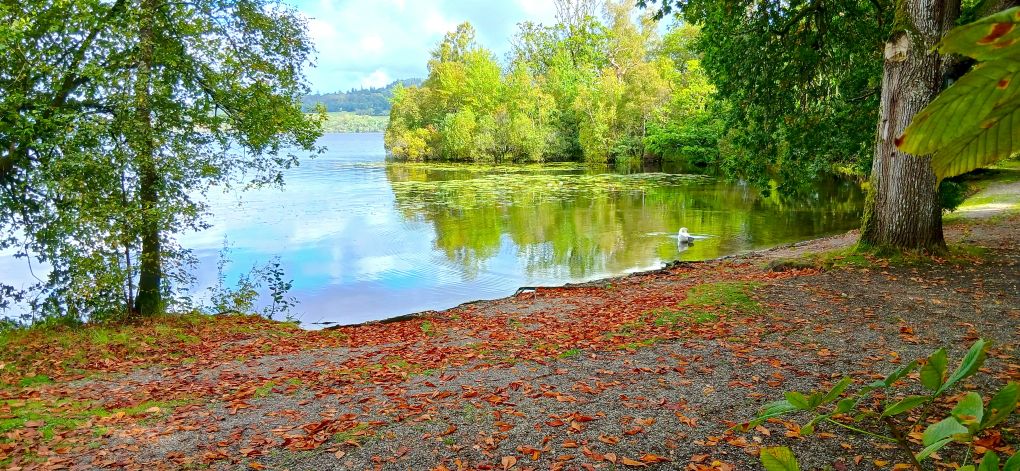
Loch Lomond from Cameron House

A Place of Wild Strawberries


It was our anniversary today, so we drove over to Loch Lomond for lunch. Autumn had begun its quiet transformation of the landscape. The hills were changing colour, the light had softened, and there was that particular beauty which comes when summer is loosening its hold and the earth seems to invite us to become still.

We went in search of our own place of “wild strawberries.”

The expression comes from the Swedish smultronställe — literally, a “wild strawberry place.” It has come to mean something more than a physical location: a treasured place, often known intimately to us, where we can withdraw from the noise of life, remember what matters, and simply be.

I suspect most of us have such a place.

It may be beside a loch, beneath an old tree, on a hillside, in a garden, or in a familiar chair beside a window. It need not be spectacular. What matters is that something happens to us there. The clamour subsides. The hurried conversations inside our heads begin to quieten. We become present again — to ourselves, perhaps to someone we love, and ultimately to God.

The Bible is full of such places.

Nathanael had his fig tree. When Nathanael wondered how Jesus knew him, Jesus answered, “I saw you while you were still under the fig tree before Philip called you.” We are not told exactly what Nathanael was doing there, but Jesus had seen him in that private, hidden place long before Nathanael realised he was seen.

Jonah, exhausted and angry, sat outside Nineveh and took shelter beneath the shade of a plant. His solitude was not particularly peaceful; he was wrestling with God. Yet even there, in the shade, God met him and exposed something deeper in his heart.

And Jesus himself repeatedly sought solitary places.

There was the wilderness. There were mountainsides in the early morning. And, as the shadow of the cross drew near, there was Gethsemane — a garden among olive trees where Jesus withdrew to pray.

Perhaps these places tell us something profound about the human spirit.

We were not made for uninterrupted noise.

There is something within us that needs withdrawal — not withdrawal from love or responsibility, but withdrawal from the constant demands upon our attention. We need places where nobody is asking us to perform, explain ourselves, produce something or hurry to the next thing.

We need somewhere simply to be.

And perhaps this is why a “wild strawberry place” can become sacred. Not because God inhabits one patch of earth more than another, but because sometimes we become more capable of noticing that He is already there in the beauty of creation.

There is another tenderness in this idea too. Sometimes solitude is shared.

On our anniversary, beside Loch Lomond and surrounded by the colours of autumn, I was not alone. I was with the person with whom I have shared so much of life. There are moments when two people can be quiet together without needing to fill the silence. That to is a kind of  gratitude expressed simply by being present to one another before God.

Our wild strawberry places will all be different.

Some we visit alone. Some we share with the person we love. Some become places where we wrestle with God, as Jonah did. Others become places where, like Nathanael beneath his fig tree, we discover the astonishing possibility that before we ever thought to look for God, He had already seen us.

And that is the deeper invitation.

Find your place.

Sit beneath your fig tree. Walk beside your loch. Find the garden, hillside, woodland path or quiet corner where your soul becomes still.

Stay there for a while.

You may discover that solitude is not really about being alone at all.

It is about becoming quiet enough to recognise the One who was already there.

Written by Jim, with editorial assistance from ChatGPT.


Permalink Add your comment
Share post
Jim McCrory

I Will Miss This World

Visible to anyone in the world
Edited by Jim McCrory, Sunday 16 August 2026 at 09:15

sketch.png

I Will Miss This World

On our walks along Scotland’s west coast — something my wife and I have done for years — we often drift into our own quiet worlds. The sea, the sky, the wind off the loch lomond: they create a kind of gentle solitude we share without speaking. On one of those walks, I found myself thinking how beautiful this planet is, and how much I will miss it when my time here ends.

The thought was prompted, oddly enough, by a man I met who told me he’d abandoned his disappointing hotel and booked into another, taking the financial hit just to salvage his holiday. I understood him. Life is short, and we try to gather good memories while we can.

If you’re new here and haven’t read the backstory, let me bring you into it.

Three years ago, I learned that the very cells which had served me faithfully all my life had turned traitor. They staged a rebellion in my prostate, marched to my pancreas, and finally settled in my liver — a cancerous time bomb quietly ticking inside me.

The diagnosis arrived in September 2023. Neuroendocrine cancer. Spreading. Serious. Delivered gently, almost tenderly, by a consultant who knew there is no script for receiving such news.

And yet, I discovered there was a script — one written long before I knew I would need it.

On the morning I was due to receive my results, something extraordinary happened. Before I stepped into the hospital, before the diagnosis had a name or a prognosis, God spoke to me through words I hadn’t sought but that arrived like a lifeline dropped into deep water:

He who dwells in the shelter of the Most High will rest in the shadow of the Almighty. I will say of the Lord, “He is my refuge and my fortress, my God, in whom I trust.” — Psalm 91:1–2

I didn’t read those words casually. They were spoken into my spirit — not just read, but revealed. It felt as though God leaned close and whispered: This is for you. For today. For what you’re about to hear.

I turned to my wife and said, “We’re going to get bad news today.”

And He didn’t stop there.

That evening, my wife — who has walked every step of this path with me — showed me something I had missed. She had been reading the same psalm, but her eyes were drawn to its closing verses:

Because he loves Me, I will deliver him; because he knows My name, I will protect him. When he calls out to Me, I will answer him; I will be with him in trouble. I will deliver him and honor him. With long life I will satisfy him and show him My salvation. — Psalm 91:14–16

In her quiet way, she revealed what I needed most: God was not only promising protection — He was promising presence. Not just a fortress, but companionship in trouble. Not just deliverance, but honour. And most tender of all: long life, whether measured in days here or in eternity with Him.

Cancer can make you feel absurdly small — like Sisyphus, condemned to push the stone of your own body uphill, knowing it will only roll back down. Camus wrote that one must imagine Sisyphus happy, that the struggle itself is enough to fill a man’s heart. But unlike Camus’s Sisyphus, my life is not condemned to futility. The stone is heavy, yes — but I do not push it alone. God’s presence transforms the absurd into the bearable, and the unbearable into the meaningful.

Viktor Frankl, who endured the concentration camps, wrote that those who have a why to live can bear almost any how. My why is clear. It is anchored not in medicine or prognosis, but in God — my refuge, my fortress, my salvation. I know how easily this can sound like well‑worn Christian rhetoric. But unless you’ve walked this path with God yourself, you may never know how it feels from the inside.

Psalm 91 does not promise the absence of pain. It promises His presence in it. It promises that when we love Him and call on Him, He hears, He answers, He walks with us.

I may have been given a year, but I have been given far more than that — I have been given hope. Not wishful thinking, but anchored hope. The kind that steadies a man living with a time bomb inside him.

To anyone who has sat in that sterile room and heard the doctor say “cancer,” or who lies awake wondering what the future holds: God still speaks. And more than that — He stays.

There is a future for those who walk with God. John 5:24 says:

Truly, truly, I tell you, whoever hears My word and believes Him who sent Me has eternal life and will not come under judgment. Indeed, he has crossed over from death to life.

Before all this, I was working on a book called What It Means to Be Human, exploring the question from Christian, subjective, and objective angles. These days I write smaller, “word of the day” style pieces instead — finishing them when I finish them — many of which appear here. Thank you for reading.

And as for the man searching for a better hotel, a better experience, a better memory — I hope he found it. We all want our days, however many remain, to be good ones.

Permalink Add your comment
Share post

This blog might contain posts that are only visible to logged-in users, or where only logged-in users can comment. If you have an account on the system, please log in for full access.

Total visits to this blog: 3067423