Frothing For Nature
Yesterday I woke at 7 a.m. and had the thought to go "frothing" for nature, as our Aussie cousins would say. But I have always believed that some of the finest encounters with nature are found in conversations with our fellow human beings.
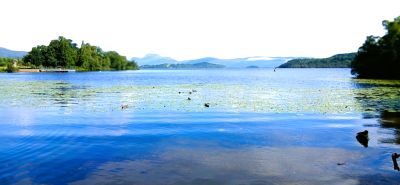
Our plan was to stop for breakfast at Loch Lomond, the gateway to the natural beauty of Scotland's west coast. There we struck up a conversation with an Australian couple from Canberra who, by now, will no doubt have awakened to the bustling harbour at Oban, where the great CalMac ferries come and go between the Inner and Outer Hebrides. A landscape shaped in my head by the wonderful music and lyrics of Runrig.
"Fancy driving up to Glencoe?" I asked my wife.
"Sure," she replied, as always happy to indulge one of my spontaneous ideas.
The road was busy. Tourists from across Europe manoeuvred oversized campervans through the Highlands, often cramping in on the landscape. Others squeezed into every possible viewpoint, even when there was clearly no room, bringing traffic to a standstill. This is Scotland in July.
On arriving at Glencoe, I missed the turning for the car park, so we decided to continue on to Kinlochleven. The village was filled with tired, but undoubtedly uplifted, walkers completing the penultimate stage of the West Highland Way.
I use the word uplifted deliberately because we met an elderly local lady in the village shared something that stayed with me. After chatting for a while, I asked her about one of her happiest memories.
"When I'm feeling low," she said, "I walk into our local landscape and simply sit for a while, enjoying the moment. When I come home, I feel rejuvenated."
Her words reminded me of Nathanael's encounter with Jesus. Before Nathanael had even met Him, Jesus said, "I saw you while you were still under the fig tree." It was a place of quiet reflection before it became a place of revelation. Sometimes we all need somewhere peaceful to sit, think and simply be.
Later, we stopped at a restaurant for a late lunch, where I found myself talking with a man walkingThe West Highland Way. As the conversation unfolded, I asked him about his happiest childhood memory.
He told me he had grown up near the ski slopes. His mother was the accomplished skier in the family, and as he learned to ski, she would gently remind him, "Don't rush down the mountain. Take in the surroundings."
As a boy he would weave his way slowly between his mother's tracks, savouring both the landscape and the moment. Today he is a highly skilled craftsman and furniture designer, working with wood. Listening to him, I couldn't help wondering whether those childhood journeys down snowy mountains first awakened the creativity that would shape his life's work.
His mother closed her eyes when he was a young man. I left our conversation with a quiet sense of sadness, having lost my parents at a young age. Some people seem to give far more than they ever receive. Mothers often do. I was grateful for having met him and I wish him the best as he journeys through the Highlands and indulging in his own nature walk.
As we journey through life, it is worth taking time to connect with the people we meet along the way. Everyone carries a story, and every conversation has the potential to leave a lasting impression.
I will never forget the people we met yesterday. And perhaps, in the great renewal that Job longed for—the hope that stretches beyond this present world—we shall meet many of life's fellow travellers again.
Part two
Some months ago, my wife and I were watching a Christian livestream from Amsterdam on Presence Revival. Greetings were appearing from around the world: South Korea, Thailand, the Philippines, the United States and across Europe.
And then there was us, watching from Scotland.
We posted our greeting, and a lady named Brenda from Kinlochleven replied to say hello. We returned the greeting and thought little more about it. It was one of those pleasant encounters made possible by the internet, with no expectation that we would ever meet.
Then, on Thursday, we found ourselves in Kinlochleven.
As we were preparing to leave the village, we suddenly remembered Brenda.
“Let’s see if we can find her before we go.”
We had no address and very little information. Our first attempts drew blanks, and eventually we decided to give up.
Then we passed a lady outside talking with one of her neighbours. On impulse, I asked whether she knew where Brenda lived.
“I am Brenda,” she replied.
Then she looked at us and asked, “Are you the couple from Ayrshire?”
Of all the people we might have stopped, we had stopped Brenda herself.
There was an immediate bond between us. We discovered that we shared something else too. The three of us were committed Christians, yet none of us regularly attended a conventional church. We found Christian encouragement and fellowship in other ways, including online preaching, teaching and worship.
References
Frothing in Australian slang means being wildly excited and hyped up about something — usually in a fun, over‑the‑top way. The term is especially common in Aussie surf culture, where “I’m frothing!” basically means “I’m buzzing with enthusiasm.”