OU blog

Personal Blogs

Jim McCrory

But Seas Between Us Broad Have Roared

Visible to anyone in the world
Edited by Jim McCrory, Sunday 25 January 2026 at 18:45

But seas between us broad have roared
since auld lang syne.
And there's a hand my trusty friend
And give me a hand o' thine
And we'll take a right goodwill draught
for auld lang syne

Robert Burns

sketch.png


But Seas Between Us Broad Have Roared

I have a large plastic folder at home that I cannot throw away.

I have been careful about almost everything else. Since my cancer diagnosis, I have done what the Swedes call death cleaning: giving things away, discarding what no longer earns its place, loosening my grip on objects that once felt essential—like photos, which I have passed on to posterity. Books have gone. Papers. Mementoes I defended for years with elaborate justifications now seem strangely willing to leave.

But not this.

The folder is plain and slightly warped with age. Inside it are business cards and contact cards collected over decades, mostly from Christian conventions and gatherings in Berlin, Paris, Edinburgh, and other cities whose names still feel larger than my present world. The cards are from the French, Germans, Dutch, Belgians, Japanese, Poles, Ukrainians, Russians, Italians, Swedes, and other nationalities. Names, email addresses, family photos, and phone numbers—sometimes with handwritten notes; details that felt important at the time.

There is no practical reason to keep them. Decades have passed. I will not contact these friends. Life, with its quiet and uncompromising turns, has made that impossible. Some of them will be dead. Some unreachable. Some so changed that even recognition would feel dishonest. I am no longer who I was when these cards were exchanged across café tables strewn with leaflets, faith, and optimism.

And yet the folder remains.

What it holds is not a network, nor even nostalgia in the usual sense. It is evidence. Proof that for a moment—sometimes only a very brief one—connection happened. That faith made strangers speak to one another as if they belonged to the same story, even if they would never share another chapter.

I’ve been thinking about this folder in connection with Auld Lang Syne, written down by Robert Burns, who once lived just along the road from me here on Scotland’s west coast. With music added, the song is often treated as sentimental—a harmless ritual for New Year’s Eve or other partings. But I don’t think it is really about the past at all.

Auld Lang Syne mourns the limits of time.

It recognizes something quietly unbearable: that some connections are real, even sacred, and yet cannot be sustained within one human lifespan, one geography, one changing self. The song never says we will stay. It only says we once held this together. And that restraint is everything.

There is a kind of honesty in that which feels almost moral. The song does not pretend that love, friendship, or shared struggle can always survive careers, illness, distance, age, or death. It accepts that finitude fractures continuity—not because people fail, but because life itself is short and fragile.

Psychologically, this is rare. Most cultures offer us stories that resolve connection into permanence: always, forever, till death do us part. Auld Lang Syne offers something more difficult, and perhaps more truthful: connection can be complete without being continuous.

Sociologically, that idea unsettles us—especially now, when technology whispers that nothing should ever be lost, that every relationship can be retrieved if only we try hard enough. The song gently frees us from that demand. It says: you did not betray the bond simply because time moved faster than you could.

That is why it is sung at thresholds. It is not so much a farewell as a witness. Someone stands with you—only briefly—to acknowledge that what existed was real, that it mattered, and that it has not been erased by silence or absence.

The handclasp at the end matters. People cross arms awkwardly, unsure who is holding whom. It is a physical admission of the truth the song dares to hold: connection can be briefly re-entered, but not permanently re-inhabited. We touch, and then we let go.

There is something almost theological in this, even though the song never names it. A sense that meaning exceeds duration. That what is shared participates in something larger than time, even if time itself cannot hold it.

This is why I cannot throw the folder away.

Those cards are not unfinished business. They are not failures of friendship. They are witnesses. Each one says: for a moment, this mattered. That prayer was shared. That recognition crossed borders that history works very hard to keep intact.

This life is not long enough to carry all the love it generates. Some of it must be set down without resolution.

And yet.

There is a moment in the Gospels where Jesus turns to a dying man beside him and says, “Today you will be with me in paradise.” It is not explained. No map is drawn. No mechanics are offered. It is simply a promise spoken at the edge of time, where explanation would be too small.

But in these words of Jesus, we do not have a promise so much as a denouement: a new life where old connections, found worthy of that life, may renew—and where friendships, old and new, may meet again at the cusp of eternity.

So I keep the cards.
And I keep the question.

And still, the cup is raised.

'And Jesus said to him, “Truly I tell you, today you will be with Me in Paradise.”'

Luke 23:43

Image by Copilot

Permalink Add your comment
Share post
Jim McCrory

Let’s Escape This Life for a Day

Visible to anyone in the world
Edited by Jim McCrory, Friday 5 September 2025 at 15:13

sketch.png

Let’s Escape This Life for a Day

In 1999, I lived for a time in Stavanger, Norway. Most mornings, leaving Randaberg and heading into the city, I stopped at a filling station for a freshly made skolebolle—a school bun. I can still taste the custard, coconut, and sweetness. I miss them still.

Sometimes, in the private cinema of my imagination, I step into a time machine and escape this life for a single day. Don’t tell me you’ve never entertained the thought. One press of a button and I’m in a 17th-century Japanese village, mist curling like silk above the paddies, sandals shuffling across the earth. Another press and I’m wandering an Indian night market, the air alive with cumin and cardamom, the chatter of merchants and buyers weaving a living symphony. Or perhaps I’d go further still—away from humanity altogether—and find myself alone in the Rockies, a bag of skoleboller somehow beamed away while the coffee brewed. I’d pitch my tent beneath a midnight sky brimming with stars and listen to a silence so complete it feels as though the earth itself is holding its breath.

But then the dream fades. I blink, and here I am—back in Scotland on a Saturday evening. Nothing extraordinary. Just reality humming along.

And in those quiet returns, the questions arrive. What’s it all about? Why are we here at all? Are we only a passing arrangement of atoms—chance evolution—replicating ourselves until we vanish? Some are content with that explanation. I’m not. Because the world does not behave as though it’s meaningless.

Think about it. Flowers bloom in colours that surpass function. Birds sing songs more elaborate than survival requires. We, too, hunger for what is unnecessary. We write poetry. We compose music. We fall in love with paintings, with stories, with the way sunlight filters through a late-afternoon window. None of this is needed to stay alive. Yet without it, are we truly living? The unnecessary becomes essential.

And then there’s time. We grow older. Doors begin to close one by one. Torschlusspanik, the Germans call it—the panic of gates shutting as opportunities slip away. Suddenly, we cling to life with a desperation we never knew was in us. Few are ready to say, “Tomorrow is enough.” We bargain for more time, more seasons, more chances. Why? Because something deep within whispers that life ought not to end.

My sister once spoke with an old man who stood weeping at the sight of the countryside. When she asked if he was alright, he said, “I see all this beauty, and I don’t have much longer to live. But I want to stay.” His tears were the language of eternity. He wanted more not because he was greedy, but because he was human.

The writer of Ecclesiastes put it plainly: God has “set eternity in the human heart.” That single thought explains much of our restless longing. It explains why sunsets undo us, why we fear the final curtain, why we ask questions that biology cannot satisfy. It tells us that our hunger for permanence is not a flaw but a clue.

The Garden of Eden was a template for what the whole earth was meant to be. Our first parents were told to spread out and cultivate the land. Imagine it—the whole earth filled with Rockies, Japanese gardens, skoleboller, and the rich delights of every age and culture. And here is the point: with eternity in your lap, there is no need to beam about. There is no hurry. Build a boat, sail to the Orkneys, then to the Faroes, and on to Norway. Ride a horse to Stavanger. Kult! as the Norwegians say.

“Truly I tell you, today you will be with me in paradise.”
— Luke 23:43 (NIV)

Image by Copilot

Permalink Add your comment
Share post
Jim McCrory

Why Are We Here? Let's Escape This World For a Moment

Visible to anyone in the world
Edited by Jim McCrory, Thursday 28 August 2025 at 12:50

Updated at

Let’s Escape this Life for a Day | learn1

He has made everything beautiful in its time. He has also set eternity in the human heart…” 

Permalink 6 comments (latest comment by Jim McCrory, Monday 9 September 2024 at 14:17)
Share post
Jim McCrory

The Secret Kept in Children's Books and Picturebooks

Visible to anyone in the world
Edited by Jim McCrory, Monday 26 August 2024 at 11:13

"“Some day you will be old enough to start reading fairy tales again.”
― C.S. Lewis


Image by https://unsplash.com/@matblueforest

I have an embarrassing  secret. I am happy to tell you what it is so long as you don’t tell anyone. Is that a deal? This is my secret. I love children’s books. At my age I should know better, but it's an addiction . I love them so much that I changed my degree from a Literature Degree to an Open Degree to accommodate EA300 Children’s Literature with The Open University.

Gyo Fujikawa is the most addictive for me. Children in paradise. Waving from tree houses. Gentle fairies and children no bigger than polka-dot toadstools. Captivating. But, there's the loneliness of the child with no one to play with except a frog. That saddens me. I was a lonely child and I empathise. 

https://www.newyorker.com/books/page-turner/how-gyo-fujikawa-drew-freedom-in-childrens-books

Then there’s Astrid Lindgren’s The Children of Noisy Village. I’m a Swedophile who can speak a few words of Swedish and I am in awe of the beauty and setting where the tale is filmed. An age of innocence. Swedish village life that will never return, perhaps.

https://tv.apple.com/no/movie/the-children-of-noisy-village/umc.cmc.13bmjs0xgg1sv8sju2tv3za5j

There’s the Portuguese word that best explains my longing to enter a world that these stories encapsulate, Saudade,  a longing or nostalgia for something that cannot be realised.

I guess the reason such stories appeal is the desire to escape mentally from this broken world. C.S. Lewis wrote:

“If we find ourselves with a desire that nothing in this world can satisfy, the most probable explanation is that we were made for another world.”

Interesting, but what world did C.S Lewis mean? Did he mean the world of The Lion, the Witch and the Wardrobe? No, he was a Christian and an academic who wrote children’s books, Christian, apologetic and academic books. The world he was thinking of was the world recorded in Luke 23:43 “Truly I say to you today, you will be with Me in Paradise.”

Writing:  © 2024 Jim McCrory


Permalink
Share post
Jim McCrory

The Joys and Sorrows of Young Yuguo

Visible to anyone in the world
Edited by Jim McCrory, Wednesday 17 July 2024 at 12:21


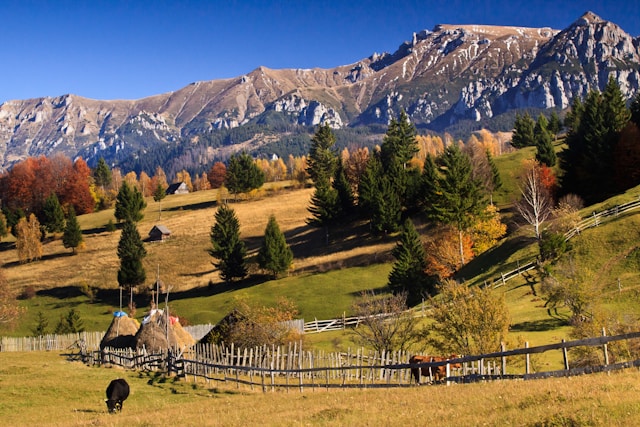
Image of Bran, Romania, by Calin Stan at https://unsplash.com/@calinstan


The Joys and Sorrows of Young Yuguo


In a recent post, I wrote about a music teacher who changed my life and made me believe that Scandinavia was my real home.

Last night, my wife and I watched a moving documentary on Netflix called The Joys and Sorrows of Young Yuguo.

It told the story of a teenage Chinese boy with a good heart who developed a deep desire to study literature and Romanian language in a Romanian university. His love for the country and nation was inspired by the Romanian national poet, Mihai Eminescu. Yuguo, left an incredible impression on his university teachers and the nation as a whole. Somewhere in the future haven of wonder, I hope I will meet Yuguo. His story among other matters, stand as a testament to the transforming power of literature.

I'm curious about all this; is there a place you always felt you belonged to? Make a comment, please.

*******

 “You may have the universe if I may have Italy”: Giuseppe Verdi

After the documentary, I asked my wife, “Is there a place that draws you and makes you feel you belong there?” She replied, “Italy.”

C.S. Lewis wrote of the emotion that creates a desire to live in another world as a glimpse of a future paradise. He wrote,

"If we find ourselves with a desire that nothing in this world can satisfy, the most probable explanation is that we are made for another world.”

And Jesus said to the repentant criminal, “Truly I say to you, today you shall be with Me in Paradise.” Luke 23:43 (Legacy Standard Bible).


Scripture quotations taken from the (LSB®) Legacy Standard Bible®, Copyright © 2021 by The Lockman Foundation. Used by permission. All rights reserved. Managed in partnership with Three Sixteen Publishing Inc.  LSBible.org and 316publishing.com.


Permalink Add your comment
Share post

This blog might contain posts that are only visible to logged-in users, or where only logged-in users can comment. If you have an account on the system, please log in for full access.

Total visits to this blog: 1451263