
OU blog

Personal Blogs

Jim McCrory

The Eight Billion Worlds We Have Never Known

Visible to anyone in the world
Edited by Jim McCrory, Wednesday 11 November 2026 at 13:03

sketch%20%281%29.png

The Eight Billion Worlds We Have Never Known

This morning, the beach was sitting at two degrees below. A low winter sun offered a little warmth, while a fine mist hung over the water, concealing the Island of Arran behind a veil of cloud. It was the kind of morning that invites contemplation. I found myself wondering what more I could write under the heading of my notebook, What It Means to Be Human. The subject seems inexhaustible, and the more I explore it, the more I become aware of its extraordinary depth.

One of the things I value most in life is meeting other human beings, particularly those whose cultures, histories and circumstances differ from my own. Every encounter offers an opportunity to discover something of another person's world. But as I stood looking across the water, another thought occurred to me: what about the billions of people I will never meet?

There are approximately eight billion people alive today, each possessing an interior world shaped by memories, relationships, fears, private joys, disappointments and hopes. Every person experiences existence from a consciousness uniquely their own. We can study human behaviour, explore our psychology and trace the great patterns of history, yet none of this allows us to experience the world as another person experiences it. We can know a great deal about humanity without ever knowing what it is to be someone else.

Somewhere in the world, a person is experiencing an emotion for which I have no name, attached to a memory I could never imagine, and arriving at a conclusion about life that has never occurred to me. Their understanding of existence is being shaped by experiences entirely beyond my reach. They are interpreting the same mysterious reality that I inhabit, but from a position I can never occupy.

There is something profoundly existential in this recognition. Each of us lives within the boundaries of a single consciousness, looking outwards at a universe of which we can only experience one small part. We share the same world, yet no two people inhabit it in quite the same way. Our lives intersect, our experiences sometimes resonate, and our emotions provide bridges between us, but the private experience of being alive remains uniquely our own.

This makes the human condition both intimate and mysterious. We are capable of extraordinary connection, yet there is an irreducible distance between one consciousness and another. We can listen, empathise, love and try to understand, but we cannot completely enter another person's experience. The inner life of every human being contains dimensions that may remain unknown even to those closest to them.

I find this thought less unsettling than humbling. It reminds me that humanity is far greater than the portion of it I have encountered or could ever hope to understand. Every person carries a perspective on existence that adds something to the collective human story, whether or not the world ever hears it.

As the mist continued to obscure Arran, I found myself thinking that being human involves living with this extraordinary paradox: we are each alone in the experience of our own consciousness, yet profoundly connected through our shared existence.

There are eight billion worlds of experience unfolding around us, and I have only ever known my own from the inside.

It is a remarkable thought, and one that leaves me with an enduring sense of wonder about the human family.


Now we see but a dim reflection as in a mirror; then we shall see face to face.

Now I know in part; then I shall know fully, even as I am fully known.

I Corinthians 13:12
 

Permalink Add your comment
Share post
Jim McCrory

The Barefoot Pilgrim: The Search For Truth

Visible to anyone in the world
Edited by Jim McCrory, Thursday 14 May 2026 at 15:53

sketch.png

The Barefoot Pilgrim: The Search For Truth


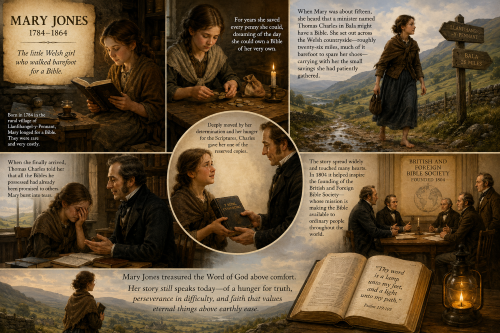
Mary Jones was born in the rural village of Llanfihangel‑y‑Pennant in 1784. Her family was poor, and in those days, Welsh Bibles were rare and costly possessions. From childhood she longed to own one for herself. She is still remembered as “the little Welsh girl who walked barefoot for a Bible.”

For years Mary saved every penny she could. When she was about fifteen years old, she heard that a minister named Thomas Charles in Bala might have a Bible available. Determined to obtain one, she set out across the Welsh countryside and walking roughly twenty‑six miles, much of it barefoot to spare her shoes and carrying with her the small savings she had patiently gathered over the years. 

When she finally arrived, Thomas Charles told her that all the Bibles he possessed had already been promised to others. Mary reportedly burst into tears. Deeply moved by her determination and by her hunger for the Scriptures, Charles gave her one of the reserved copies.

The story spread widely and touched the hearts of many Christians. In time, it helped inspire the founding of the British and Foreign Bible Society in 1804, whose mission became making the Bible available to ordinary people throughout the world.

Whether every detail has survived exactly as it happened matters less than the truth at the centre of the story: a young girl treasured the Word of God enough to endure hardship simply for the privilege of owning it. Her story still speaks today because it reveals something rare, a hunger for truth, perseverance in difficulty, and faith that valued eternal things above comfort.

Today the contrast is striking. Bibles are no longer scarce. Many people own several copies, and digital versions can be downloaded freely within seconds. Yet despite such abundance, few take the time to read them deeply. One cannot help but wonder why.

Science has expanded human knowledge, yet it has not replaced the questions the Bible addresses. The Scriptures stand apart as more than a historical document or a collection of moral sayings; they speak to the meaning of life, to conscience, suffering, forgiveness, hope, and salvation. In an age increasingly uncertain of what virtue even means, the Bible remains profoundly relevant.

Modern society often appears to be losing its moral and spiritual centre. As people abandon shared truths, each increasingly follows his own way, and the result is confusion, loneliness, and division. The Bible teaches that humanity is made in the image of God. In other words, we bear, however imperfectly, reflections of qualities that originate in God Himself, those of  love, justice, mercy, reason, creativity, and moral awareness. Scripture not only reveals these qualities but also defines what is truly good, grounding human dignity in something higher than personal opinion or social fashion.

Many people sense that something in the modern world is disintegrating, even if they struggle to explain exactly what it is. The philosopher Friedrich Nietzsche famously wrote, “God is dead. God remains dead. And we have killed him.” Yet Nietzsche understood the terrible question that followed: if humanity removes God from its centre, by what standard will we guide ourselves, and how shall we console ourselves in the emptiness left behind?

Perhaps that is why the story of Mary Jones still matters. Her journey through the Welsh hills was not merely a search for a book. It was a search for truth, meaning, and the voice of God in a troubled world. In many ways, the modern world possesses infinitely more knowledge than Mary ever could have imagined, yet far less certainty about what it means to live well. The tragedy today is not that Bibles are unavailable, but that so many remain unopened.

Permalink Add your comment
Share post

This blog might contain posts that are only visible to logged-in users, or where only logged-in users can comment. If you have an account on the system, please log in for full access.

Total visits to this blog: 3054415