OU blog

Personal Blogs

Richard Walker

A Brocken Spectre in the Brecon Beacons

Visible to anyone in the world

A friend of my daughter's snapped this Brocken Spectre near Abergavenny, in the Bannau Brycheiniog (Brecon Beacons).
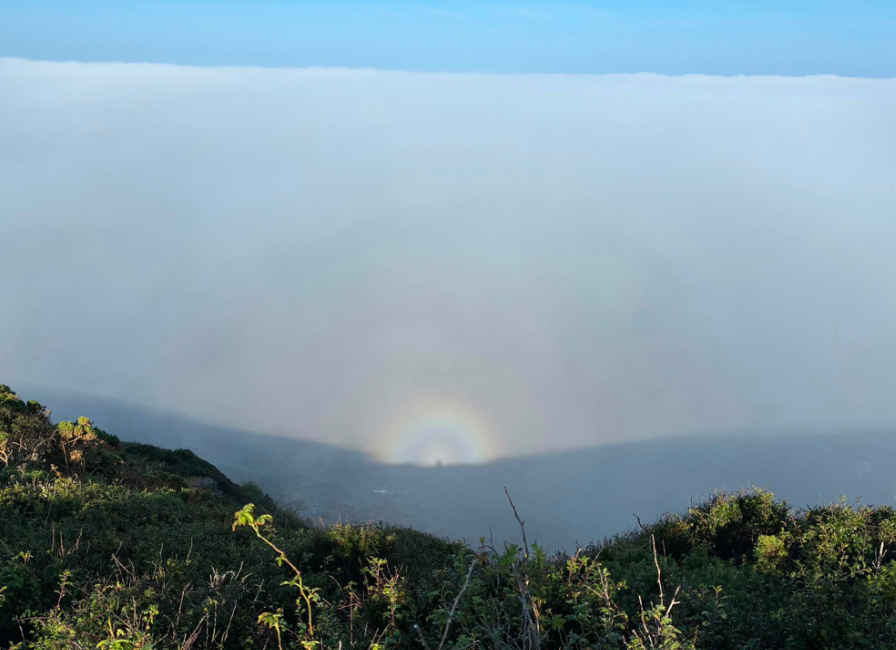
When the sun shines from behind an observer onto a bank of mist, the observer's shadow may be cast on the mist and depending on the elevation of the sun the shadow may look like a giant figure, giving rise to the legend of the 'Brocken Spectre', named after the Brocken, a peak in the Harz mountains of northern Germany, where the condition are often favourable for seeing the phenomenon.

In this example the shadow appears tiny but we can clearly see the other feature of a Brocken Spectre: the observer's head is surrounded by a 'glory' – a ring of light like a halo. The ring has colours, in the same order as a rainbow, although distributed somewhat differently, but a glory is much smaller that a rainbow and caused by different mechanisms.

The water droplets in the mist are much smaller than the raindrops responsible for a rainbow, by a factor of about 100. The incoming light is back scattered and the colours are caused by the light waves interfering. But how does this back scattering happen?

Theory 1

The water droplets refract the light back. Unfortunately the water does not bend the light enough for this to be the explanation.

Theory 2

The physics of electromagnetic waves predicts the light can become a wave that travels round the surface of the raindrop and then emerges as a back scattered wave. This seems to happen but does not account for the amount of light actually back scattered.

Theory 3

More recent calculations have shown that energy can tunnel into a water droplet from light waves close by and after travelling round inside the droplet emerge as back scattered light, and that this effect can explain the observed brightness of glories. This is all explained in more detail in the excellent 2012 Scientific American article The Science of the Glory by H. Moysés Nussenzveig.
Permalink Add your comment
Share post
Richard Walker

New blog post

Visible to anyone in the world
Edited by Richard Walker, Monday 24 August 2026 at 16:45

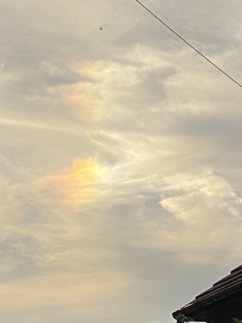
Here's a Sun Dog I snapped one evening last week.

sketch%20%282%29.png

Sun Dogs are seen when the sun's light is refracted by flat hexagon ice crystals drifting in the clouds.

sketch%20%285%29.png

In favourable conditions, if the cloud formation is right and no nearby objects get in the way, we may see a pair of Sun Dogs, 22° left and right of the sun, but this is rarer than seeing just the one.

They fall into the class of phenomena you don't notice until something or someone makes you aware and then you realise they are quite common and see them frequently. Sun Dogs are more often visible than rainbows and I spot them often, usually looking West as the sun is setting in a bank of thin high cirrus clouds. You can see them to the East at sunrise too, of course, it's just that I see sunset more often.

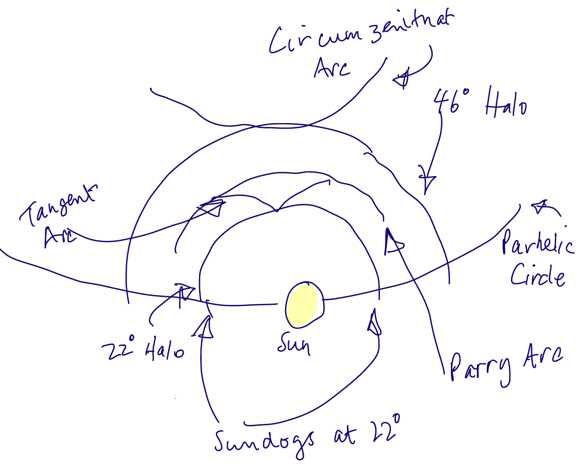
These Sun Dogs are just a small part of a whole complex of arcs and circles that have sometimes been observed, although unless we are in the mountains or in Antarctica we are unlikely to witness them. My sketch below only includes the best known halo-related phenomena; at least 119 have been documented.

sketch%20%286%29.png

Permalink
Share post
Richard Walker

On The Rainbow Bridge

Visible to anyone in the world
Edited by Richard Walker, Tuesday 11 August 2015 at 02:20

Last night at sunset I saw a beautiful iridescent cloud, the best example I have ever witnessed.

Sunset sky with a bright iridesent cloud

The photo was taken from my mobile phone and gives no idea at all really, but I hope you can just about see that the shiny cloud in the middle displays a range of bright pastel colours, rather like mother-of-pearl.

These clouds are quite rare. They are caused by sunlight shining through clouds whose water droplets (or ice crystals) are all the same size in any small part of the cloud but vary in size between one part of the cloud and another. They act a bit like an oil-slick on a puddle.

Atmospheric optics are an interest of mine. The most familiar example is a rainbow, but there are many others. Sun dogs are commoner than rainbows, but less conspicuous so many people have never noticed one. But as soon as you become aware of them, perhaps just from a single example, you learn to recognize the cloud conditions when it's worth trying to spot a sun dog.

Here is a gallery of remarkable photos of iridescent clouds.

Permalink Add your comment
Share post

This blog might contain posts that are only visible to logged-in users, or where only logged-in users can comment. If you have an account on the system, please log in for full access.

Total visits to this blog: 7016643