

This short post is a part of a larger writing project to create a helpful guide for tutors. Sometimes these posts share what might seem the blindingly obvious, but sometimes it is helpful to say the blindingly obvious. What follows is a set of useful definitions for some key terms and ideas.
Module codes
Module codes begin with a group of letters, and then have a group of numbers. The letters refer to a curriculum area, and the first number relates to the level of study. If you tutor computing modules, you will see modules that begin with M, modules that begin with T, and modules that begin with TM. M modules were historically hosted within the Maths and Computing Faculty, and the T modules were from the old Technology bit of the faculty.
Sometimes, you might see letter X, Y and Z in modules codes. These codes relate to either special projects, or special versions of modules. Don’t worry too much about what these codes mean; if you are working on a module with an unusual module code, your line manager will be able to help. Access level modules typically begins with the letter Y. If an access module contains the letters FT, this relates to a ‘fast track’ version of a module, where some students starts at a different date.
Access level modules have a number that begins with zero. Undergraduate modules contain numbers that begin with the numbers 1 through 3. Sometimes there is a level 4 module code, which is applied to special dissertation modules. Postgraduate modules, on the other hand, typically begin with the number 8.
Module presentations
Module presentation codes begin with a year, and then a letter. The letter is shorthand for the month in which a module presentation begins. If you take the first 12 letters for the alphabet, A = January, B = February, C = March, and so on. A module presentation code 29J is a module that begins in October 2029.
Academic credit
Modules are described in terms of academic credit. Academic credit is awarded for study that has been completed. To get a degree, students need to complete 360 points of academic credit. If students were to study at a full-time study intensity, 120 can be usually studied in one year. One academic credit point amounts to 10 hours of study. More information about how academic credit works can be found in the Curriculum blog.
FTE
Tutors are typically employed for a number of hours per calendar year, which is expressed in terms of FTE, or Full-time Equivalent. More details underneath the notion of FTE can be found in the article: Understanding your FTE.
Pedagogy
Pedagogy is one of those words that you will see a lot, but it is also one of those words that is rarely defined since there’s an assumption that everyone knows what it means. Pedagogy is knowledge of how to teach. Knowledge of pedagogy is implicitly expressed within the design of modules. It is also expressed through the work that tutors do, such as facilitating tutorials, marking assignments, answering questions, and working within others. A related term is andragogy, which means knowledge of how to teach adults. An important principle of andragogy is that adults have existing knowledge and experience, that can be used and shared to develop an understanding of module materials. An engineering module may well attract students who are practicing engineers. A skilled tutor will be able to draw on the experience of students in a way that enriches and contexualises module materials.
Reflective practice
Linked to pedagogy, there is the idea of reflective practice, which is (in my opinion) the biggest idea in education. It is, in fact, really very simple. Before teaching (whether this is facilitating a tutorial, or leaving feedback comments), it is important to reflect on (to have a careful think about) what needs to be done to enable students to understand something. After the teaching has taken place (enacting of practice), it is then important to reflect on (to have a careful think about) whether the teaching was success or not, and whether some refinements could be made to make it better. This reflection could be done informally, or formally through a scholarship project that might apply a methodology known as action research.
Learning outcomes
The concepts and ideas that are taught by modules are often described in terms of learning outcomes. A learning outcome is sometimes expressed in terms of knowledge and understanding of concepts, cognitive skills, and key skills (which may also be important within a workplace). In addition to module learning outcomes, there may well be programme level learning outcomes, which relate to name degrees. These higher level learning outcomes are often related to sector-wide educational norms, such as subject standards that are defined by the Quality Assurance Agency for Higher Education (QAA).
Constructive alignment
Constructive alignment is the idea that everything should work together. If the aim of a module is to help a student attain a set of learning outcomes, the assessment for that module should aim to assess whether its learning outcomes have been met. Tutorials should also be designed so they align with module learning outcomes as should the advice given to tutors by module teams. In turn, the feedback offered by tutors should also link back to knowledge and understanding, and skills that are expressed within learning outcomes.
Educational frameworks
Learning outcomes and constructive alignment are practical tools that help to structure module materials, and help us to begin to understand what we need to teach. These ideas represent the beginning of a bigger topic; education theories and frameworks. What follows are two frameworks that can be useful in understanding tutoring and tutoring practice. It the big ideas they present and embody that are important.
Laurillard’s conversational framework
Education is, ultimately, all about people. Tutors speak with students. Tutors speak with other tutors, and students speak with other students (through the VLE, through collaborative activities, or through social media).
Laurillard’s framework shows the variety of conversations that can take place.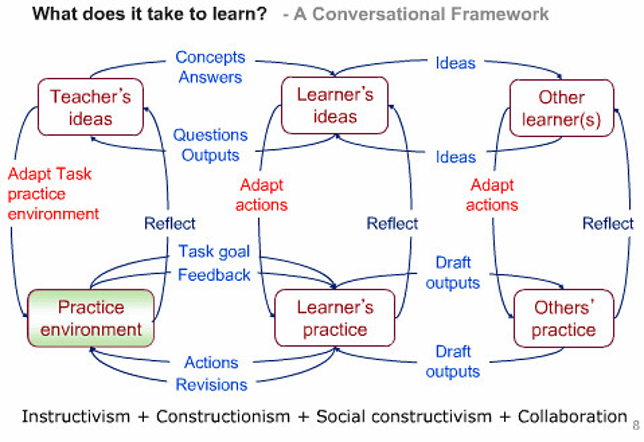
Figure 1: Laurillard’s conversational framework
Since it is a framework, it doesn’t predict what could happen. Instead offers an idea that can be used to understand teaching practice. It also implicitly emphasises the importance of belonging to an academic environment, a ‘practice environment’.
TPACK framework
I really like the TPACK framework by Mishra and Koehler because of its conceptual simplicity: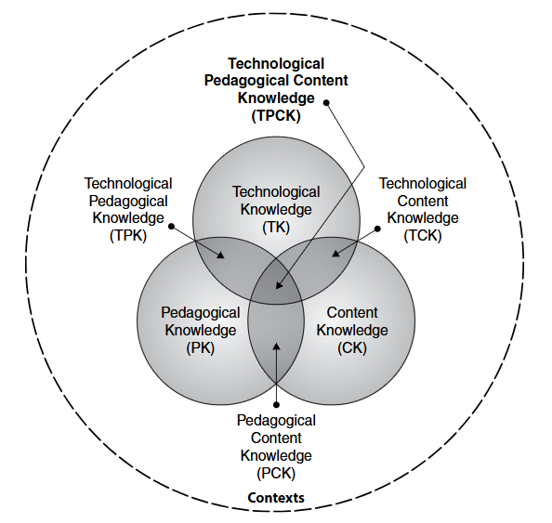
Figure 2: Mishra and Koehler’s TPACK model. See Herring, Koehler, and Mishra (2016).
When teaching using technology, you need to apply different types of knowledge. You need to know how to teach in a general sense (it is helpful to know something about learning outcomes and constructive alignment, for example). You need to know how to teach the difficult parts of your subject. You also need to know how to teach using your online teaching tools. You only become really effective as a tutor when each of these three aspects are combined together, as shown by the intersection in Figure 2.
Resources
The following OpenLearn course share further details about the role of reflection in education: Learning to teach: becoming a reflective practitioner.
Within the AL professional development section of your TutorHome pages, there is a useful VLE site called Reflective Toolkit for Teaching Practice. The theories and models of reflective practice section complements the earlier educational framework section.
Another resource that is both interesting and useful is the Supporting Open Learning (SOL) Theoretical Reader, which can be found within the Booklets and articles archive section of the AL Development section of TutorHome. Although the SOL booklets are now showing their age, they still have relevance.
References
Herring, M.C., Koehler, M.J. and Mishra, P. (2016) Handbook of technological pedagogical content knowledge (TPACK) for educators. Second edition. Routledge. Available at: https://doi.org/10.4324/9781315771328.
Mishra, P. and Koehler, M.J. (2006). ‘Technological pedagogical content knowledge: A new framework for teacher knowledge’. Teachers College Record, Vol. 108, No. 6, pp.1017–1054.
Laurillard, D. (2001) Rethinking University Teaching: A Conversational Framework for the Effective Use of Learning Technologies, Taylor & Francis.
Acknowledgements
Thanks are extended to Diana Laurillard who gave permission to share a presentation slide that was featured in an earlier blog post, published in 2009.