OU blog

Personal Blogs

Christopher Douce

Tutoring: key ideas

Visible to anyone in the world

This short post is a part of a larger writing project to create a helpful guide for tutors. Sometimes these posts share what might seem the blindingly obvious, but sometimes it is helpful to say the blindingly obvious. What follows is a set of useful definitions for some key terms and ideas.

Module codes

Module codes begin with a group of letters, and then have a group of numbers. The letters refer to a curriculum area, and the first number relates to the level of study. If you tutor computing modules, you will see modules that begin with M, modules that begin with T, and modules that begin with TM. M modules were historically hosted within the Maths and Computing Faculty, and the T modules were from the old Technology bit of the faculty.

Sometimes, you might see letter X, Y and Z in modules codes. These codes relate to either special projects, or special versions of modules. Don’t worry too much about what these codes mean; if you are working on a module with an unusual module code, your line manager will be able to help. Access level modules typically begins with the letter Y. If an access module contains the letters FT, this relates to a ‘fast track’ version of a module, where some students starts at a different date.

Access level modules have a number that begins with zero. Undergraduate modules contain numbers that begin with the numbers 1 through 3. Sometimes there is a level 4 module code, which is applied to special dissertation modules. Postgraduate modules, on the other hand, typically begin with the number 8.

Module presentations

Module presentation codes begin with a year, and then a letter. The letter is shorthand for the month in which a module presentation begins. If you take the first 12 letters for the alphabet, A = January, B = February, C = March, and so on. A module presentation code 29J is a module that begins in October 2029.

Academic credit

Modules are described in terms of academic credit. Academic credit is awarded for study that has been completed. To get a degree, students need to complete 360 points of academic credit. If students were to study at a full-time study intensity, 120 can be usually studied in one year. One academic credit point amounts to 10 hours of study. More information about how academic credit works can be found in the Curriculum blog.

FTE

Tutors are typically employed for a number of hours per calendar year, which is expressed in terms of FTE, or Full-time Equivalent. More details underneath the notion of FTE can be found in the article: Understanding your FTE.

Pedagogy

Pedagogy is one of those words that you will see a lot, but it is also one of those words that is rarely defined since there’s an assumption that everyone knows what it means. Pedagogy is knowledge of how to teach. Knowledge of pedagogy is implicitly expressed within the design of modules. It is also expressed through the work that tutors do, such as facilitating tutorials, marking assignments, answering questions, and working within others. A related term is andragogy, which means knowledge of how to teach adults. An important principle of andragogy is that adults have existing knowledge and experience, that can be used and shared to develop an understanding of module materials. An engineering module may well attract students who are practicing engineers. A skilled tutor will be able to draw on the experience of students in a way that enriches and contexualises module materials.

Reflective practice

Linked to pedagogy, there is the idea of reflective practice, which is (in my opinion) the biggest idea in education. It is, in fact, really very simple. Before teaching (whether this is facilitating a tutorial, or leaving feedback comments), it is important to reflect on (to have a careful think about) what needs to be done to enable students to understand something. After the teaching has taken place (enacting of practice), it is then important to reflect on (to have a careful think about) whether the teaching was success or not, and whether some refinements could be made to make it better. This reflection could be done informally, or formally through a scholarship project that might apply a methodology known as action research.

Learning outcomes

The concepts and ideas that are taught by modules are often described in terms of learning outcomes. A learning outcome is sometimes expressed in terms of knowledge and understanding of concepts, cognitive skills, and key skills (which may also be important within a workplace). In addition to module learning outcomes, there may well be programme level learning outcomes, which relate to name degrees. These higher level learning outcomes are often related to sector-wide educational norms, such as subject standards that are defined by the Quality Assurance Agency for Higher Education (QAA).

Constructive alignment

Constructive alignment is the idea that everything should work together. If the aim of a module is to help a student attain a set of learning outcomes, the assessment for that module should aim to assess whether its learning outcomes have been met. Tutorials should also be designed so they align with module learning outcomes as should the advice given to tutors by module teams. In turn, the feedback offered by tutors should also link back to knowledge and understanding, and skills that are expressed within learning outcomes.

Educational frameworks

Learning outcomes and constructive alignment are practical tools that help to structure module materials, and help us to begin to understand what we need to teach. These ideas represent the beginning of a bigger topic; education theories and frameworks. What follows are two frameworks that can be useful in understanding tutoring and tutoring practice. It the big ideas they present and embody that are important.

Laurillard’s conversational framework

Education is, ultimately, all about people. Tutors speak with students. Tutors speak with other tutors, and students speak with other students (through the VLE, through collaborative activities, or through social media).  

Laurillard’s framework shows the variety of conversations that can take place.The diagram shows how different communities of people interact. The people highlighted are: teachers, learners, and other learners. Teachers learn from each other, and share ideas. Learners learn from others.the diagram shows that everyone carried out reflection.
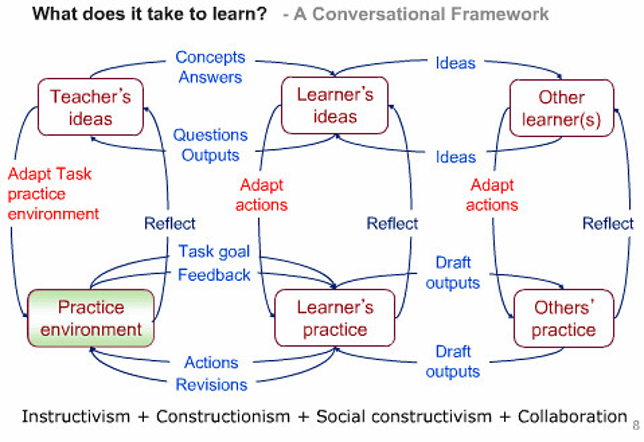
Figure 1: Laurillard’s conversational framework

Since it is a framework, it doesn’t predict what could happen. Instead offers an idea that can be used to understand teaching practice. It also implicitly emphasises the importance of belonging to an academic environment, a ‘practice environment’.

TPACK framework

I really like the TPACK framework by Mishra and Koehler because of its conceptual simplicity:A set diagram shows the intersection between technical knowledge, content knowledge and pedagogical knowledge.
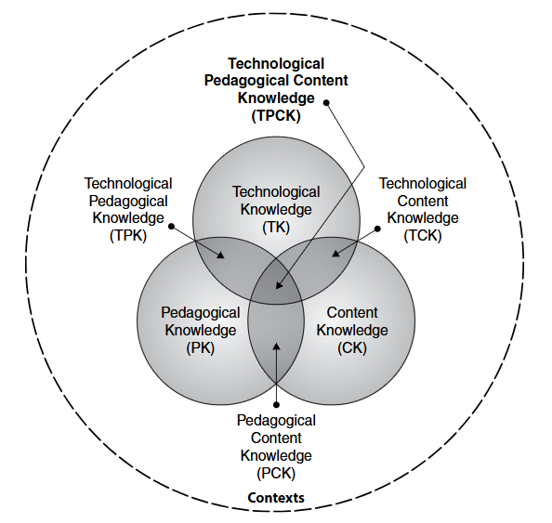
Figure 2: Mishra and Koehler’s TPACK model. See Herring, Koehler, and Mishra (2016).

When teaching using technology, you need to apply different types of knowledge. You need to know how to teach in a general sense (it is helpful to know something about learning outcomes and constructive alignment, for example). You need to know how to teach the difficult parts of your subject. You also need to know how to teach using your online teaching tools. You only become really effective as a tutor when each of these three aspects are combined together, as shown by the intersection in Figure 2.

Resources

The following OpenLearn course share further details about the role of reflection in education: Learning to teach: becoming a reflective practitioner.

Within the AL professional development section of your TutorHome pages, there is a useful VLE site called Reflective Toolkit for Teaching Practice. The theories and models of reflective practice section complements the earlier educational framework section.

Another resource that is both interesting and useful is the Supporting Open Learning (SOL) Theoretical Reader, which can be found within the Booklets and articles archive section of the AL Development section of TutorHome. Although the SOL booklets are now showing their age, they still have relevance.

References

Herring, M.C., Koehler, M.J. and Mishra, P. (2016) Handbook of technological pedagogical content knowledge (TPACK) for educators. Second edition. Routledge. Available at: https://doi.org/10.4324/9781315771328.

Mishra, P. and Koehler, M.J. (2006). ‘Technological pedagogical content knowledge: A new framework for teacher knowledge’. Teachers College Record, Vol. 108, No. 6, pp.1017–1054.

Laurillard, D. (2001) Rethinking University Teaching: A Conversational Framework for the Effective Use of Learning Technologies, Taylor & Francis.

Acknowledgements

Thanks are extended to Diana Laurillard who gave permission to share a presentation slide that was featured in an earlier blog post, published in 2009.
Permalink Add your comment
Share post
Christopher Douce

Formative e-assessment dissemination day

Visible to anyone in the world
Edited by Christopher Douce, Tuesday 3 November 2026 at 11:26

A couple of weeks ago I was lucky enough to be able to attend a 'formative e-assessment' event that was hosted by the London Knowledge Lab.  The purpose of the event was to disseminate the results of a JISC project that had the same title.

If you're interested, the final project report, Scoping a Vision for Formative e-Assessment is available for download.  The slides for this event are also available, where you can also find Elluminate recordings of the presentations.

This blog post is a collection of randomly assorted comments and reflections based upon the presentations that were made throughout the day.  They are scattered in no particular order.  I offer them with the hope that they might be useful to someone!

Themes

The keynote presentation had the subtitle, 'case stories, design patterns and future scenarios'.  These words resonated strongly with me.  Being a software developer, the notion of a design pattern (wikipedia) is one that was immediately familiar.  When you open the Gang of Four text book (wikipedia) (the book that defines them), you are immediately introduced to the 'architectural roots' of the idea, which were clearly echoed in the first presention.

The idea of a pattern, especially within software engineering, is one that is powerful since it provides software developers with an immediate vocabulary that allows effective sharing of complex ideas using seemingly simple sounding abstractions.  Since assessment is something that can be described (in some sense) as a process, it was easy to understand the objective of the project and see how the principle of a pattern could be used to share ideas and facilitate communication about practice.

Other terms that jumped out at me were 'case stories' and 'scenarios'.  Without too much imagination it is possible to link these words to the world of human-computer interaction.  In HCI, the path through systems can be described in terms of use cases, and the settings in which products or systems could be used can be explored through the deployment of descriptive scenarios and the sketching of storyboards.

Conversational framework

A highlight of the day, for me, was a description of Laurillard's conversational framework.  I have heard about it before but have, so far, not had much of an opportunity to study it in great detail.  Attending a presentation about it and learning about how it can be applied makes a conceptual framework become alive.  If you have the time, I encourage you to view the presentation that accompanies this event.

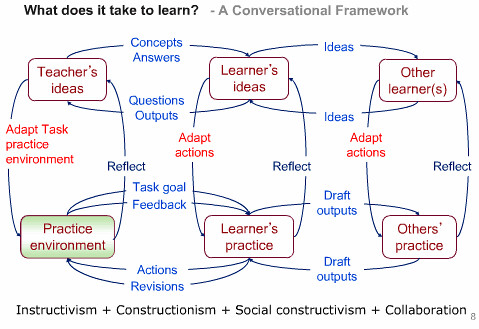
I'm not yet familiar enough with the model to summarise it eloquently, but I should state that it allows you to consider the role of teachers and learners, the environment in which the teacher carries out the teaching, and the space where a learner can carry out their own work.  The model also takes into account of the conversations (and learning) that can occur between peers.

Representation of the confersational framework which presents space for teacher, learner and other pratice and links between teacher, student and peers, indicating the types of conversations that can facilitate learning

During the presentation, I noted (or paraphrased) the words: 'the more iterations through the conversational model you do, the higher the quality of the learning you will obtain'.  Expanding this slightly, you could perhaps restate this by saying, 'the more opportunities to acquire new ideas, reflect on actions and receive feedback, the more familiar a learner will become with the subject that is the focus of study'.

In some respects, I consider the conversational framework to be a 'meta model' in the sense that it can (from my understanding) take account of different pedagogical approaches, as well as different technologies.

Links to accessibility

Another 'take away' note that I made whilst listening to the presentation was, 'learning theories are not going to change, but how these are used (and applied) will change, particularly with regards to technology'.

It was at this point when I began to consider my own areas of research.  I immediately began to wonder, 'how might this model be used to improve, enhance or understand the provision of accessibility?'  One way to do this is to consider each of the boxes the arrows that are used to graphically describe the framework.  Many of the arrows (those that are not labelled as reflections) may correspond to communications (or conversations) with or between actors.  These could be viewed as important junctures where the accessibility of the learning tools or environments that could be applied need to be considered.

Returning to the issue of technology, peers, for instance, may share ideas by posting comments to discussion forums.  These comments could then be consumed by other learners (through peer learning) and potentially permit a reformulation or strengthening of understandings.

Whilst learning technologies can permit the creation of digital learning spaces, such as those available through the application of virtual learning environments, designers of educational technologies need to take account of the accessibility of such systems to ensure that they are usable for all learners.

One of my colleagues is one step ahead of me.  Cooper writes, on a recent blog post,  'Laurillard uses [her framework] to analyse the use of media in learning. However this can be further extended to analyse the accessibility of all the media used to support these different conversations.'  The model, in essence, can be used to understand not only whether a particular part of a course is accessible (the term 'course' is used loosely here), but also be used to highlight whether there are some aspects of a course that may need further consideration to ensure that is as fully inclusive at it could be.

Returning to the theme of 'scenario', one idea might be to use a series of case studies to further consider how the framework might be used to reason about the accessibility status of a course.

Connections

There may be quite a few more connections lurking underneath the terms that were presented to the audience.  One question that I asked to myself was, 'how do these formative assessment patterns relate to the idea of learning designs?' (a subject that is the focus of a number of projects, including Cloudworks, enhancements to the Compendium authoring tool, the LAMS learning activity management system and the IMS learning design specification).

A pattern could be considered as something that could be used within a part of a larger learning design.  Another thought is that perhaps individual learning designs could be mapped onto specific elements of the conversational model.  Talking in computing terms, it could represent a specific instantiation (or instance).  Looking at it from another perspective, there is also the possibility that pedagogical patterns (whether e-assessment or otherwise) may provide inspiration to those who are charged with either constructing new or using existing learning designs.

Summary

During the course of the day, the audience were directed, on a number of occasions to the project Wiki.  One of the outcomes of the project was a literature review, which can be viewed on-line.

I recall quite a bit of debate surrounding the differences between guidelines, rules and patterns.  I also see links to the notion of learning designs too.  My understanding is that, depending on what you are referring to and your personal perspective, it may be difficult to draw clear distinctions between each of these ideas.

Returning to the issue of the conversational model being useful to expose accessibility issues, I'm glad that others before me have seen the same potential connection and I am now wondering whether there are other researchers who may have gone even further in considering the ways that the framework might be applied.

In my eyes, the idea of e-assessment patterns and the notion of learning designs are concepts that can be used to communicate and share distilled best practice.  It will be interesting to continue to observe the debates surrounding these terms to see whether a common vocabulary of useful abstractions will eventually emerge.  If they already exist, please feel free to initiate a conversation.  I'm always happy to learn.

Acknowlegements

Thanks are extended to Diana Laurillard who gave permission to share the presentation slide featured in this post.

Permalink
Share post

This blog might contain posts that are only visible to logged-in users, or where only logged-in users can comment. If you have an account on the system, please log in for full access.

Total visits to this blog: 4670652