OU blog

Personal Blogs

Stylised image of a figure dancing

You found me

Visible to anyone in the world
Edited by Martin Cadwell, Monday 12 October 2026 at 17:58

All my posts: https://learn1.open.ac.uk/mod/oublog/view.php?u=zw219551

or search for 'martin cadwell -caldwell' Take note of the position of the minus sign to eliminate caldwell returns or search for 'martin cadwell blog' in your browser. There is a space between my name and the minus sign and NO space before 'caldwell' to eliminate the name 'caldwell' in the Google listings

I am not on YouTube or social media

Cadwell NOT Caldwell

Opinion

Tacit consent by way of the back door

[ 4 minute read ]

I think if we take all the digital interactions we are nudged into making and put them in a mixing bowl, with the essential idea not to put anything else in, such as emotion, and we bake the mess, we would pull from the oven a policy to collect data on every movement we make. The smell in the kitchen is not one of fondness or care such as a grandmother might make with cinnamon and icing sugar; it is a smell like a disc-cutter makes when cutting steel, or the smell of a slipping clutch on a vehicle passing by with the handbrake still on.
Just the idea of the acrid and pungent aftertaste in my mouth once the bolus is swallowed elicits feelings of absorbing carcinogenics in me. I think, this drive to profile each of us, while projecting a smooth veneer of compatibility with our modern lifestyles, once cracked the inner stuff is of worms and gaping maws of razor-sharp fangs. 
This last weekend I heard an LBC presenter make a brief exclamation of surprise. He noted on air that in October 2027 there will be a 'tax' on, I think he started his piece by saying drinks containers such as plastic bottles and tins or cans of 'pop'. As he padded out his startled piece I started to think he was including all tins and cans since he included glass as one of the things that would be taxed at the source. By 'taxed' I mean a surcharge of either 20p or 20% would be charged on every item that passes through a checkout or is otherwise bought, that is products that are packaged in glass, metal, or plastic. Apparently, this extra cost would be redeemed at specific recycling collection points. The presenter moved on, no doubt because he and his research team were blindsided by this revelation, and they would need to properly research the implications and how it is to be implemented.
I set to turning an imagined future over in my head. How would this impact on my life? I live in a village and so I would need to lug all my glass and empty tins to my local city, How would I be able to collect the returns money? It dawned on me then that it would necessarily go into my bank account and that due to the British public's tacit agreement to being filmed everywhere we go, there would be cameras at every collection point; just like the cameras at the bank ATMs. So, in with my card and the pin (obviously!) and look sweetly at the camera without a face-mask. Facial recognition. It would not matter that I do not carry a GPS tracking device in the form of a phone, my precise location will be known simply because I am not rich enough to avoid being tracked.
I dwelt on the way that the charge would be made. It would necessarily be twenty pence and not 20% of the product price. Everything recycled in this way would otherwise still have a barcode still attached and it would need to be scanned into the recycling machine. Waitrose coffee is more expensive than LIDL coffee and costs more in the south than in the north of England. Surely, reading barcodes and returning 20% of the purchase price is unworkable. The retailer would take the surcharge and then have to submit it to the government so the government can give it back to the recycling shopper, surely. That is expensive to implement on a national scale. It also means that the barcode meta-data held in computers necessarily needs to include information on the packaging. That is expensive for small retailers to have; they would need to maintain a continuous subscription to a bar-code data bank and a live and highly reliable and super-fast internet connection to check every single product during every transaction. Moreover, it must be unbreakable. A faulty internet connection would shut an entire shop or supermarket. Any competent bad actor could paralyse the country's food supply. Those vegetables in the wafer-thin plastic bag cannot possibly be considered to have packaging that can be recycled. Packaging that is definitely NOT bio-degradable. Scales at the recycling point would need to be frequently calibrated. I mean two cabbages have two plastic wrappers and if fifty of these are shoved in a recycling point 'bin' and weighed, the payment might only be for forty eight. That is a 40 pence loss to the customer. If not another thin wedge to add to a reason to riot then an angry driver who will be prone to road-rage.
No, I am certain that someone somewhere had a problem to solve. 'Look team. Not everyone uses the self-checkout in the larger supermarkets and not everyone face-times their family, so we have an incomplete 'picture' of the British population. We can't force them to do those things at present so what can we do?'
       'Make them pay a redeemable surcharge under the auspices that they do not recycle properly. We can film them while we read their bank cards at specific collection points for recycled packaging.'
 The 'tell' will be the absence of alternative packaging. I buy coffee in a glass jar. I would buy loose coffee from a vending machine that dumps it into a container I brought with me. Tinned tomatoes; a bit more tricky. We will never see vending machines dispensing loose produce, such as we used to see loose muesli mix in health food shops. They will inevitably always be banned on Health and Safety grounds. Personally, I would definitely go into a 'store / warehouse' full of vending machines that dispense cornflakes and milk and sugar and stuff. Logistically, it takes too long for each customer to receive their selection; there would be long queues and the 'warehouse stores' would necessarily need to be jointly-owned by the manufacturers that dispense their products (they save on the cost of packaging).
It is a dystopian world I paint; one that with precise positioning of the dispensing spouts, robots would inhabit. If  humans were to be anywhere they would be in their precisely parked cars; shifted by stepper-motors upon arrival in the car-park into slots. Robots would deliver carts of loose produce in bins with scoops chained to the bins. The customer would then transfer their purchases into their own containers and let the car drive them home. This would need to be in a car-park with a roof and probably heated too. Oh, they would need to look into a camera while their bank card is read to get into the car-park before they make their selections. Might we see mobile traders with analogue scales driving steam-powered vehicles in our streets dispensing loose product to householders who hearing their bell flock to their vehicles? 'Stop me to buy some!' The closest you might get to being filmed or noticed is a curious child's eye who doesn't speak our language sitting on the lap of a woman in the dark recesses of the van.
Interestingly, the LBC presenter did not mention cardboard as a packaging that will attract a surcharge. It absorbs water and weight and is of course, biodegradable. Is there not a prevailing presence of cardboard in supermarkets?

 
 
Permalink Add your comment
Share post
Stylised image of a figure dancing

Moving too fast without smuggled frog-spawn

Visible to anyone in the world
Edited by Martin Cadwell, Thursday 19 March 2026 at 15:12

All my posts: https://learn1.open.ac.uk/mod/oublog/view.php?u=zw219551

or search for 'martin cadwell -caldwell' Take note of the position of the minus sign to eliminate caldwell returns or search for 'martin cadwell blog' in your browser.

I am not on YouTube or social media

silhouette of a female face in profile 


[ 8 minute read ]

Elements throughout this post tie in with the Tuesday 17th March 2026 'Why did they suddenly brake?' post on pressing SNOOZE, braking distances, foreign holidays and English Summers. (Tags: English Summer, snooze, holiday, micro-sleep, alert)

What are you up to?

     'What you got there then? Been newting?' I asked.

It just came out as I cycled up behind a man carrying a black plastic bucket. I didn’t know him and had never seen him before. He visibly jumped in surprise. Most people can hear my bicycle tyres on the lane, but he didn't. I suppose the surprise of a man on a bike suddenly by his side and the, what turned out to be, very direct and relevant line of questioning caused him to answer with words that surprised me in return.

     'I have been collecting frog-spawn. It is illegal to collect it now, but I shall maintain that I am relocating it to my pond.' I assumed he meant his pond in the back of his garden. But I was a little confounded that he was confessing to a crime to someone who may just work for the Environment Agency. Who else would ask about 'newt-napping’ with no preamble or introduction? Amazing!

We fell to chatting and named ourselves. He was alarmed that I used to drive at 65mph on motorways in one of my vans while thinking about how I could improve my business. That, to him, was indicative of someone in dire straits and driving too fast to fulfill a contract they were late for. Why would anyone think that? It turned out he used to be an upholsterer and sometimes he had to deliver his finished chairs or things in a van. He considered, it seemed to me, that the slow and easy pace of upholstering also requires gently allowing a van to roll merrily along back roads and giving way to proud Shire horses pulling large open farm wagons (wains).

There is the difference between us; it was my job to be efficient, and everything I could control in my job was firmly in transport and logistics. His job, on the other hand was about fine finishing. 

     '65mph is quite fast enough for me', he said. 'Me too', I thought, because it costs exponentially more money the faster we drive while the extra time saved for each extra unit of speed diminishes.

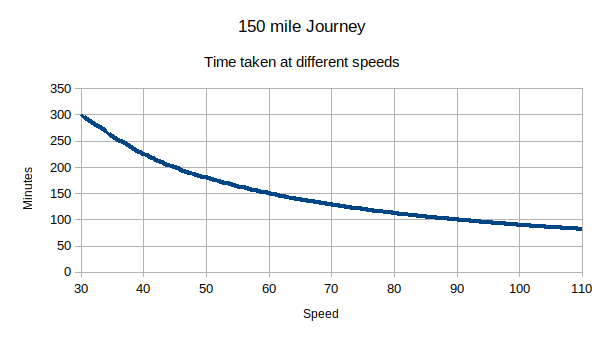
Let me tell you that it is only at the lowest speeds of travel that the greatest savings in time is made. Assuming one can drive at a constant speed for 150 miles we can see the amount of time saved diminishes as the speed rises:

sketch%20%281%29.png

30 mph – 5 hours

40 mph – 3 hours and 45 minutes (75 minutes quicker than 30 mph)

47 mph - 3 hours and eleven minutes

50 mph – 3 hours (45 minutes quicker than 40 mph)

60 mph – 2 hours 30 minutes (30 minutes quicker than 50 mph)

70 mph – 2 hours and 9 minutes (21 minutes quicker than 60 mph)

80 mph – 1 hour 53 minutes (16 minutes quicker than 70 mph)

90 mph - 1 hour 40 minutes (13 minutes quicker than 80 mph)

100 mph -  1 hour 30 minutes (10 minutes quicker than 90 mph)

110 mph - 1 hour and 22 minutes (8 minutes quicker than 100 mph)

Remember this is at a constant speed over 150 miles.

All well and good, if you can actually drive at those speeds from your doorstep to your destination. In France, on the motorways you can. In the real world in the UK, you need to drive exclusively on motorways and dual carriageways at night and with no other traffic delays for those timings to be considered useful. Our road network and traffic flow just isn't like France though. In the UK, I used to drive from a town right next to the A1 (The 'Old North Road' - Ermine Street - goes through that town) with excellent North, South, East and West roads local to the town, to all parts of the UK, and drive to all parts of Europe, doing 65 mph whenever I could, and the average speed over 10,000 miles, according to my dedicated SatNav, was just 47mph. 

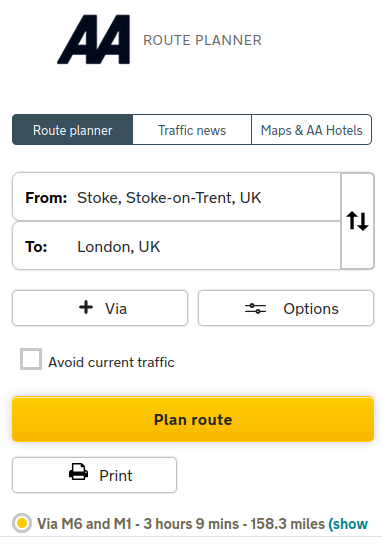
See the AA Route Planner image below for a route from Stoke-on-Trent to central London, that is mostly on motorways. (3 hrs and 9 mins for 158 miles) which is very close to an average 47 mph. Stoke is connected to the M6 by the dual carriageway A500 at Jct 15.

In Town, outside ALDI, I met a man with a £10,120 electric bicycle that does 30 mph. In the UK, it should only be able to reach 15.5 mph, he told me; but by using a VPN (Virtual Private Network) on his digital internet device, he managed to get it sent from China. I think that means it avoids some kind of check on it, even import duty if the value is so high. Isn't that smuggling? It, like many mountain bikes had a small front sprocket so a very low gear could be engaged to get up those really, steep hills. But it has a seemingly unrestricted electric motor to make this happen! Another cyclist came along with a small front sprocket on his bike and the two of them rattled on about stuff that just went straight over my head. I did manage to hear that the electric motor on the £10,120 electric bicycle was a top of the range one. The whole bicycle is more expensive than a secondhand, 2009 Kawasaki ZZR1400 that has done 11,863 miles, for sale in 'Exchange and Mart' for £5,590; a 2024 Honda CBR650R with 2,196 miles on it, for £6,990; or a brand new moped for less than £3,000.

It seems there is no accounting for taste. From illegally collecting frog-spawn (he only guessed the gloop he gathered is frog-spawn) to illegally importing an electric mountain bike, I come to tax and insurance dodgers.

The UK Government, I heard, intends to crack down on online-sellers to seek lost revenue from tax evaders. As a process to glean more revenue, it might just work. As a device to make the UK population pay more for even more stuff it will indubitably succeed. Yet, on the DuckDuckGo index pages, which reads the Google indexing and others, the 'postoffice.co.uk' entry has 'Start your online selling side hustle with our guide.' to attract 'beginner' online-entrepreneurs to its site. I am pretty sure a 'side hustle' is a slang term used to denote a personal income that is beyond or outside of normal and regulated work activities. If you own a sawmill and openly sell planks with invoices and pay appropriate taxes, the side hustle is selling the normally wasted sawdust to pet owners and stables for cash, 'under the table' so to speak, or as a 'back-hander' in other words, not declaring the sales to the tax collector in the relevant country. A side hustle is not a legitimate business, is it?

I have a very eager chap who keeps phoning me to try to get me to take on a delivery contract. He expected me to give a 'yes' or‘no’ over the phone a couple of days ago. Of course, I told him that I would need to start a new spreadsheet and link it to a number of other spreadsheets to ascertain the feasibility of his offer. It really comes down to opportunity cost, with money thrown into the lengthy equations. One of the key factors for self-employment in transport and logistics is insurance, specifically commercial insurance for a motor vehicle; Goods in Transit insurance; and Public Liability insurance. It took me about five minutes to see that the job wasn't really for me as it stands. However, 48 hours later, I am still adjusting and rewriting whole sections of spreadsheets to fit in any new opportunity, as a value adding programme for new avenues of revenue (in this case, offsetting costs). Even though, I declined the contract, he has phoned me three more times. I don't answer his calls because I still haven't satisfied myself that I have examined all the facets of a myriad of new opportunities and their future viability that such a contract throws up. Just like students flipping burgers to pay for a new future, I have to consider doing undesirable jobs or contracts if they might provide a route to a more favourable position. Money, in my head, is not really measured as having value, as much as it is for its utility (what it can be used for).

Let me explain: Taking on a new contract such as the one I am currently assessing will mean hiring a van. Hiring a van is a fixed cost that heavily impacts on any income stream a new contract provides. Normally, this would be enough to determine whether a contract as a single enterprise is feasible. But feasible doesn't end with 'money in' and 'money out' calculations. The cost of a hire vehicle can be offset by the poor but adequate revenue from a new contract, which means that any other low revenue contract that uses the same van considered as solely providing income, with only the variable cost of fuel to be considered, and of course, time. In the current financial climate there is no choice but to hire only an EV (electric vehicle).

However, time is also a fundamental issue. How much time, as a resource, is used? Time spent 'here', is time that cannot be spent elsewhere. Much as I like to quickly and easily generate income, I also, am not about to skip doing diligent research into paying tax and insurances; nor will I be driving too fast to save useless time; start smuggling; or take protected wildlife in my spare time.

***

According to the BBC web page for Thursday 19th March 2026: 'Stretching 2,689 miles, the world's longest coastal path opens in England' - (About 80% of the route is now open and most of the rest of the path is due to be completed by the end of the year.)'

'The new English coast path links with the Wales Coast Path - an 870-mile route encircling the Welsh coastline. It was completed in 2012 and was the first path in the world to follow an entire national coastline.

There is no single official coastal trail in Scotland, though much of the shoreline is accessible thanks to Scotland's "right to roam" law passed more than 20 years ago. Estimates of its mainland coastline vary depending on how it is measured, but it is often put at around 5,500 miles.

Taken together, a continuous coastal walk around Britain would therefore total some 9,000 miles. At an average of 15 miles a day, it would take almost two years to complete, assuming no rest days.'

For context: The flight route to Perth in Western Australia is about 9000 miles from London, UK.

Now, a trip around Britain including the new 'King Charles III England Coast Path' is an experience I just might be attracted to, tent and sleeping bag and all. 10 mph on a bicycle, where allowed, would take 900 hours, or over a month if you never sleep. A 14 hour cycle ride at 10 mph every day would be 64 days.

Permalink Add your comment
Share post

This blog might contain posts that are only visible to logged-in users, or where only logged-in users can comment. If you have an account on the system, please log in for full access.

Total visits to this blog: 984641