

What twenty-first-century technology has taught me about the learning theories I studied at the Open University.
What do I miss from the old days?
Not much, as it happens.
I’ve lived through the Moon landings, the arrival of personal computers, the Internet, the World Wide Web, smartphones and now artificial intelligence.
I’m 65, and I hope to witness another thirty years of extraordinary technological change.
But there’s one experience I remember with particular affection.
Getting lost in a library.
As an undergraduate at Oxford, I could spend days following a question through the Bodleian, the Science Library, the Map Room, the Rhodes Library and the reading rooms containing historical newspapers.
One reference led to another.
A journal suggested a map. The map raised another question. A footnote sent me searching for something entirely unexpected.
I loved it.
One particularly memorable expedition involved an essay I’d chosen to write about breastfeeding.
I wanted to investigate its historical, anthropological, physiological and educational significance.
How did mothers and infants learn to breastfeed? How did the experience differ across cultures? What did biology determine, and what was socially learned?
It sent me everywhere.
Among my discoveries was the hormonal mechanism through which breastfeeding could delay ovulation.
Several years later, in April 1988, I was back in Newcastle, working as a television producer.
My sister had a six-month-old baby boy.
Naturally, I enthusiastically shared what I’d learned about breastfeeding and fertility.
I must have been convincing.
The following February, she gave birth to a daughter.
She’s blamed me ever since.
Apparently, she had understood my explanation to mean that breastfeeding would reliably prevent another pregnancy.
It doesn’t.
My sister went on to have five children and now has seven grandchildren.
But I still get the blame.
Quite a result for an undergraduate essay.
From library shelves to learning theory
When I began studying for my Masters in Open and Distance Education at the OU, I became fascinated by the theories that might explain what was happening when we learned.
Constructivism. Social constructivism. Situated learning. Communities of practice. Activity theory. Metacognition.
I devoured them.
Looking back, my Oxford library expeditions provide an interesting example of several of these ideas in practice.
I wasn’t simply receiving information.
I was actively constructing an understanding, drawing connections between disciplines, testing explanations and discovering that each answer generated further questions.
The libraries, catalogues, books and maps were tools.
My tutors and fellow students were part of a community.
The academic disciplines had their own conventions, assumptions and expectations.
And I was trying to produce something meaningful from the interaction.
Sound familiar?
Engeström enters the room
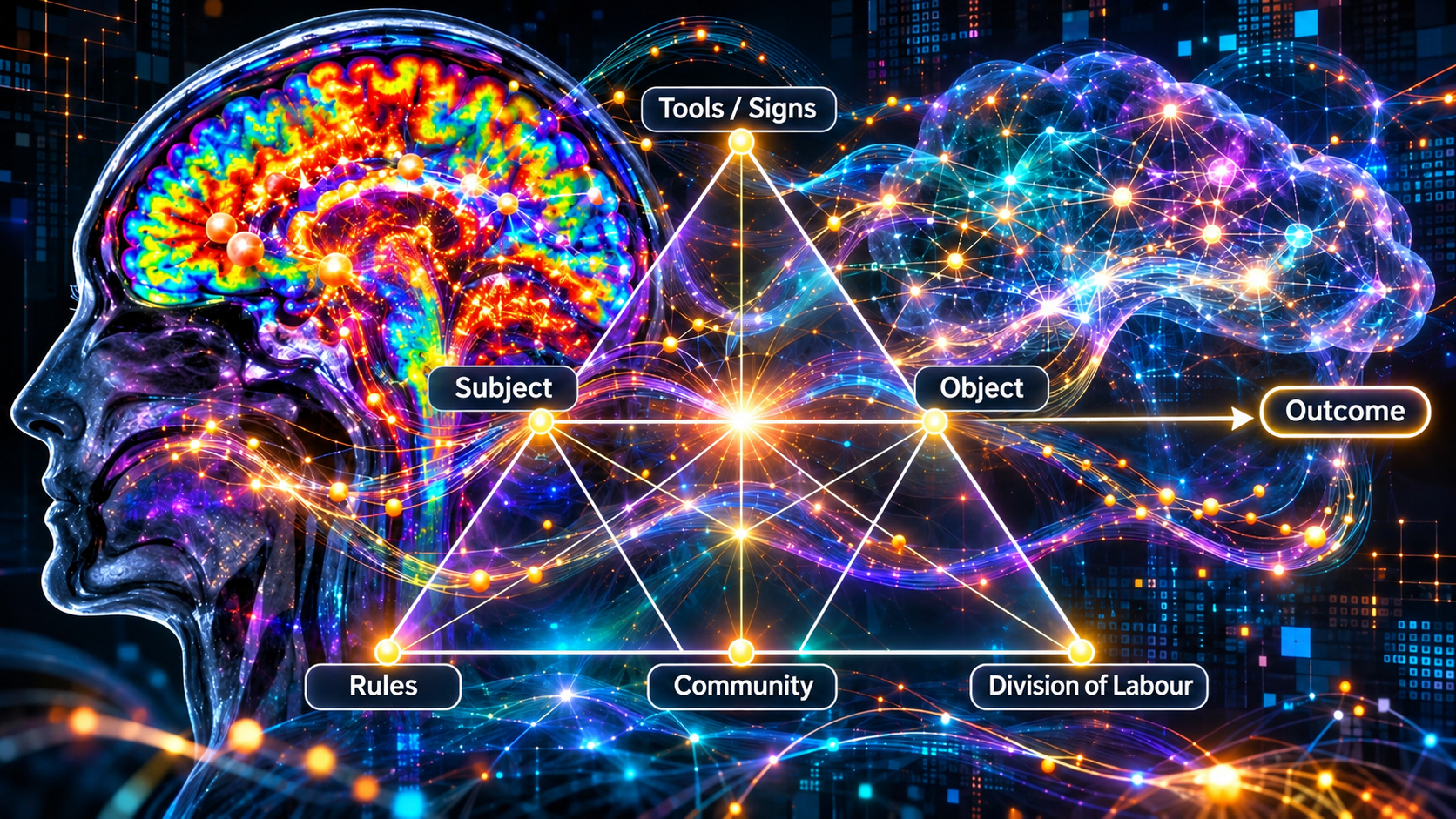
Yrjö Engeström’s Activity Theory model particularly appealed to me.
It offered a way of understanding learning not simply as something happening inside an individual’s head, but as an activity mediated by tools, social relationships, rules and shared objectives.
The familiar triangle had its subject, object, tools, community, rules and division of labour.
I could use it to examine my undergraduate research.
And I can use it again today.
Only the tools have changed.
Instead of searching catalogues and travelling between libraries, I might begin with a question to an AI.
The AI retrieves, explains, compares, challenges and suggests connections.
I respond.
It responds.
Another question emerges.
And off we go again.
Except that Engeström’s model also encourages us to consider contradictions.
A tool that gives me immediate access to information might also encourage me to accept an answer before properly examining it.
Something that makes research easier might make certain intellectual shortcuts more tempting.
An AI capable of proposing a plausible explanation might also produce one that is completely wrong.
The tool changes the activity.
And the activity changes how I learn.
The curious case of my AI companion
Here’s something that made me smile.
I’ve recently been using AI to explore an archive of more than 3,750 entries from my OU student blog.
In March 2013, I wrote a post titled:
“Right now I need an AI Companion.”
Thirteen years later, here I am.
I have one.
Well, something approaching what I imagined.
And I find myself returning to questions I was asking during my MAODE studies.
What constitutes meaningful interaction?
Can a machine provide useful scaffolding?
Where does the learner’s agency reside?
What is the relationship between receiving an explanation and developing an understanding?
When does reflection become learning?
What happens when the technology can participate in something resembling a tutorial dialogue?
And perhaps most importantly, how do I know when I’ve actually learned something?
A billion ping-pong balls
Early this morning, I was discussing these ideas with an AI.
One recollection prompted another. I remembered my grandfather learning to fly in 1918, my Oxford libraries, my sister’s unexpected baby, the educational technologies we experimented with during my Masters, and the extraordinary possibilities of AI.
My brain felt as though a billion ping-pong balls were ricocheting around a nuclear reactor hall.
Ideas everywhere.
Connections forming.
Questions multiplying.
I was having a wonderful time.
And suddenly I recognised the experience.
It was remarkably like getting lost in those Oxford libraries.
Not identical, of course.
There’s no substitute for the physical presence of other people, the unexpected conversation, the tutorial, the argument over a whiteboard or the sensory experience of books and places.
But the intellectual excitement was familiar.
It also made me reconsider the educational technologies we experimented with during the MAODE.
Some now seem almost comically crude.
Yet the questions we were asking about learning design, social interaction, learner autonomy and the mediation of learning remain remarkably relevant.
Perhaps more relevant than ever.
What comes next?
I’ve begun imagining a new kind of library.
Not simply shelves of books, but galleries, archives, studios, music, games, laboratories, swimming pools, places to eat, and spaces for conversation and argument.
Somewhere people could learn through every available medium.
A physical community connected to an almost limitless digital world.
A place where an unexpected encounter might lead to an entirely new intellectual adventure.
It’s beginning to look suspiciously like the Oxbridge campus I enjoyed so much.
But I’d want it to be open to everyone.
And perhaps that’s the most important connection to my Open University experience.
The opportunity to participate in learning shouldn’t depend upon age, background, income or whether you’ve ever attended a university.
Technology can widen that opportunity.
But technology alone doesn’t create a learning community.
People do.
So what do I miss from the old days?
The pleasure of getting lost in knowledge.
Except that I haven’t really lost it.
I’ve simply found another way to wander.
And I’d love to know whether other OU graduates feel the same.
Has technology fundamentally changed the way you learn, or has it simply given your curiosity new places to explore?
References and further reading
Engeström, Y. (1987). Learning by Expanding: An Activity-Theoretical Approach to Developmental Research.
Engeström, Y. (2001). ‘Expansive Learning at Work: Toward an Activity-Theoretical Reconceptualization.’ Journal of Education and Work, 14(1), pp. 133–156.
Vygotsky, L. S. (1978). Mind in Society: The Development of Higher Psychological Processes.
Related reading: The Art of Getting Lost — the longer, personal version of this story on JVernon.blog.