

Ramsey's theorem (1928) says that if all the elements of a big enough system are assigned to one one of a finite set of colours, there must exist a structured subsystem with elements all the same colour.
For concrete example suppose the system consists of points and edges joining each pair of points, usually called the "complete graph " and we have colours Red and Blue. Every set of points and the edges between them forms a triangle. The theorem asserts that if \n\) is big enough there must be a monochromatic triangle, one with its edges all Red or all Blue.
Here I previously presented a rather nice proof that 'big enough" means and that there must in fact be exactly monochromatic triangles in that case.
Ramseys seminal paper and related results published around the same time launched a whole sub-branch of combinatorial mathematics called Ramsey Theory, and it wasn't all that long before some "anti-Ramsey" or "Rainbow" theorem emerged. A pioneering paper this topic was by Erdos et al in 1973 and new results continue to be published to this day.
The idea of an anti-Ramsey theorem is that instead of proving a big enough system will contain monochromatic subsystems, we prove that big enough systems may also contain rainbow subsystems, ones all of whose elements are different colours.
So here is a neat proof of a small example.
Theorem: If the edges of the complete graph are coloured using colours, with each colour appearing at least once, there must be a rainbow triangle with edges of different colours.
Proof:
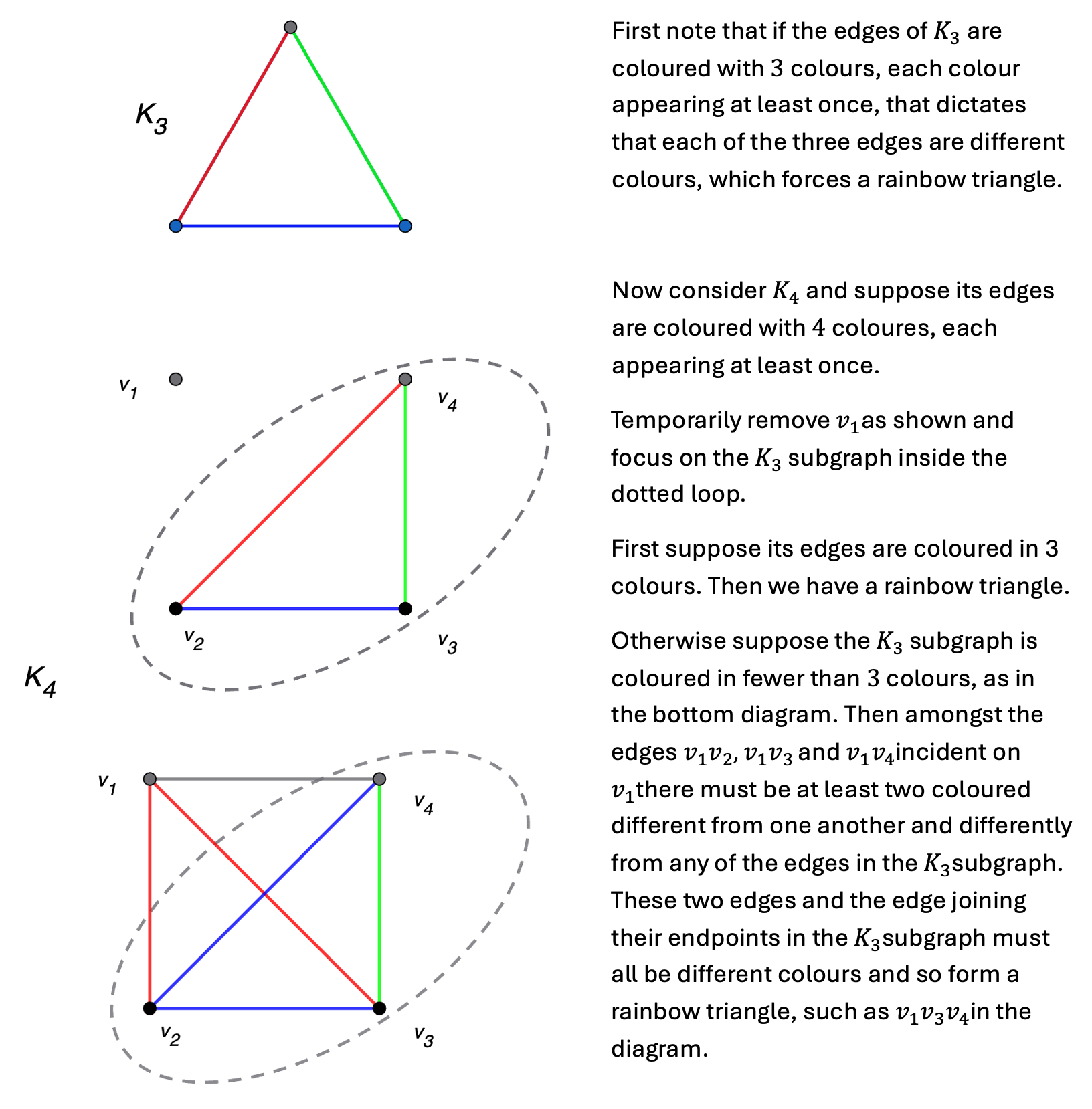
This proof can be extended to that case of colours used to colour the edges of . Can you see how?
F P Ramsey (1928) On a problem of formal logic, https://www.cs.umd.edu/~gasarch/BLOGPAPERS/ramseyorig.pdf
Paul Erdős, Miklós Simonovits, and Vera T. Sós (1973) Anti-Ramsey theorems.