In his Natural History Pliny the Elder wrote of Druids venerating oak trees and and climbing them on the sixth day of the moon to harvest mistletoe with a golden sickle *.

"The druids; or the conversion of the Britons to Christianity". Engraving by S.F. Ravenet, 1752, after F. Hayman.¶
This is a vivid story and part of our stereotype of Druids, but perhaps it is just a myth. However we know the concept of the sacred grove plays a prominent part in the religions of many Indo-European cultures (see the WP article on the topic) and in Greece I once visited a holy well in the woods that felt a bit a distant echo of this tradition.
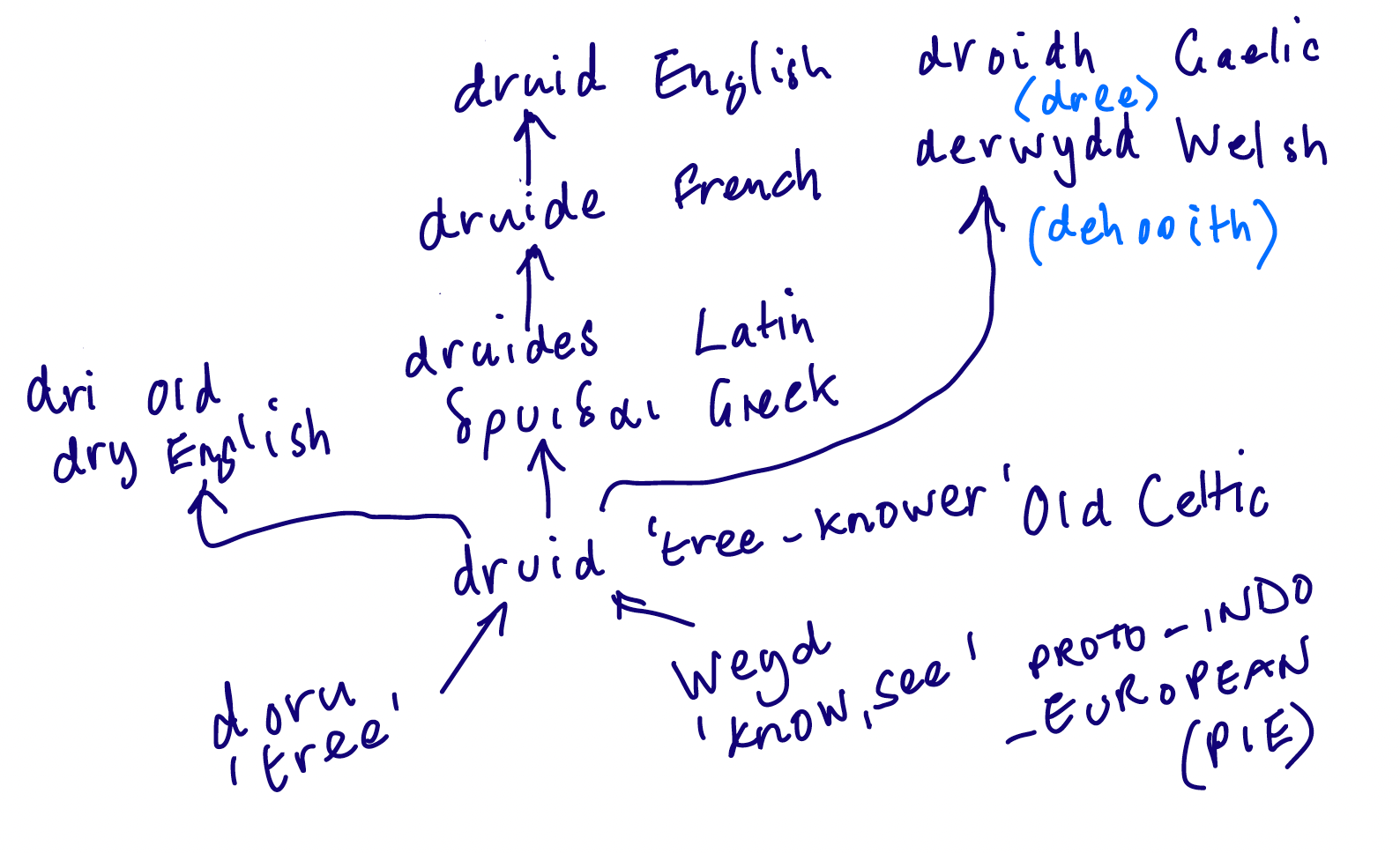
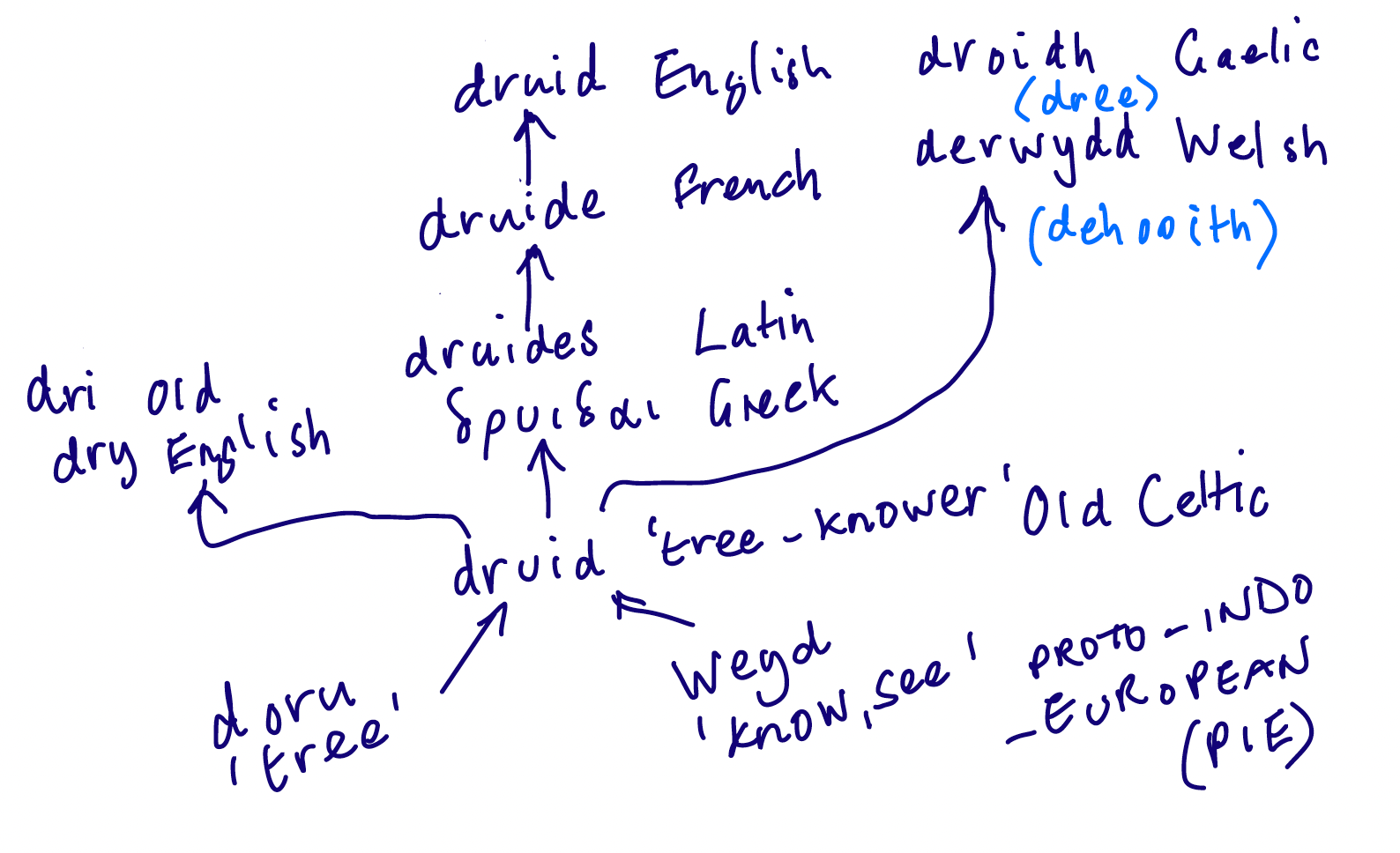
The connects with trees is also supported by the generally accepted etymology (already prefigured by Pliny). Druid seems to come ultimately from ancient PIE roots *doru-, 'tree'§ and *weyd-, 'see, know', so it would mean something like 'tree-knower'.
The word is found in Latin druides and Greek δρυΐδαι (dryidai), borrowed from Old Celtic. Old English had dry, 'magician', a direct borrowing, but Modern English druid came from Latin via French. Modern Gaelic and Welsh have cognates draoidh (dree) and derwydd (dehrooith), presumably directly from Old Celtic. A rough genealogy of these words in shown in this sketch.
* Fans of Asterix the Gaul will be familiar with these details.
¶ Welcome Foundation ICV No 36622 Licensed under Creative Commons.
§ The first root might instead be a word meaning 'strong' or the two words might be the same (trees are emblematic of strength).