The American comedian George Carlin once did a routine in which he said a new integer, called bleen, had been found between five and six, and this idea was taken up in a New York Times puzzle column. There they wrote
Suppose that a “new integer” is “discovered” between 5 and 6 called bleen, written B.
This is a little misleading and doesn't quite make sense; at bottom, we are not being asked to imagine any new integers have been discovered, but that we are going to represent the same old integers in a different number base, specifically eleven, so that for example whereas 42 normally stands for 4 tens and two units, if taken to be in the new system it would stand for 4 elevens and two units.
Most people nowadays will have met different bases in school and hexadecimal — base sixteen — is widely used in computing. In that base we write digits — we need sixteen of them now, so we co-opt some letters — .
And the Dozenal Society of Great Britain has long campaigned for us to use a system of counting in dozens, on the grounds that a dozen has more divisors than ten. Dozenal uses the digits .
Notice that in both these real-life examples, we add symbols representing the extra digits needed at the end of the list, and that would be the normal convention.
The genius of Bleen is that we break this convention and insert the extra digit, B for Bleen, between 5 and 6. So now we have . This quixotic decision makes the new system quite challenging.
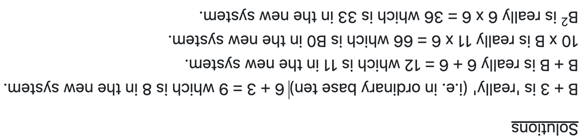
Frank Potter, who submitted the puzzle, then invited us to work these out in the new system
B + 3
B + B
10 x B
B2
Solutions at bottom of page.
And here are two harder ones.
B3
42 - 6