Edited by Richard Walker, Saturday 6 June 2026 at 00:49
This follows on from my last post.
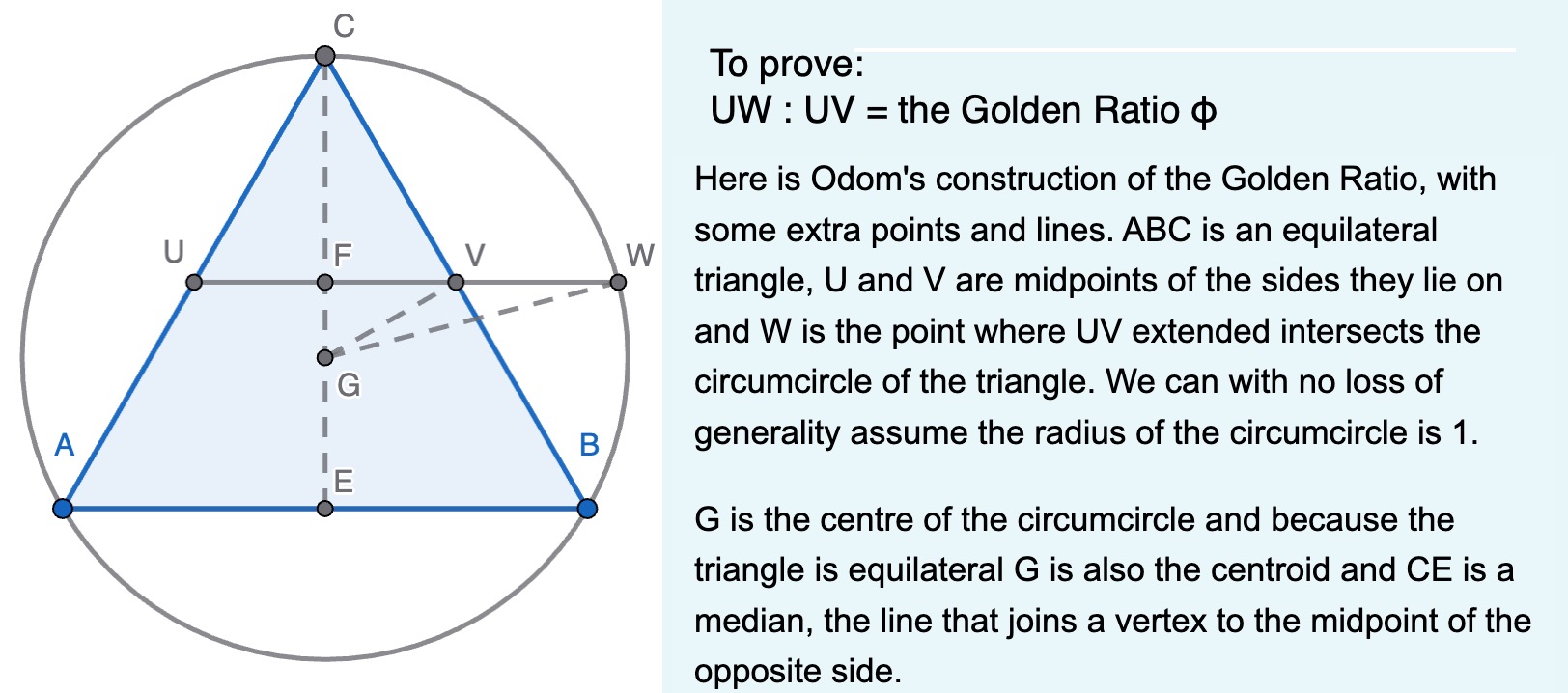
It is a well-known result that in any triangle the centroid divides each median in the ratio 2:1. The length of CG is 1 because it a radius of the circumcircle and so we have GE = and CE = .
Because U and V are midpoints F must be the midpoint of CE, so CF = and FG = .
Note also that from the fact that V is the midpoint of BC and the symmetry of the equilateral triangle we have GV = GE = .
Now we can apply Pythagoras' Theorem, first in triangle GFV and then in GFW, to find lengths FV and FW.
In GFV, FV2 = GV2 - GF2 = . So FV = .
In GFW, FW2 = GW2 - GF2 = 1 - = . So FW = = .
Finally, UV = 2 x FV = ; UW = UV + FW = + ; and so = ( + ) ÷ () = = , as claimed.
George Odom's interesting Construction of the Golden Ratio φ
Wednesday 3 June 2026 at 21:53
Visible to anyone in the world
Edited by Richard Walker, Wednesday 3 June 2026 at 23:37
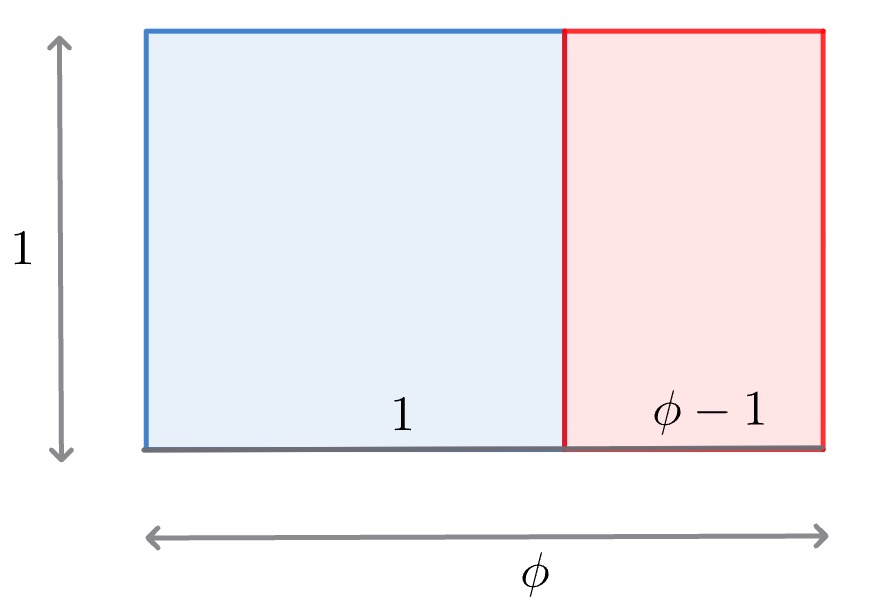
You've probably heard of the famous Golden Ratio, . It satisfies the equation , which means that if we have a rectangle we can cut off a square and be left with a smaller rectangle whose sides are in the same ratio as the original rectangle.
This works because the ratio is equal to , by virtue of the equation given above.
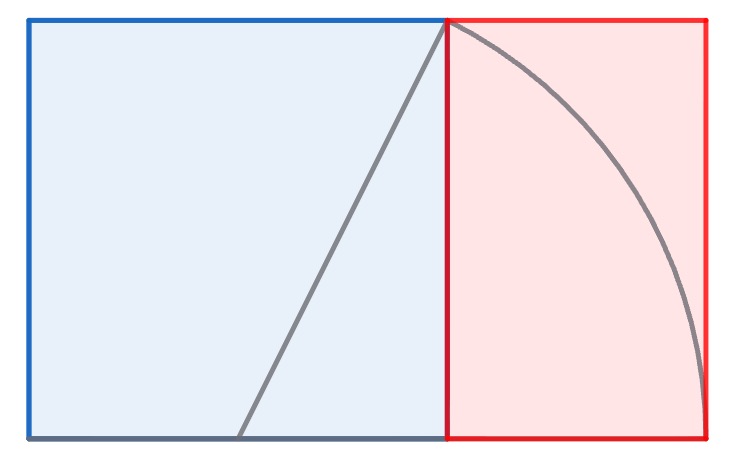
The golden ratio has many interesting and important mathematical properties and also crops up in art, architecture, music and many other places in science and culture. The number of words written about it must be in the hundreds of millions and the subject too vast even to survey in this blog post. I just want to look at two methods of constructing with ruler and compasses. The first is from Euclid ca. 300 BCE. Here is his construction.
He starts with a square, draws a line from the midpoint of its base to an opposite corner, then draws a circular arc to intersect the line formed by extending the base. The ratio between the length of the extended base and that of the original square is then , as can be shown using Pythagoras.
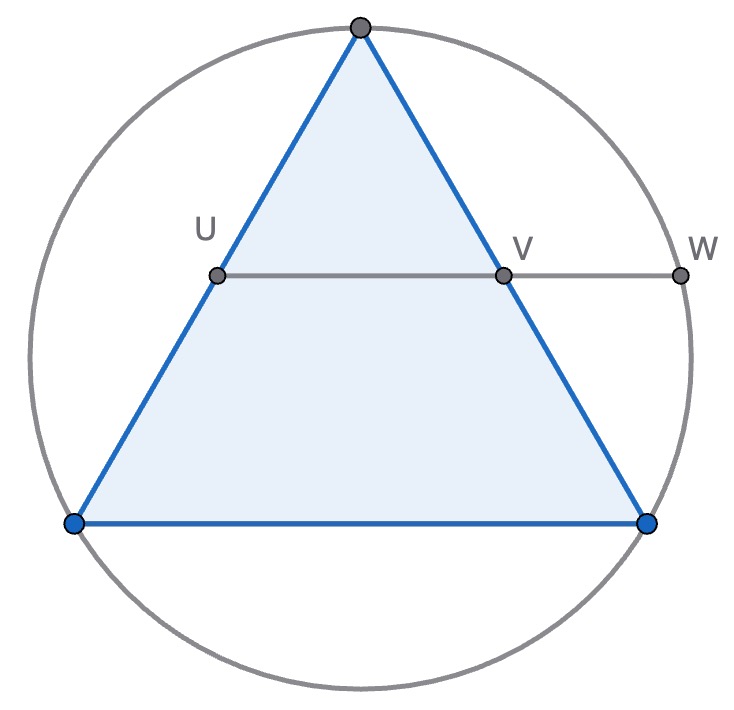
The second construction was discovered by the 20th century designer and mathematical enthusiast George Odom. Here it is, very simple, and has the additional elegance of including an equilateral triangle, one of my favourite polygons.
Inscribe an equilateral triangle in a circle. Draw a line through the midpoints and of two of its sides, to meet the circle at . Then . Isn't that neat? Odom must have been very please to discover it. It was later published in the American Mathematical Monthly as problem E3007.
I will post my solution on Friday. In the meantime if you want to have a go please do put solutions whole or partial in the Comments. It would be interesting to see what ideas and thoughts people have.
This blog might contain posts that are only
visible to logged-in users, or where only logged-in users can comment. If you
have an account on the system, please log in for full access.