I was listening to a BBC interview between Rachel Millward, deputy leader of the Green Party, and Mark Acton, executive director of the Data Centre Alliance, this morning (BBC Radio 4, Today Programme 7:35 am) when I realised how easily this particular debate can become polarised.
Rachel Millward was arguing for a temporary freeze on new data centres in England. Her concerns were environmental and political: water use, electricity demand, climate change, effects on local communities, competition with housing and infrastructure, and the growing influence of large technology companies.
Mark Acton pushed back hard. Some of those claims, he said, were simply wrong. In particular, he argued that frightening figures for data-centre water consumption were largely being imported from the United States and applied inappropriately to Britain. UK data centres were not routinely consuming vast amounts of water, he said, while their importance to almost every aspect of modern digital life was being overlooked.
Listening to the two of them, I found myself agreeing with each at different moments. That made me want to look more closely at the evidence.
I am involved in local politics and regularly encounter questions concerning planning, infrastructure, climate change and environmental policy. These are areas in which apparently technical decisions can have profound consequences for communities. I am therefore wary both of environmental arguments built around dramatic but poorly contextualised figures and of industry reassurances that legitimate concerns are based upon misunderstanding. My conclusion is neither that Britain should stop building data centres nor that their environmental consequences are being exaggerated into insignificance. It is that Britain is rapidly expanding a new generation of strategically important, highly resource-dependent infrastructure without yet possessing all the information required to plan that expansion intelligently. That, to me, is the central issue.
What are we actually talking about?
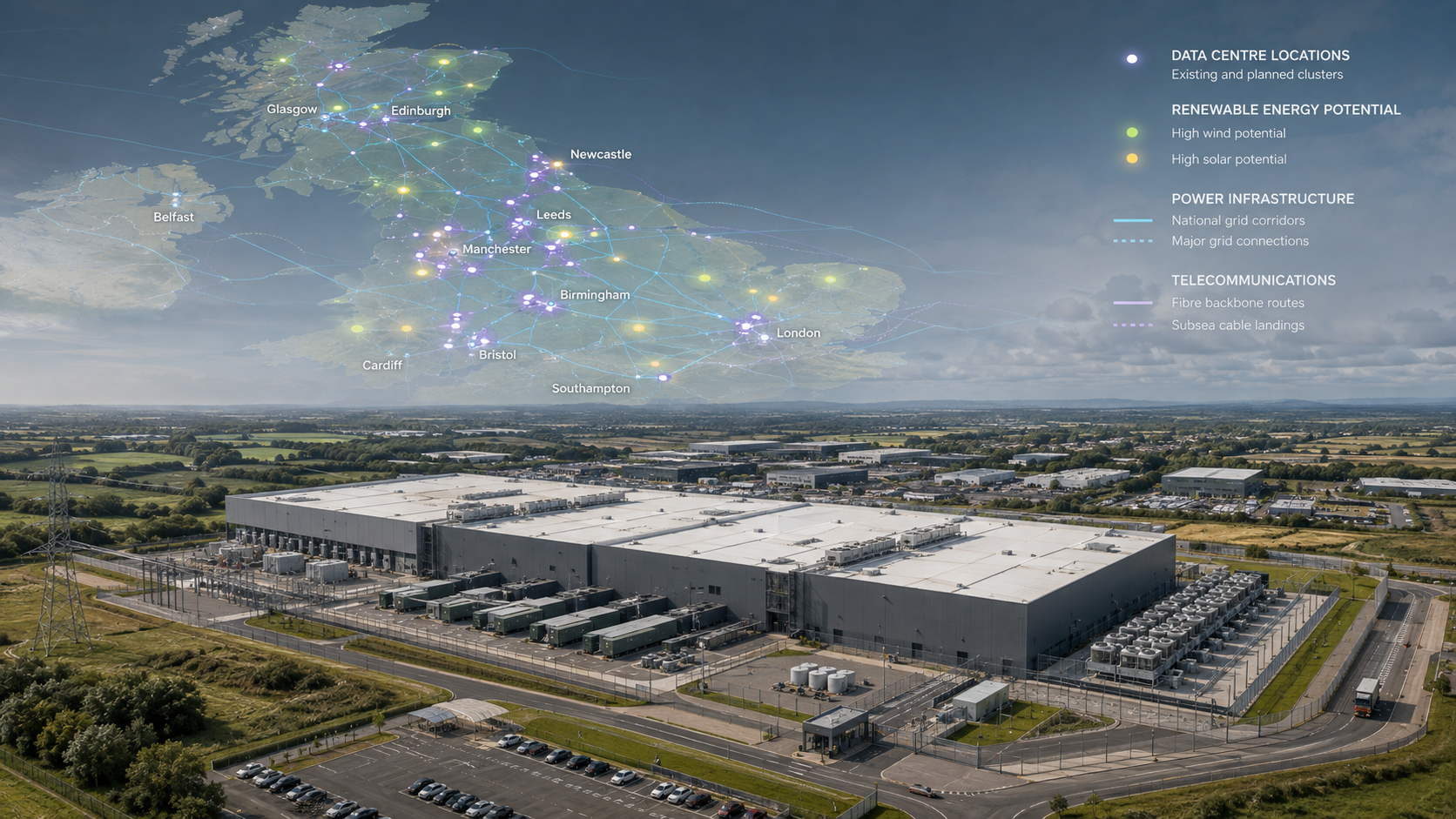
One reason the debate becomes confused is that the term data centre covers remarkably different things. A relatively small facility providing cloud or colocation services and a proposed hyperscale artificial-intelligence campus drawing hundreds of megawatts are both called data centres, yet their demands upon land, electricity, water and local infrastructure may differ enormously. The House of Commons Library distinguishes enterprise, colocation, hyperscale and AI data centres and estimates that Britain had approximately 1.6 GW of data-centre capacity in 2024. It also notes that the sector currently accounts for around 2.5% of UK electricity consumption and that consumption is expected to increase substantially as capacity expands. (commonslibrary.parliament.uk)
Government ambitions give some sense of the scale of what may be coming.
The UK Compute Roadmap forecasts that Britain will need at least 6 GW of AI-capable data-centre capacity by 2030, roughly three times present capacity, with demand potentially rising further if AI adoption accelerates. The Government wants nationally significant AI Growth Zones capable of accommodating at least 500 MW each, with at least one eventually exceeding 1 GW. (gov.uk) That is a fundamentally different planning proposition from fitting another server room into an industrial estate.
Do British data centres really consume enormous quantities of water?
This was one of the sharpest disagreements in the BBC interview. Rachel Millward presented water consumption as one of the principal environmental objections to data-centre growth. Mark Acton responded that the figures commonly quoted originated largely in the United States and were not relevant to British facilities. On this particular point, I think Acton had an important argument. Britain is not Arizona. Climate matters, and so does cooling technology. Large American facilities in hot or arid regions may rely heavily on evaporative cooling, while British facilities operate in a cooler climate and many use air cooling, refrigerant systems, or closed-loop liquid systems that require far less consumptive water. A 2025 techUK survey, undertaken in collaboration with the Environment Agency, obtained valid responses from 73 commercial data-centre sites in England. It found that 51% used waterless cooling, 64% consumed less than 10,000 cubic metres of water annually, and 89% either measured their water use or operated cooling systems requiring no water. (techuk.org)
More recent work cited by techUK and undertaken by MOSL and WRc estimates that English data centres consume around 1.879 million cubic metres of potable water annually, approximately 0.2% of England's non-household water market. The same evidence suggests that consumption is highly concentrated among a relatively small number of larger facilities. (techuk.org) That is important evidence. It does not support the proposition that the existing UK data-centre sector is, collectively, one of England's dominant consumers of potable water.
Friends of the Earth itself acknowledges some of this counter-evidence.
Its 2025 paper notes the techUK findings that 51% of surveyed sites used waterless systems and 64% used less than 10 million litres annually. So far, then, the strongest version of the claim that British data centres are already consuming catastrophic quantities of water does not appear to be supported. But that is not the end of the matter. National percentages can conceal local problems. Water is not really a national resource in the way that a percentage such as 0.2% might imply. It exists within specific catchments and water resource zones. A large development may account for a negligible proportion of national consumption but still be significant if it is situated in a part of southern England already experiencing water stress.
The Environment Agency explicitly warns of this problem.
Its National Framework for Water Resources 2025 identifies data centres and AI as areas of emerging demand and says that water availability must be considered when facilities are planned. It also says there are already catchments closed to additional abstraction and that some water companies have refused applications from data centres. (gov.uk) This shifts the question from how much water data centres use nationally to how much a particular facility will use, in a particular catchment, under present and future climatic conditions. That is a much more useful planning question. T
The new generation may not resemble the old one.
There is another difficulty with the existing evidence. Most measurements describe facilities that already exist. They do not necessarily describe the enormous AI-oriented campuses now being proposed. The Government's own criteria for AI Growth Zones demonstrate this. Candidate sites must demonstrate access to at least 500 MW of electricity capacity by 2030 and provide written confirmation from the relevant water supplier confirming that sufficient water can be made available to support infrastructure on that scale. (gov.uk)
The Environment Agency is unusually candid about the information problem.
It says that it is encountering barriers in obtaining water-consumption data from the sector, that large variations exist between facilities and that, without better information, it cannot accurately model future water needs. It also warns that substantial numbers of new facilities could be built before major strategic water-resource schemes come online. (gov.uk)
This is where I find the environmental argument strongest.
It does not require me to believe that today's British data centres are draining reservoirs. It requires me to recognise that we do not yet know enough about the cumulative water requirements of tomorrow's vastly larger data-centre estate.
Electricity may be the bigger issue.
The more I looked into the subject, the more I wondered whether water was dominating the public debate because it is easier to visualise than electricity. The question of electricity may be considerably more important. The House of Commons Library estimates that data centres currently consume around 2.5% of UK electricity, with consumption expected to rise approximately fourfold by 2030. (commonslibrary.parliament.uk) The Department for Energy Security and Net Zero has commissioned successive studies precisely because digitalisation and data-centre growth are creating significant new electricity demand. Its latest work was updated in July 2026. (gov.uk) This is occurring as Britain simultaneously attempts to electrify transport, domestic heating, and industry while decarbonising electricity generation.
There is an opportunity-cost question.
If a 500 MW connection becomes available, what should use it: a data centre, housing, manufacturing, electric transport, heat pumps, or some combination of them? That is not an argument for data centres automatically losing. It is an argument that the allocation of scarce infrastructure capacity constitutes public policy, not merely a private commercial transaction.
Are data centres being given priority?
Rachel Millward argued in the interview that data centres were gaining priority access to electricity and water because they had been designated Critical National Infrastructure. That does not appear to be correct as stated. The Government designated UK data centres as Critical National Infrastructure in September 2024. The purpose was primarily resilience: enabling closer government support to protect and recover the sector from cyberattacks, outages, extreme weather, and other serious disruptions. The designation does not itself create an automatic entitlement to water or electricity ahead of households or other industries. (gov.uk)
Beneath Millward's inaccurate explanation lies a genuine policy issue.
The Government is explicitly facilitating the development of AI data centres. Its policy for AI Growth Zones includes faster grid connections, planning reforms, and targeted electricity price support. Government says these interventions could reduce the time required to secure power by up to five years and save a 500 MW data centre up to £80 million annually in electricity costs. (gov.uk) So I would not say that data centres receive priority because they are Critical National Infrastructure. I would say that the Government has made a strategic decision to facilitate the development of major AI data centres and is altering planning and energy policy accordingly. That is a different proposition, but still one worth debating.
What about housing?
Friends of the Earth points to west London, where electricity constraints affected housing development, as evidence that data centres can compete with homes for infrastructure. This is not an invented controversy. The Greater London Authority confirms that electricity constraints affected development across parts of west London and that intervention was subsequently required to unlock stalled schemes. By February 2025, developments containing at least 11,690 permitted homes had been unlocked through work involving the GLA, network operators, government and developers. (london.gov.uk) A subsequent London Assembly analysis identified rapid data-centre development as the primary driver of those particular capacity constraints, although it also noted that some connection applications may have been speculative. (london.gov.uk) So it would be misleading to claim that data centres are generally given priority over housing throughout Britain. But it would be equally misleading to say there is no competition for infrastructure.
West London demonstrates that this can happen, and for planners the lesson is important: cumulative demand matters. Individual applications can appear manageable while collectively exceeding the capacity of the infrastructure serving an area.
Why Britain nevertheless needs data centres
It would be easy at this point to turn this into an argument against data centres. I do not think the evidence warrants that conclusion. Acton was right about something fundamental in the BBC interview: data centres already underpin modern life. Online banking, cloud services, communications, government systems, healthcare data, streaming, business software and increasingly artificial intelligence depend upon physical computing infrastructure located somewhere. The House of Commons Library notes several reasons why Britain may reasonably want domestic capacity: access to high-quality computing, support for AI research and economic activity, lower latency for applications requiring rapid response, resilience, and the ability of UK authorities to regulate infrastructure situated within their jurisdiction. (commonslibrary.parliament.uk) There is also an environmental consideration that can be missed. Refusing to build data centres in Britain does not make digital demand vanish. Some of the infrastructure may simply be built elsewhere. If it moves to hotter countries requiring more intensive cooling or electricity systems with higher carbon emissions, displacement could conceivably worsen rather than improve the global environmental outcome. So not here is not automatically the same as not harmful. Nor is “100% renewable” the end of the carbon argument
There is another conceptual difficulty.
A data centre may purchase electricity under contracts described as renewable. That does not necessarily mean its additional demand has no consequences for the electricity system. What matters is additionality. If hundreds of megawatts of new demand are accompanied by genuinely additional renewable generation, storage, transmission and other low-carbon capacity, the climate consequences may be manageable. If they are not, additional demand can prolong the use of fossil-fuelled generation or absorb low-carbon electricity that might otherwise have displaced fossil fuel elsewhere. The relevant question is therefore not simply whether a company purchases renewable electricity, but what additional generation and network capacity are required because the development is in place. That is a much harder question, but a more meaningful one.
The knowledge gap: what do we know that we do not know?
This is perhaps the most important part of the debate. There are significant known unknowns. We know that information is missing. We do not yet have a comprehensive, mandatory public dataset showing site-by-site water consumption across the British data-centre estate. We do not know with sufficient precision how much water the next generation of hyperscale AI facilities will consume, because that depends upon technologies still evolving, local climate, computing density and operators' design choices. We do not know exactly how quickly AI computing demand will grow. Even the Government's own forecast acknowledges that its 6 GW estimate for 2030 could prove too low if adoption accelerates. (gov.uk)
We also do not know the eventual geographical distribution of that demand, how much electricity will actually be consumed rather than merely reserved through grid-connection agreements, how effectively waste heat can be reused at scale, how future cooling technologies will alter the trade-off between water and electricity, or the cumulative local consequences where multiple large developments cluster in the same water-resource zone, electricity network or planning authority. These are known unknowns because we can identify the questions even though we cannot yet supply satisfactory answers.
And what about the unknown unknowns?
This is harder. Every major technological transition generates consequences that were not anticipated when policy was designed. Twenty years ago, planners considering warehouses could scarcely have anticipated that apparently nondescript industrial buildings might become nationally significant electricity loads because of machine learning. We therefore also need to recognise unknown unknowns: effects whose importance we may not yet have identified. AI hardware may become more energy-efficient, or computing demand may grow dramatically even faster than efficiency improves. Cooling technology may greatly reduce water demand while increasing electricity demand. AI inference may become increasingly distributed, changing where computing infrastructure needs to be located. New technologies may make large quantities of waste heat economically useful. Conversely, higher summer temperatures may reduce the effectiveness of cooling systems just when water and electricity systems are themselves under greatest climatic pressure. Changes in semiconductor design might alter cooling requirements altogether. The rapid turnover of specialist hardware may create waste streams and mineral demands that become more important than operational water consumption. Technological or commercial concentration may create forms of infrastructure dependency that we have not yet adequately considered. By definition, I cannot list the true unknown unknowns. That is the point. Their existence argues for adaptive planning: regulation that responds as assumptions change, rather than locking authorities into predictions made during a rapidly evolving technological transition.
What should planners actually ask?
For me, this is where the debate becomes practical. If a significant data-centre development came before a planning authority, I would want to know how much electricity it will actually consume and how much capacity it will reserve; where that electricity will come from; what additional generation and grid infrastructure will be needed; how much potable water it will consume and how that demand changes during extreme heat; which cooling technology it will use and what alternatives have been considered; what happens during drought restrictions; what waste heat it will produce and whether any of it can be used locally; how many permanent jobs it will genuinely create; what other development could the required infrastructure capacity support; and what happens when several similar developments are considered together rather than individually. Friends of the Earth argues for mandatory reporting of energy mix, water withdrawal and consumption, energy efficiency, equipment reuse and waste, as well as better integration of water companies into the planning process. I do not accept every conclusion or rhetorical claim in the Friends of the Earth paper. It is explicitly an advocacy document, and some of its international examples and headline comparisons require considerably more contextualisation. But on transparency and cumulative planning, I think it identifies a genuine weakness. Indeed, the Environment Agency reaches a remarkably similar conclusion from an entirely different institutional starting point: without better information, future water requirements cannot be reliably modelled. (gov.uk) That ought to concern planners irrespective of their political position.
Where does this leave me?
After listening to Rachel Millward and Mark Acton, I am not persuaded by either extreme. The evidence does not support treating every British data centre as a water-guzzling environmental disaster, but nor does it support the industry's more dismissive suggestion that water, electricity and planning concerns are largely the result of inappropriate American comparisons. Existing British data centres appear to account for a relatively small proportion of national water consumption, but some facilities consume much more than others. Water scarcity is intensely local. The next generation of AI centres will be far larger. Electricity demand will be substantial. Government is actively encouraging their development. And some of the data needed to understand their cumulative environmental consequences remains incomplete. That leads me to a fairly straightforward conclusion.
Britain needs data centres.
But if government regards them as Critical National Infrastructure, we should plan them with the seriousness normally associated with critical infrastructure. That means deciding approximately how much capacity we require, identifying locations capable of sustaining it, understanding cumulative water and electricity demand, establishing transparent reporting standards, and continually revisiting assumptions as technology evolves. It means neither assuming that every proposed data centre is environmentally unacceptable nor accepting that every development justified in the name of AI growth must therefore be necessary. Above all, it requires distinguishing between what we know, what we know we do not know, and what we have not yet realised we need to know. The danger otherwise is that Britain will create a national infrastructure strategy accidentally — one individual planning application at a time.