

The Square Peg Problem asks whether every closed path in the plane, if it doesn't intersect itself, contains the four corners of a square, or to put it differently, has an inscribed square. For example this path does, as we can see
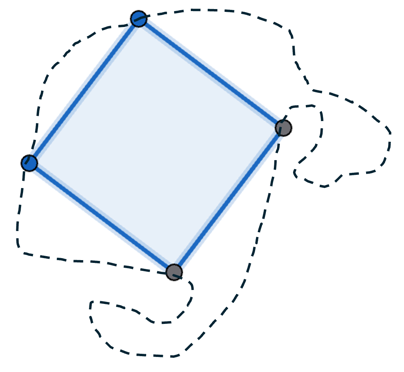
The path can be any shape, and is generally referred to as a 'curve', although it can be wholly or partly made up of straight line segments.
The problem was posed in 1911 by Otto Toeplitz. It is quite intuitive to grasp and feels highly plausible. Yet despite more than a century of chipping away at it, the question is not completely answered. But it has been solved for many special cases, including the case of a convex quadrilateral, which was solved by Clarence M. Hebbert in 1914.
Hebbert's solution was noteworthy not just for being an early contribution but also because he showen that in this case there is always at least one solution, and if there is more than one then there infinitely many. Think of that. You can't have 0, or 2, or 42, or 123456789, or a quadrillion. No, the choice is 1 or ∞.
There is actually a ruler and compasses construction for finding an inscribed square in a convex quadrilateral but it is a little fiddly, so I will try to come up with a shorter version. Here I just want to give a 'Look and see' explanation of why if there are as many as two solutions, there must be infinitely many.
Here is a quadrilateral I have constructed so it has two inscribed squares, PQRS and KLMN
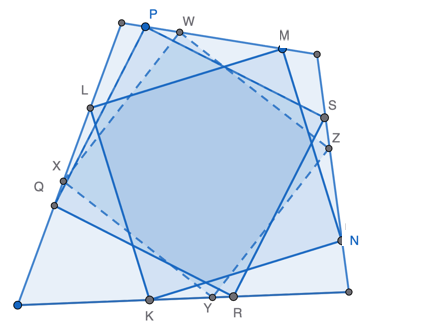
Now if we choose points W, X, Y and Z to divide segments MP, LQ, KR and NS, each in the same ratio, these points will form a new inscribed square, and since we can choose any ratio we please we can find infinitely many such squares, as claimed.
There a special name for this situation, where if there is one solution (or in this example two, but same general idea) there are an infinitude. It is called a porism.