

At the start of this month I wrote about the following problem.
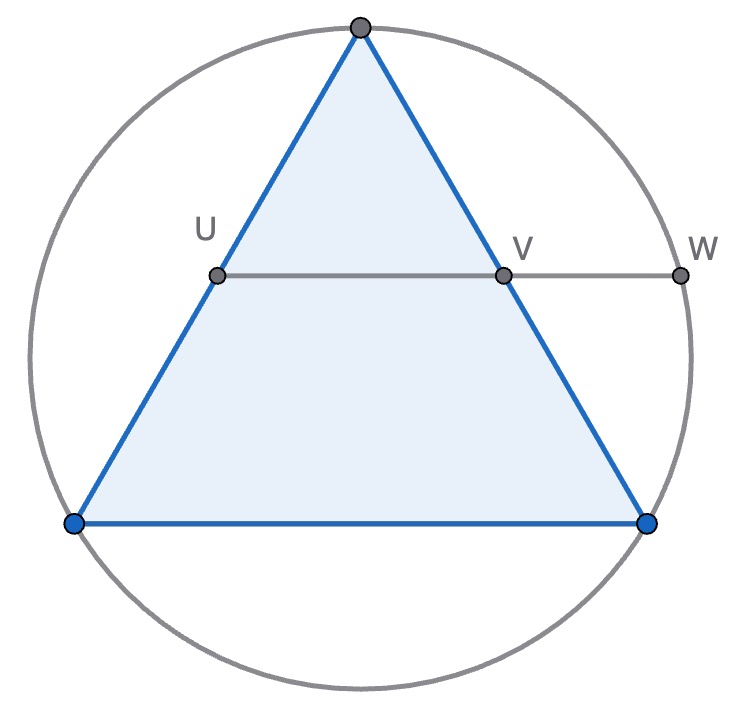
Inscribe an equilateral triangle in a circle. Draw a line through the midpoints and of two of its sides, to meet the circle at .
Show that is equal to , the number of the Golden Section.
This elegant result was proposed by George Odom as problem E3007 in the American Mathematical Monthly in 1983 and the best solution out of the 74 receive was published in 1986. Here is the miraculous solution given by Jan van de Craats. I have drawn my own diagram and provided slightly more explanation but not changed the underlying proof at all. Here is the diagram above but with some additional lines and labels.
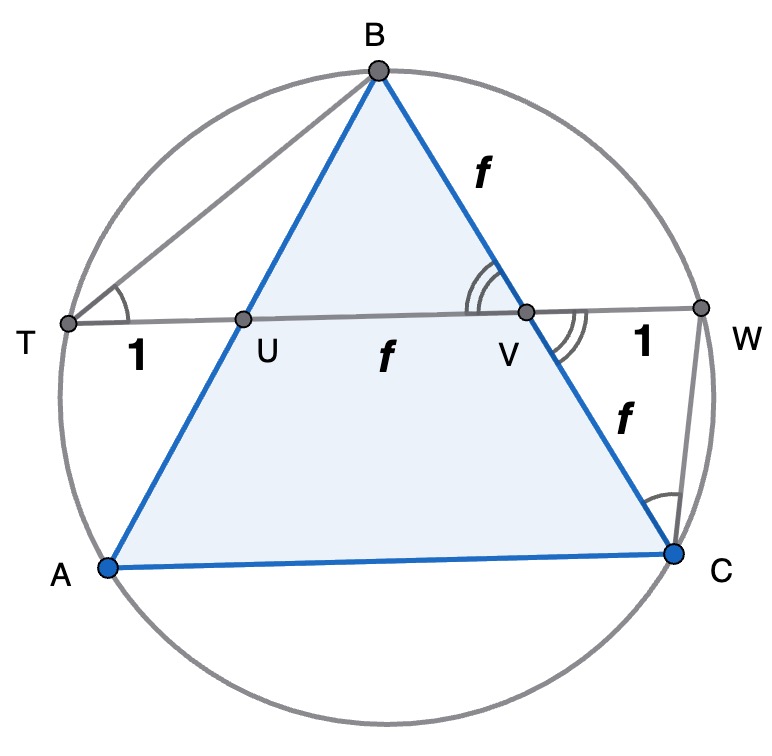
Take the length of as and suppose . By symmetry . Because the small triangle is equilateral and is the midpoint of we have .
Because and are subtended on the circumference of the circle by the same arc the angles there are equal. Angles and are equal, because they are vertically opposite. Hence triangles and are similar.
The ratios of corresponding pairs of sides in these two triangle must therefore be equal, so we have
and rearranging gives or , the equation whose positive root is , the number of the Golden Section.
(Jan van de Craats' write-up was terser; he just gave the diagram above and underneath wrote
relying on the Intersecting Chords Theorem, but I thought it would be better to use similar triang;es and not assume knowledge of that theorem.)
Footnote: I quite liked my own proof but the one above is far, far nicer, which I suppose is the reason it got published. Mine was a worthy effort but really just an 'also ran', along with the 74 other ARs.