Come Sit With the Creator For a While
Sometime back in the fourth century, a troubled man sat weeping in a garden in Milan. His name was Augustine, and although he would eventually become one of the most influential Christian thinkers in history, at that moment he was simply a man in turmoil, painfully aware of the distance between the life he was living and the life he knew he ought to live.
Then, from a nearby house, he heard the voice of a child repeating a little refrain:
Tolle, lege. Tolle, lege.
“Take up and read. Take up and read.”
Augustine later described the moment in his Confessions. He took the words as an instruction, picked up the Scriptures, and read. What he encountered there became part of the great turning point of his life.
There is something wonderfully simple about those words.
Take up and read.
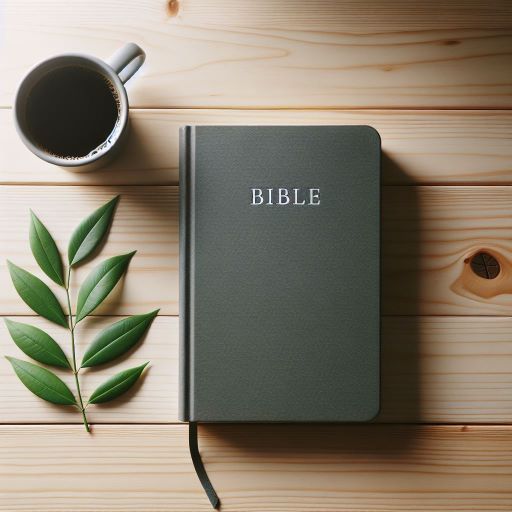
If you have never read the Bible, or have not opened one for many years, I would like to offer you that same invitation. Not an invitation to understand everything at once, to become religious, or even to settle beforehand what you believe about God. Just take it up and read.
We sometimes imagine the Bible as a distant book: ancient, formidable, filled with unfamiliar names, difficult passages and ideas belonging to another age. Yet the Bible says something rather different about itself:
“Assuredly the word is exceedingly close to you—even in your mouth and your heart—so that you might do it.”
—Deuteronomy 30:14 NKJV
I love that expression: exceedingly close to you.
That is increasingly how I have come to think about the Bible. Not merely as a book to be studied, though it certainly rewards study, but as something close enough to enter the ordinary circumstances of a human life.
In my quiet hours, when I sit with the Bible, my prayer is often very simple: Father, what do you have for me today?
Sometimes I need direction. Sometimes discipline. There are aspects of my personality that still need changing, and occasions when I need the uncomfortable honesty of Scripture rather than reassurance. At other times I come carrying a fear, a disappointment, or something I cannot resolve. I read, and sooner or later a sentence seems to arrest me. I stop. Read it again. Sit with it.
And there it is.
For me, this is not merely an interesting thought from an ancient writer. I receive it as communication from God, meeting me in the circumstances of my life.
Cancer medication sometimes has me awake during the night. Oddly enough, I have come to treasure some of those hours. The house is still, the world seems to have withdrawn for a while, and there is time to read without interruption.
Early this morning, my attention settled on a verse in Psalm 118:
“I called on the LORD in distress;
The LORD answered me and set me in a broad place.”
—Psalm 118:5 NKJV
I stayed there for a while.
Life has many ways of hemming us in. Illness can do it. So can fear. There are pressures outside our control: the unkindness of others, slander and gossip, unhappy relationships, financial worries, loneliness, uncertainty about the future. Then there are the pressures within us, those private struggles that other people may know nothing about.
The writer of the psalm knew that feeling.
The Hebrew language behind his words makes the image especially vivid. The word associated with his distress carries the idea of narrowness or confinement—a tight place, somewhere you can hardly move.
Then comes the answer.
The Hebrew word merḥāḇ means breadth, spaciousness, room.
The movement of the verse is therefore almost physical. The psalmist cries to God from the narrow place, and God answers him in spaciousness.
From confinement into room.
I find that image beautiful because God does not always remove the circumstance that confines us. Some things cannot simply be wished away. I still have cancer. A broken relationship may still be broken tomorrow. Someone who has treated us badly may never apologize. Grief does not obey a timetable.
And yet, in circumstances that have not changed, something within us can.
The walls no longer seem quite so close.
There is room to breathe.
That morning the verse was no longer simply something written by a Hebrew poet thousands of years ago. It had reached across those centuries and entered a quiet room where one man happened to be awake because of his medication.
“The word is exceedingly close to you.”
I thought again of Augustine in his garden and that child’s strange little song drifting over the wall.
Take up and read.
You do not need to approach the Bible with someone else’s certainty. You can bring your questions with you. Bring your doubts too, if you have them. Bring your disappointments, your curiosity, your objections, your hopes, and all the untidy pieces of being human. The Bible is remarkably unafraid of such things. Its pages are populated by frightened people and courageous people, doubters and believers, failures and saints, kings and prisoners, grieving mothers, angry prophets, bewildered disciples and people desperately looking for a way home.
So if there is a Bible somewhere in your house, take it down.
Open it.
You might begin with one of the Gospels and meet Jesus through the recollections of those who knew him. Or begin with the Psalms, where almost every human emotion eventually finds a voice. Do not worry about how much you read. A few verses may be enough.
And before you begin, you might even try the little prayer I use in those quiet hours:
Father, what do you have for me?
Then take up and read.
The book that seems so ancient may turn out to be exceedingly close.
Note
Are you a regular visitor or a new visitor? If so, please drop me a note in private and tell me what articles have appealed to you. You can reach me at JimAlba@proton.me
Scripture quotations marked NKJV are taken from the New King James Version®. Copyright © 1982 by Thomas Nelson. Used by permission. All rights reserved.