OU blog

Personal Blogs

Jim McCrory

Frothing For Nature

Visible to anyone in the world
Edited by Jim McCrory, Saturday 8 August 2026 at 13:38

sketch%20%281%29.png

Frothing For Nature

Yesterday I woke at 7 a.m. and had the thought  to go  "frothing" for nature, as our Aussie cousins would say. But I have always believed that some of the finest encounters with nature are found in conversations with our fellow human beings.

Our plan was to stop for breakfast at Loch Lomond, the gateway to the natural beauty of Scotland's west coast. There we struck up a conversation with an Australian couple from Canberra who, by now, will no doubt have awakened to the bustling harbour at Oban, where the great CalMac ferries come and go between the Inner and Outer Hebrides.  A landscape shaped in my head by the wonderful music and lyrics of Runrig.

"Fancy driving up to Glencoe?" I asked my wife.

"Sure," she replied, as always happy to indulge one of my spontaneous ideas.

The road was busy. Tourists from across Europe manoeuvred oversized campervans through the Highlands, often cramping in on the landscape. Others squeezed into every possible viewpoint, even when there was clearly no room, bringing traffic to a standstill. This is Scotland in July.

On arriving at Glencoe, I missed the turning for the car park, so we decided to continue on to Kinlochleven. The village was filled with tired, but undoubtedly uplifted, walkers completing the penultimate stage of the West Highland Way.

I use the word uplifted deliberately because we met an elderly local lady in the village shared something that stayed with me. After chatting for a while, I asked her about one of her happiest memories.

     "When I'm feeling low," she said, "I walk into our local landscape and simply sit for a while, enjoying the moment. When I come home, I feel rejuvenated."

Her words reminded me of Nathanael's encounter with Jesus. Before Nathanael had even met Him, Jesus said, "I saw you while you were still under the fig tree." It was a place of quiet reflection before it became a place of revelation. Sometimes we all need somewhere peaceful to sit, think and simply be.

Later, we stopped at a restaurant for a late lunch, where I found myself talking with a man walkingThe West Highland Way. As the conversation unfolded, I asked him about his happiest childhood memory.

He told me he had grown up near the ski slopes. His mother was the accomplished skier in the family, and as he learned to ski, she would gently remind him, "Don't rush down the mountain. Take in the surroundings."

As a boy he would weave his way slowly between his mother's tracks, savouring both the landscape and the moment. Today he is a highly skilled craftsman and furniture designer, working with wood. Listening to him, I couldn't help wondering whether those childhood journeys down snowy mountains first awakened the creativity that would shape his life's work.

His mother closed her eyes when he was a young man. I left our conversation with a quiet sense of sadness, having lost my parents at a young age. Some people seem to give far more than they ever receive. Mothers often do. I was grateful for having met him and I wish him the best as he journeys through the Highlands and indulging in his own nature walk. 

As we journey through life, it is worth taking time to connect with the people we meet along the way. Everyone carries a story, and every conversation has the potential to leave a lasting impression.

I will never forget the people we met yesterday. And perhaps, in the great renewal that Job longed for—the hope that stretches beyond this present world—we shall meet many of life's fellow travellers again.

Part two

Some months ago, my wife and I were watching a Christian livestream from Amsterdam on Presence Revival. Greetings were appearing from around the world: South Korea, Thailand, the Philippines, the United States and across Europe.

And then there was us, watching from Scotland.

We posted our greeting, and a lady named Brenda from Kinlochleven replied to say hello. We returned the greeting and thought little more about it. It was one of those pleasant encounters made possible by the internet, with no expectation that we would ever meet.

Then, on Thursday, we found ourselves in Kinlochleven.

As we were preparing to leave the village, we suddenly remembered Brenda.

     “Let’s see if we can find her before we go.”

We had no address and very little information. Our first attempts drew blanks, and eventually we decided to give up.

Then we passed a lady outside talking with one of her neighbours. On impulse, I asked whether she knew where Brenda lived.

     “I am Brenda,” she replied.

Then she looked at us and asked, “Are you the couple from Ayrshire?”

Of all the people we might have stopped, we had stopped Brenda herself.

There was an immediate bond between us. We discovered that we shared something else too. The three of us were committed Christians, yet none of us regularly attended a conventional church. We found Christian encouragement and fellowship in other ways, including online preaching, teaching and worship.

References

John 1:48 "How do You know me?" Nathanael asked. Jesus replied, "Before Philip called you, I saw you under the fig tree."

Job 1:3 and he owned 7,000 sheep, 3,000 camels, 500 yoke of oxen, 500 female donkeys, and a very large number of servants. Job was the greatest man of all the people of the East.

Job 14:14 When a man dies, will he live again? All the days of my hard service I will wait, until my renewal comes.

Frothing in Australian slang means being wildly excited and  hyped up about something — usually in a fun, over‑the‑top way. The term is especially common in Aussie surf culture, where “I’m frothing!” basically means “I’m buzzing with enthusiasm.”
Permalink Add your comment
Share post
Jim McCrory

On love, loss, and longing

Visible to anyone in the world
Edited by Jim McCrory, Monday 3 August 2026 at 13:58

sketch%20%282%29.png

On love, loss, and longing.

On Sunday morning my wife and I set off for breakfast at the Duck Bay Hotel. We always aim to arrive for 9 a.m., before the tourists fill the dining room and the peaceful atmosphere gives way to the bustle of the day. It has become something of a ritual for us. With my immune system weakened by chemotherapy, these early outings allow me to enjoy the beauty of the world while avoiding the infections that crowded places can so easily bring.

After breakfast we wandered around Luss, a village I never grow tired of visiting. No matter how many times I walk its narrow streets or stand by the shores of Loch Lomond, it always seems to offer something new to notice or ponder. This time, after chatting with a delightful young couple from Malta, my thoughts drifted towards the wonderfully expressive words that exist in some languages but have no direct English equivalent.

Before I get to that, though, something else caught my eye.

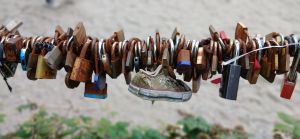
Along the beach stood metal railings covered with padlocks. Hopes hung from its branches of lockets, each one placed there by a couple who had wanted to declare their love permanent. It reminded me of a young man I once met who had an anchor tattoo on his leg.

"Were you a sailor?" I asked.

"No," he smiled. "It used to be my girlfriend's name. When we split up, I had an anchor tattooed over it."

Curious, I pointed to the tattoo on his other leg.

"Same story," he laughed. "Another relationship. Another name covered up."

As amusing as his answer was, there is a quiet lesson hidden within it.

Those locks on the railings are much the same. Each one was fastened with hope, with promises of forever, perhaps with laughter and dreams of a future together. Yet how many of those couples have since gone their separate ways? The locks remain, silent witnesses to love that once burned brightly but eventually faded. They have become monuments, not only to romance, but to the fragile nature of human affection.

Then my thoughts returned to Malta and to a beautiful Maltese word xoqqa.

There is no simple English translation. It speaks of a deep longing or yearning for someone or something absent. It is more than ordinary missing; it carries emotional, even spiritual, overtones. It is the ache that lingers when the heart still reaches for what is no longer there.

How many of those who once fastened a lock on the bonny banks of Loch Lomond now carry a xoqqa within them? How many young people today live with that same quiet yearning for someone they loved, someone who gradually grew distant, until love turned cold and only memories remained?

Perhaps that is why places like Luss never fail to make me think. Amid beautiful scenery and peaceful waters, they gently remind us that while landscapes endure, human hearts are forever learning the difficult lessons of love, loss, and longing.

"Above all else, guard your heart, for everything you do flows from it."
Proverbs 4:23 (NIV)

Permalink Add your comment
Share post
Jim McCrory

Two Poached Eggs on Loch Lomond

Visible to anyone in the world
Edited by Jim McCrory, Monday 22 June 2026 at 10:32

sketch.png

Two Poached Eggs on Loch Lomond

Chemotherapy, for the moment, has narrowed the walls of life somewhat. Don’t overdo the walking. Eat healthily. Stay away from people. Sensible advice, of course, but even sensible advice can begin to feel like a small room with the windows painted shut.

My wife could see the cabin fever working on me. So, at 6.30 on Sunday morning, she said, “Go and get ready. We can drive to Glencoe.”

I was reluctant. Glencoe is glorious, but the road can be difficult when the weather is kind and every car and campervan in Scotland seems to have had the same revelation. So, as a compromise, I suggested breakfast at Duck Bay Marina on Loch Lomond.

     “After all,” I reasoned, “it will be quiet at nine in the morning.”

And so it was.

We sat there having breakfast, looking out over the loch, watching the early morning bathers brave the low-temperature water. Swifts skimmed the surface, swift by name and swift by nature, while two swans kept dignified guard over their little ones.

The beauty of creation has this way of reviving the soul when one feels a wee bit north of one’s usual temperament. I felt it happen in that short time. The walls moved back a little. The air came in. Something in me breathed again.

After breakfast, we walked along the loch, watching people arrive and prepare for a day on the beach. Families carried bags and towels. Children had that holiday energy that seems to arrive before the sun has fully committed itself. It was good to see life gathering around the water.

But then I began to notice them: food packets, empty cans, plastic bottles cast aside on the beach, even though bins were available. I had a quiet rant inside myself.

The therapeutic value of God's handiwork is no coincidence. It is a gift for man to enjoy. Yet, like selfish children, we open the gift and throw away the wrapper. Some, it seems, would cut down the tree just to get at the fruit.

How long will we have these beautiful places if some are bent on not caring for them?

There is a verse in the Book of Revelation that speaks of God bringing to ruin those who ruin the earth. It came to mind as I stood there, looking at the loch, the birds, the swans, the children, and the litter.

We are not owners of such places. We are guests, stewards instructed to care for our planetary home. And if creation can do so much to restore us, surely, we might show the humility to protect it.

Two poached eggs, a view of Loch Lomond, and a walk by the water did me better than I expected. But it also reminded me that gratitude must become more than a feeling. Sometimes it needs to bend down, pick something up, and leave a place better than it found it.


Permalink Add your comment
Share post
Jim McCrory

Thoughts on Cancer and the High Road to Loch Lomond

Visible to anyone in the world


The High Road and the Low Road: A Journey to Loch Lomond

On Wednesday evening, my wife and I set out for Balmaha on the banks of Loch Lomond. Drawn by the dual promise of celestial splendour and dawn's first light breaking over the rugged highlands. Our trip was spurred by something more urgent than mere wanderlust—my recent diagnosis with terminal cancer, which has sharpened our focus on seizing the moments that remain.

Loch Lomond isn't just a place of natural beauty; it's a sanctuary where each vista and shifting cloud seems orchestrated to remind us of life's transient, precious nature. As the night sky surrendered to sunrise, I felt a profound connection to the Creator, an assurance that despite the uncertainties of my health, there remains a greater plan at work.

During our visit, the echoes of "Loch Lomond" filled my mind—the haunting lyrics about parting ways, taking different roads through life and beyond. "O you'll take the high road, and I'll take the low road, and I'll be in Scotland before you." The song, a poignant anthem of farewell, resonated deeply, reflecting our current crossroads. It was as if the high road was my impending journey beyond this life, while the low road was the here and now with my wife.

This melody, which has always stirred the soul, now underscored our experience with its profound symbolism. It wasn't just background music; it was a narrative woven into the fabric of our visit, a narrative about love, parting, and the passages we all must navigate.

Standing there, with the dawn light washing over the loch and mountains, I was struck by a mix of grief and gratitude. Grief, for the days that will be no more, and gratitude for the immeasurable beauty and joy that have filled my days. Each moment by the loch was a moment stolen back from fate, a declaration that even in the face of life's end, we can find reasons to cherish and celebrate.

Our journey back home was quiet, reflective. We spoke little, but our hands found each other often, a silent language of support and mutual strength. The road, both literal and metaphorical, stretched out before us, each mile a step towards whatever awaits.

As we navigate this chapter, the lesson of Loch Lomond remains with us: to embrace each day with vigour, to find solace in nature's embrace, and to love fiercely in the face of the unknown. Even as I consider the roads we take—the high ones and the low—the journey is as beautiful as it is heart-breaking, filled with the promise of love’s enduring presence.


When a man dies, will he live again?

All the days of my hard service I will wait,

until my renewal comes.

Job 14:14 (BSB)


Permalink Add your comment
Share post

This blog might contain posts that are only visible to logged-in users, or where only logged-in users can comment. If you have an account on the system, please log in for full access.

Total visits to this blog: 2603412