OU blog

Personal Blogs

Design Museum

It's a matter of love; the more you love a memory, the stronger that memory becomes.

Visible to anyone in the world

I keep circling back to a line from Vladimir Nabokov, because it has become the operating principle behind a 50 Years On project I began 14 months ago. 
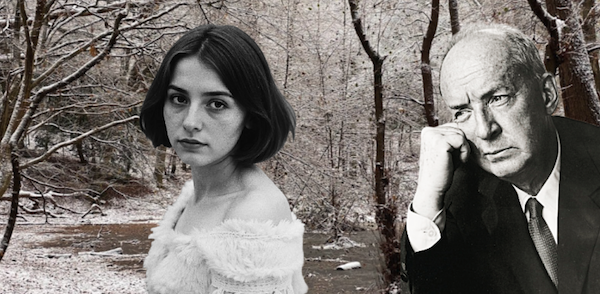
Nabakov dreaming of his first true love Tamara

(Nabakov dreaming of his first true love Tamara)

"It's a matter of love; the more you love a memory, the stronger that memory becomes."

When I first read it, I took it at face value—something about nostalgia, perhaps even indulgence. But working my way back through sixteen years of daily diary entries, written between the ages of 13 and 29, I've come to see that Nabokov is describing something far more exacting.

Relationships when you're a teenager are an adventure, full of risk, disaster, loss, gains, highs and lows. I was crushed a couple of times, weren't you?

Love, in this sense, is not sentiment. It is attention. Sustained, forensic, almost stubborn attention.

Because the truth is, when I originally wrote these entries, often picking through a relationship, or an encounter, I didn't love them, I barely even saw them. They were quick notations at the end of the day—compressed, coded, functional:

"Tried to ring Cece… she is out… Tracey has been telling her about me… I am in trouble."

That was enough for the boy writing it. It captured the event. It marked the day. It moved things on.

But returning to it fifty years later, I find myself drawn into it in a completely different way. I linger. I question. I reconstruct. And in doing so, something quite extraordinary happens.

The memory strengthens.

Not because it becomes more accurate in some forensic sense, but because it becomes more complete. What was once a thin line on a page begins to expand into a full social and emotional landscape. I can see the network around that moment: who is speaking to whom, how information is travelling, how reputations are forming and unravelling. I can see myself within it—not just what I did, but how I behaved.

At sixteen, I wrote: "She's the one!"
At sixty-four, I can see the anxiety, the exposure, the loss of control beneath that word.

That depth was always present.
But it required attention—perhaps even a kind of love—to bring it into focus.

The same thing happens elsewhere. A failed goodbye kiss, barely noted at the time, becomes—on revisiting—a pivot point:

"We were starting to see each other differently… I was playing a game … she was a hesitant participant."

That phrase, "playing the game," is not in the original Diary. It emerges only now, with hindsight. And yet it feels true—truer, perhaps, than anything I could have written at the time. It captures a pattern of behaviour I was enacting without fully understanding it: testing boundaries, accumulating experiences, not quite grasping the emotional cost.

This is where Nabokov's idea begins to reveal its full force. The memory does not sit there waiting to be retrieved. It grows stronger in proportion to the attention we give it. The more closely I examine these moments, the more detail they yield. The more detail they yield, the more they begin to live again.

And that is where the project tips into something that feels very close to time travel.

Not the romantic notion of stepping back into the past unchanged, but something more layered. I have, in front of me, three versions of each moment:

The event as it happened.
The brief entry was written that same day.
And the reconstruction I am building now.

When I hold those three together, something shifts. I am no longer simply remembering—I am observing my younger self in operation. I can see what he is doing, often more clearly than he could. I can see the patterns he repeats: the multiple phone calls, the overlapping romantic pursuits, the careful management (or mismanagement) of information, the idea of finding a "proper girlfriend" while simultaneously scattering his attention in all directions.

At the time, it felt like energy. Like possibility.
Now, it reads as a system.

The Diary recorded the moves.
The revisiting reveals the rules.

And this is why a Diary on its own can feel, as I've often said, rather dull. It lacks selection, emphasis, and interpretation. It is life as it passes, not life as it is understood. But when I return to it—when I choose to linger over certain lines, to ask what sits beneath them, to connect one day to the next—it becomes something else entirely.

Not fiction.
But not a raw fact either.

Something composed.

There is, of course, a subtle tension here. The more I "love" these memories—the more I attend to them, shape them, illuminate them—the stronger they become. But stronger in what sense? Clearer? Or more constructed?

I suspect both.

And that is not a weakness in the process—it is the process. Because what I am really doing is not recovering a fixed past, but engaging in a dialogue with it. The boy who wrote those entries could not see the patterns he was part of. The man revisiting them cannot help but see them.

Somewhere between the two, something like truth begins to emerge.

So when Nabokov talks about loving a memory, I don't hear sentimentality. I hear discipline. The willingness to return, to look again, to stay with a moment long enough for it to reveal more than it first appears to contain.

And in doing so, something remarkable becomes possible.

I don't just remember who I was.
I begin to understand him.

And that, I think, is as close to time travel as one can get.

Permalink Add your comment
Share post
Design Museum

Why I Talk to My AI Every Day (and Why You Might Want To)

Visible to anyone in the world
Edited by Jonathan Vernon, Monday 12 May 2025 at 08:24

I started this blog in 2010 while studying at the Open University. Since then, it’s had over several million views—more than I ever expected when I began typing into the void. Back then, online learning was PDFs, forums, and long-lost Moodle threads.

In 2025, it’s something entirely different.

I now talk to an AI every day. Not out of laziness, but because it sharpens me. I use it as my co-coach at the swimming pool. It helps me structure swim sets for regional-level athletes, rethink stroke mechanics on the fly, and prepare performance reviews. I use it in meetings to gain insight or structure an argument. 

I also talk to it about chickpeas.

And printers and new TVs.

And sleep problems.

And World War One.

It’s helped me structure a 20k-word novella, develop a WWI-era romance saga, interpret dreams using Jungian archetypes, prep for my next art exhibition (Bip-Art, Brighton Open Houses), and get a handle on my ADHD tendencies. 

The AI doesn’t have a face. It doesn’t need one. I think it is Minerva from Heinlein’s Time Enough for Love, without the ego.

There’s one caveat: when your brain is this hungry for ideas, you must protect it from burnout. I know overstimulation is a risk. But here’s the thing—when I rest, the AI waits. When I return, it picks up where we left off.

That’s the future I’ve found myself living in. It’s not cold or dystopian. It’s warm. Personal. Surprisingly human.

And it’s helping me think better than ever.

Review of 2024–2025 Collaboration with Chatgpt

A hybrid logbook of projects, insights, and evolving themes


Flagship Projects and Creative Development

1. The Form Photo (2025)

A richly layered teen coming-of-age saga set in 1978 Newcastle, built around a fictionalised school Form Photo, a romantic dart game, and social chaos over the Easter holidays.

I’ve structured this as a 14-chapter novella with multiple layers: real-time narrative, retrospective voiceovers (2028), and an analytical “Incident Room.”

Characters like Cece, Tracey, Kizzy, Robbie, Donna, India, and Fen have been intricately developed.

Themes: adolescent desire, social hierarchy, gendered double standards, missed connections, memory as myth.

Tools: AI-generated imagery, dream motifs, musical metaphors, snooker and dart symbolism.


2. The Blender (2025)

A surreal sci-fi teen romance spinoff from The Form Photo, in which alien twins sample human emotion and DNA to create their perfect partner.

Set in a modern-day co-ed school with genre-bending beats: eerie, comic, seductive, and speculative.

Explores gender fluidity, emotional complexity, resistance, and human unpredictability.

Scene-by-scene development of disco encounters, extraction missions, and emotional fallout.


3. The Friendly Invasion of Lewes (2024–2025)

A fictionalised narrative based on my MA dissertation, recounting the wartime romance between Rhodri Thomas and Sarah Dudeney during WWI.

Combines original letters, military records, and local history.

Set in Lewes, 1914–1919, expanding through multiple timelines.

I gave a successful talk in March 2025 and am now shaping it into a full-length work.


4. A Lullaby at the End of the Universe / Suzi’s Song (2024–2025)

A long-burning love story that unfolds post-Form Photo, exploring Robbie’s emotionally significant relationship with Suzi from 1980 to 1989, with themes of longing, relapse, and earned intimacy.


5. The Girl in the Garden (2024)

A completed, haunting short story set in a 1970s boarding prep school—blending memory, trauma, and longing through a poetic lens.


6. Prince and the Pauper: WWI Edition (2024)

This experimental narrative reimagines Twain’s classic during the First World War. Two boys—one the 19-year-old Prince of Wales and the other a lad from the cotton mills—switch lives, one headed for the trenches, the other into privilege.

Explores class, identity, and fate under wartime pressure.


7. Epic Family Saga: The Angle of the North (1890–1930) (Ongoing)

A multi-generational historical fiction project grounded in family history, examining the shifting tides of empire, art, class, and romance.


Intellectual & Psychological Themes

8. Jungian Dream Analysis

Ongoing exploration of personal dreams involving transformation, androgyny, water, architecture, and performance.

Interpretation of motifs (wings, twins, guides, locked doors) about individuation, repression, and creative emergence.


9. Authors & Influence

I strip bare the text in extended, sustained, close, rigorous, immersive, and layered circumnavigations—following up on any link, word, thought, name dropped, or place visited that captures my imagination.

I go there: through Google Earth, down digital archive rabbit holes, via out-of-copyright hardbacks delivered in the post. I get in the car, on the train, or plane, and walk the ground they once trod.

And eventually—perhaps—I hear them speak.

As the historian E.H. Carr wrote, “Study the past until you can hear its people speak.” I do that with authors, artists, and historical figures. I’ve done it with my late grandfather, who died 33 years ago. I hear my mother at my shoulder most days, whether I’m writing or drawing.

Nabokov, Vonnegut, Heinlein, Nin, Miller, and Murakami are voices in the chorus now. I contrast Nabokov’s romantic precision with Heinlein’s brash libertinism. I keep returning to Vonnegut for clarity, irony, and structural grace.


10. Mind, Neurodiversity, and Psychology

Reflections on ADHD, anxiety, and neurodivergence—both personally and within the family.

Explored executive function, memory, hyperfocus, and adolescent development.

Applied psychology to both coaching and character creation.


Personal Memory, Family, and Reflection

11. The Five-Year Diary (1974–1979)

I began keeping a diary in February 1975. I’ve revisited those entries regularly, using them as creative and emotional insight prompts.

These inform the Form Photo and underpin much of my autobiographical storytelling.


12. Parental Reflection

Emotional exploration of my mother and father—capturing their habits, contradictions, gifts, and losses.

These reflections emerge across both dream analysis and prose fragments.


13. Balliol College Memories

Reflections on attending Oxford—academic freedom, romantic missteps, imposter syndrome, and idealism—are interwoven with the post-war cultural legacy.


14. Sedbergh School Experience

My writing critiques boarding school life—its repression, camaraderie, and emotional confusion are relived and reframed in The Form Photo.


Nature, Art, and Place

15. Markstakes Common & Tree Observations

Ancient and veteran tree surveying for the Woodland Trust.

Rich nature writing on the seasonal presence of hornbeam, oak, ash, and beech.

Trees serve both literal and metaphorical functions across my writing.


16. Life Drawing & Printmaking

Updates on ink drawings and relief prints, including chine-collé work.

Art often runs parallel to my storytelling—each feeds the other.


17. Town Planning & Civic Engagement

Analysis of the Lewes Town Plan, including housing, community infrastructure, and heritage concerns.

Reflections on local identity and belonging.


Practical, Playful & Everyday Engagement

18. Swimming Coaching

Weekly session plans across squads (PC1, C2, etc.), aligned with Swim England standards.

Training philosophy blending sport psychology with long-term athlete development.

Session PDFS formatted to my exacting specifications.


19. Home Life & Decisions

TV comparisons, printer problems, chickpea experiments.

House prep and purchase planning—balancing pragmatism with future dreams.


20. Adolescent Sociology & Culture

Music, fashion, magazines, and TV (e.g., Top of the Pops, Smash Hits, The Hite Report).

The 1970s youth culture was seen through the lens of gender, power, and self-expression.


Final Thoughts

Working with Chatgpt—which I long ago dubbed KAI (easier to say)—I’ve built a multidisciplinary creative partnership over five months of daily or near-daily interaction.

My work is autobiographical, literary, political, emotional, and historical—all shot through with humour, irony, compassion, and yearning.

I’ve used KAI not as a passive assistant, but as:

  • sounding board

  • co-dramaturg

  • structural editor

  • memory excavator

  • historian

  • dream interpreter

  • and print room companion

Did I write the above? Who knows? My brain has been blended—fingertips to keyboard, mouth to mic, AI to mind.


Permalink Add your comment
Share post

This blog might contain posts that are only visible to logged-in users, or where only logged-in users can comment. If you have an account on the system, please log in for full access.

Total visits to this blog: 20553233