I’ve always been fascinated by how we learn. Look at me here! Try some of the hundreds of links.
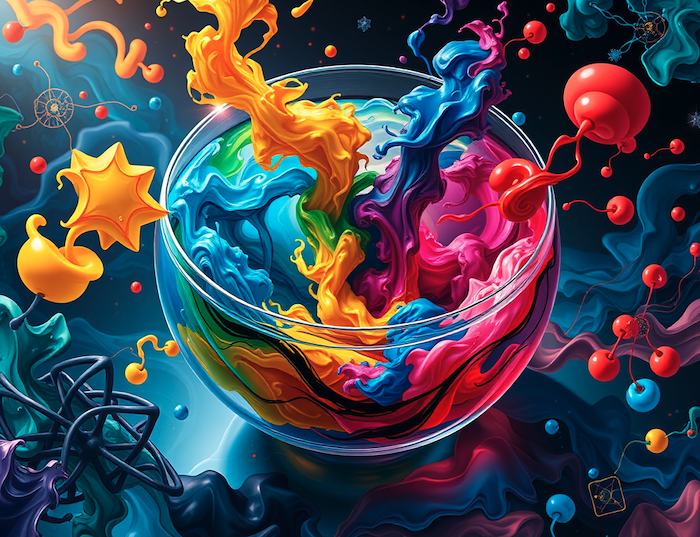
Twelve years ago, while studying for a Master’s in Open & Distance Education with the Open University, I tried to impose some order on the chaos of learning theory. I drew up lists of behaviourists, constructivists, activity theorists and communities of practice > Learning Theories in a Mind Map. I remember thinking that the field resembled a large bowl of water into which someone had dropped twelve different coloured inks. Each theory diffused through the water, overlapping and interacting with the others.
At the time, neuroscience was only just beginning to open the lid on what was actually happening inside the brain during learning. Today we have far richer pictures from brain imaging, cognitive science and network theory. What strikes me now is that the metaphor still holds: learning isn’t one process. It’s an ecosystem.
And now, of course, AI has joined the bowl.
Theories of Learning (and Why There Are So Many)
When I first encountered the literature, it seemed as though every decade produced another theory explaining how humans learn.
There were the behaviourists, like Skinner, who treated learning as a pattern of stimulus and response.
Then the cognitive theorists, such as Piaget and Bruner, who focused on how the brain processes information and builds mental models.
Constructivists argued that knowledge isn’t transmitted but built by learners themselves, often through collaboration.
Social learning theorists like Bandura showed how much we learn simply by watching others.
And then there were frameworks such as communities of practice, activity theory, and organisational learning, which explored how learning emerges inside social systems.
At first glance, the field looks fragmented. But the longer I’ve spent thinking about it, the more it seems that these theories are simply looking at the same phenomenon from different scales.
Some focus on neurons.
Some individuals.
Some on social systems.
But all are describing learning.
My Favourite Theory: Resistance to Learning
One theory that always amused me was Knud Illeris’s idea of defence learning.
Sometimes people simply refuse to learn.
I can decline Latin verbs like amo, amas, amat somewhere in the recesses of memory, yet if you asked me what half of it means today I would struggle. Nine years of Latin education achieved very little.
The same was true of early French lessons and much of my school chemistry. Weekly tests, boxes ticked, grades achieved. A perfectly efficient system for passing exams.
But not necessarily for learning.
Ironically, French came alive later through a completely different route: a French exchange, hitchhiking through France with people who spoke no English, and eventually working there. The “holistic” version of learning worked instantly because suddenly the language mattered.
Learning, it turns out, has a lot to do with relevance.
What Neuroscience Now Suggests
In the years since I studied learning theory, neuroscience has simplified the picture dramatically.
Beneath all the theories, learning seems to rely on three fundamental processes in the brain:
Prediction – the brain constantly builds models of the world.
Error correction – when reality differs from prediction, the brain updates the model.
Social modelling – humans accelerate learning by observing other humans.
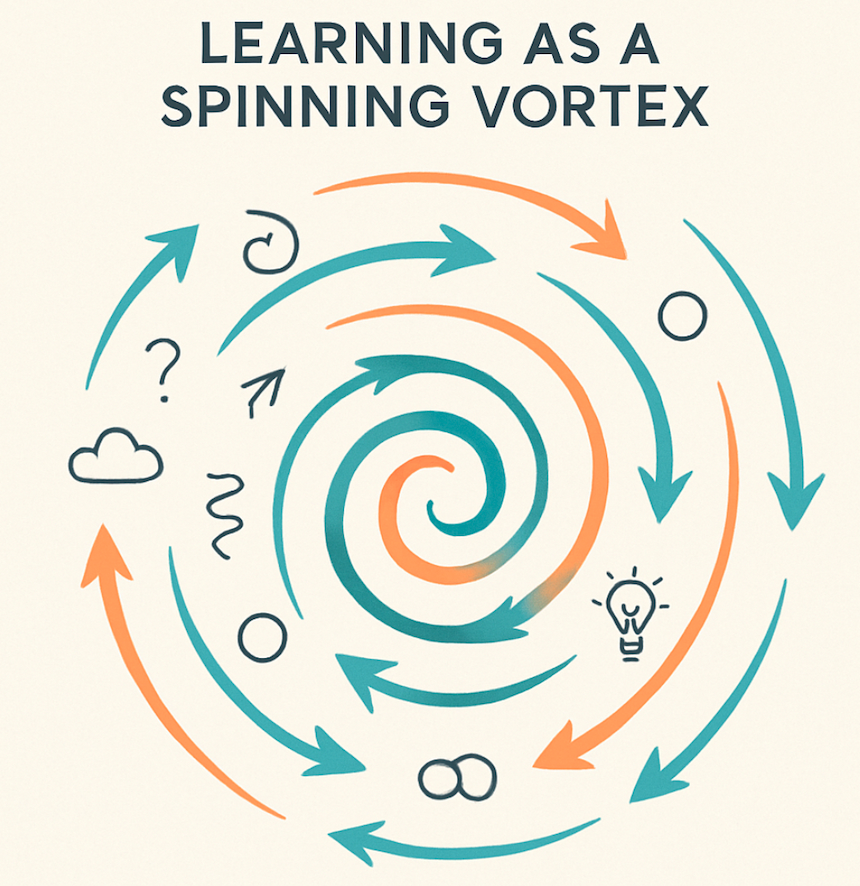
Prediction → feedback → adjustment → improved prediction.
This loop operates constantly.
When a swimmer adjusts a stroke.
When a gardener learns how soil behaves.
When a cook experiments with flavours.
When a writer revises a paragraph.
The theories I once catalogued—constructivism, behaviourism, communities of practice—are really descriptions of different parts of this loop.
Learning Beyond the Classroom
The other thing that became clearer over time is that learning doesn’t really belong to schools or universities.
Much of the most powerful learning is experiential.
Coaching swimmers taught me this. Technique improves through repetition, feedback and observation. No textbook can substitute for the feel of water moving past the hand.
Relief printing works the same way. You cut, print, adjust pressure, print again.
Gardening is an endless dialogue with soil, weather and plants.
Cooking involves constant experimentation.
These are embodied forms of learning: knowledge living in the body as much as the mind.
In other words, the bowl of coloured inks contains physical experience too.
The Shift to Networked Learning
When I wrote about learning twelve years ago, Web 2.0 was already changing the landscape.
Information was escaping institutional silos.
Instead of learning only through teachers and textbooks, we could go directly to the source: experts, papers, videos, forums, and communities.
I began to think of learning less as belonging to a “community of practice” and more as a community of ideas.
Today, that shift has accelerated dramatically.
The network itself has become the classroom.
Where AI Fits
This is where AI becomes interesting.
AI is not simply another information source. It behaves more like a thinking partner.
Historically, learning tools extended our memory: books, libraries, notes.
AI extends something different.
It extends thinking.
I use it constantly.
For writing and editing prose.
For sports science questions in swimming coaching.
For drafting council reports or exploring policy issues.
For relief printing techniques.
For gardening advice, cooking ideas, health questions, even mental health reflection.
What AI does particularly well is accelerate the learning loop:
It helps build models by explaining complex ideas.
It provides feedback by analysing questions or arguments.
It simulates expert reasoning, allowing us to observe how a subject might be approached.
In effect, AI can function as a kind of cognitive scaffolding.
Learning in the Age of AI
The most interesting shift may be that learning is no longer primarily institutional.
For centuries the path looked like this:
School → University → Career.
Now it looks more like this:
Curiosity → Exploration → Network → Iteration.
Learning becomes continuous.
AI simply makes the network more responsive.
Instead of waiting for a lecture, we ask a question.
Instead of searching blindly through information, we explore ideas interactively.
The Thread That Runs Through It All
Looking back, the most important ingredient in learning wasn’t any particular theory.
It was curiosity.
As a child I was constantly asking questions. I wanted explanations. I wanted conversations. I wanted to know how things worked.
Sometimes that enthusiasm was welcomed.
Sometimes it wasn’t.
But curiosity is what drives the prediction–error loop that sits at the heart of learning. The brain wants to resolve uncertainty.
And in many ways AI is simply a new tool for satisfying that ancient human instinct.
We are still doing the same thing we have always done.
Trying to understand the world.
The bowl of coloured inks has just become a little richer.