What It Means to Be Human: Who Decides?
I woke today and prayed for something encouraging and specific to how I was feeling about this broken world. In the randomness, up came Psalm 1.
There are hundreds of opinions about what being human means. What are the Creator’s thoughts on this? The opening words of Book of Psalms begin with a picture. It is a simple one, yet it quietly sets the tone for everything that follows.
The psalm begins:
“Blessed is the one
who does not walk in step with the wicked
or stand in the way that sinners take
or sit in the company of mockers.”
There is a gentle progression in those words.
First we walk.
Then we stand.
Finally we sit.
Take something like pornography. It rarely begins with an intention to fall into addiction. An image appears on a screen; perhaps something suggestive, something easy to dismiss. We glance, then look again. Then peer. Curiosity becomes habit. Habit deepens into something stronger. Before long the appetite grows, demanding something more explicit, more consuming.
And what began as a moment of curiosity slowly reaches further into life itself. Marriages strain and sometimes break. Children sense the change in the atmosphere of a home that no longer feels the same. What began as a passing glance quietly reshapes a family.
It reflects something true about human nature. We rarely move away from what is good in a single moment. More often, we drift. A step beside the wrong path becomes a pause. The pause becomes a place where we settle. The psalmist understands how easily the human heart grows comfortable in places it once would have passed by.
Yet the psalm quickly offers another image.
“That person is like a tree planted by streams of water,
which yields its fruit in season
and whose leaf does not wither.”
In a dry land, streams often referred to carefully dug irrigation channels guiding water to the fields. The tree is planted where life can reach it. Its roots draw quietly from a steady source.
The result is not frantic growth but steady fruitfulness. The tree stands, season after season, nourished and alive.
Then the image changes.
“Not so the wicked!
They are like chaff
that the wind blows away.”
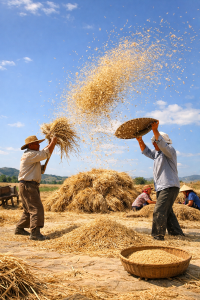
The scene shifts to a threshing floor. Farmers toss crushed wheat into the air so the grain falls back to the ground while the chaff—the empty husk—is carried away by the wind.
The contrast is striking.
The righteous are like a tree: rooted and nourished.
The wicked are like chaff: light and drifting.
The psalm is not only speaking about behaviour. It is speaking about substance. A tree has roots that reach down into life-giving water. Chaff has no roots at all. It moves wherever the wind carries it.
In this way the psalm quietly teaches something about what it means to be human. Our lives are shaped by the sources from which we draw our life. When we are rooted in what is good and true, fruit slowly appears. But when life is detached from its source, it becomes restless and weightless.
Before the rest of the psalms speak of joy, sorrow, fear, and hope, this first image remains before me: a tree beside flowing water, and chaff scattered on the wind.
And each life, in time, becomes one or the other.
He has shown you O mortal, what is good
And what does God require of you?
To act justly and to love mercy
And to walk humbly with your God.
Micah 6:8
*****
Verses from the Holy Bible, New International Version®, NIV® Copyright ©1973, 1978, 1984, 2011. All rights reserved worldwide.
Image by ChatGPT