OU blog

Personal Blogs

Design Museum

What Were You Reading at Fourteen?

Visible to anyone in the world

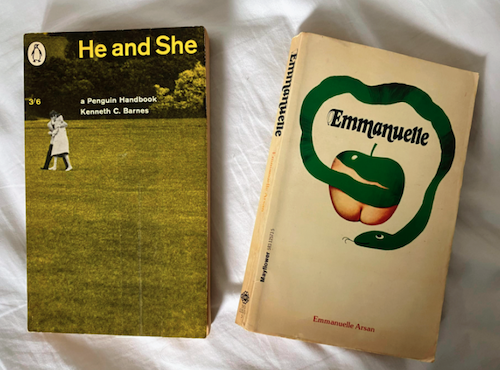
Book covers for each of He and She by Kenneth C Barnes and Emmanuelle by Emmanuelle Arsan

He and She by Kenneth C Barnes and Emmanuelle by Emmanuelle Arsan - a couple of the books I was reading in May 1976 when I was 14 1/2. 

Fifty years ago, in the spring and summer of 1976, I was fourteen and at boarding school. I sometimes wonder now what other people read when they were my age — not the books they were supposed to read, Silas Marner and the Tolpuddle Martyrs come to mind, but the books that genuinely opened doors in the mind. I was also reading a lot of science fiction. 

For those younger than me, perhaps think back to whatever period in your own life corresponds to that age: fourteen or fifteen, when reading begins to feel less like instruction and more like private discovery. Sometimes private enough to keep well hidden from Mum!! 

What books did you finish because you had to?
Which ones did you read under the desk, under the duvet, or with your heart beating slightly faster?
What genuinely shaped your imagination?

Looking back through my old diaries (1975 to 1992), I realised that two books from May 1976 sit side by side in my memory for entirely different reasons.

The first was He and She, a Penguin handbook first published in 1958. I encountered it at Sedbergh School, though I can no longer remember whether it was officially recommended, left around in a House library, or simply stumbled upon accidentally.

It was earnest, instructive and faintly disapproving of anything before marriage, and only once the couple were the closest of friends. Parts of it felt old-fashioned even then. It treated teenage relationships almost like a moral management problem requiring sensible footwear and emotional restraint. Reading it at fourteen, I remember feeling irritated by its tone. It seemed to speak to young people rather than to them. Courtesy of World of Books, I picked up a copy for £3. It was 3/6 back in the day. Someone had got as far as page 27, where I found a 1958 bookmark! 

And yet, perhaps that irritation itself was important. The book unintentionally revealed the anxieties of the adult world: fear of sexuality, fear of emotional chaos, fear of modernity itself.

Then, not long afterwards, came Emmanuelle.

This was another universe entirely.

Suddenly, sex was no longer presented as biology, morality or cautionary advice. It became mystery, glamour, psychology, fantasy and transgression. For a fourteen-year-old boy educated largely through awkward biology lessons and playground speculation, the effect was astonishing. I barely understood half of what I was reading, but perhaps that was the point.

Neither book came with diagrams that meant anything useful. 

One book tried to close doors.
The other opened far too many at once.

What I remember most strongly about Emmanuel now was not eroticism, some of it last on a young teenager, so much as the sudden awareness of ignorance. There existed whole worlds of adult feeling, desire, sophistication and uncertainty that an all-male, antiquarian, quasi-religious Quaker boarding school education barely acknowledged. Reading became not simply entertainment, but a reconnaissance into adulthood.

I suspect many of us had equivalent books.

Not necessarily erotic books. Sometimes science fiction performed the same function. Or historical novels. Or poetry. Or political writing. Certain books arrived at precisely the moment when the mind was ready to expand beyond the official syllabus.

So I'm curious:

What were you reading at fourteen or fifteen?
Which books did you abandon?
Which did you secretly persist with?
Which books made you feel older, cleverer, confused, rebellious, frightened or suddenly more awake?

And did school ever manage to put the right book into your hands at exactly the right moment?
Permalink Add your comment
Share post
Design Museum

Revisiting old posts. 2012 a shift in the epistemology of knowledge

Visible to anyone in the world

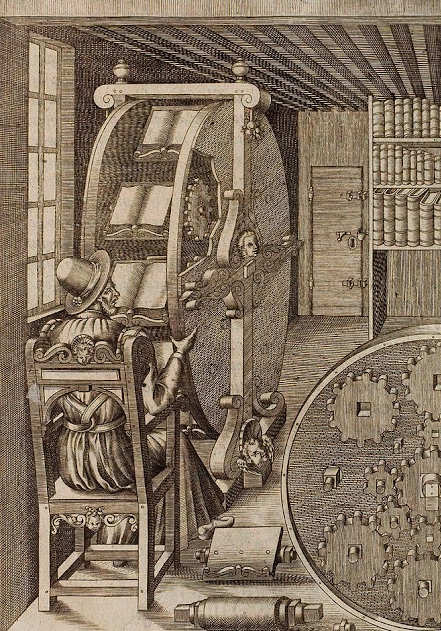
How many posts have I here? I can go back a decade or more and find the most random of posts. This one intrigued me because of the image from the 16th century of a 'bookwheel' - so 'scrolling' is not something modern at all! 

a shift in the epistemology of knowledge itself,

There is something deeply reassuring in discovering that what feels like a distinctly modern anxiety—this sense of being pulled from one text to another, never quite finishing, always half-reading—was already imagined over four centuries ago.

Agostino Ramelli's 1588 engraving of a book wheel stops me in my tracks. A scholar sits within a rotating mechanism of texts, each volume poised, open, ready to be brought into view. The wheel turns; the reader moves seamlessly from one book to the next, never losing their place. It is, in effect, a mechanical solution to an intellectual problem: how to hold multiple threads of thought at once.

And yet, looking at it now, I can't help but see something else. Not just ingenuity—but anticipation. A prefiguration of what we now call scrolling.

What I was trying to grasp in my earlier writing—and can now see more clearly—is that the transition from print to digital is not simply technological. It is epistemological. It reshapes not just how we access knowledge, but what knowledge is.

In the world of print—the libroverse—knowledge is ordered, bounded, and stabilised. Books sit on shelves, catalogued, indexed, and complete. Each one represents a finished act of thinking. Authority is conferred through publication, through editorial gatekeeping, through the physical permanence of print. A book, once printed, does not change. It can be cited, returned to, and trusted as a fixed point.

But even here, Ramelli's wheel hints at a tension. The reader is not meant to move linearly from one book to another, but to orbit them—to compare, cross-reference, and synthesise. The seeds of non-linear reading are already present, albeit constrained within a physical system.

The digital docuverse takes this latent possibility and removes the constraints.

Now, knowledge is no longer a set of discrete, finished artefacts, but an open, evolving network. Texts are unstable—edited, updated, versioned. Authorship is distributed across links, tags, and contributions. Authority becomes diffuse, emerging not just from expertise but from visibility, engagement, and network effects.

Where the book closes, the webpage remains perpetually open.

This shift has profound consequences. It blurs the boundary between thinking and publishing. In print, what we read is the result of digestion—ideas refined, structured, and finalised. In digital space, we increasingly encounter thought in its raw form: provisional, iterative, unfinished. Blogs, wikis, threads—these are not conclusions but processes.

And so the reader's task changes.

We are no longer simply consulting knowledge; we are navigating it.

The metaphor I reached for before—the "digital ocean"—now feels exactly right. Unlike the library, which offers shelves and systems, the ocean offers flow, depth, and drift. There are currents (trends), shoals (echo chambers), and vast, uncharted expanses. One does not retrieve knowledge so much as move through it.

And this is where Ramelli's wheel returns with new force.

What he designed was not just a convenience, but a cognitive apparatus—a way of managing multiplicity. His reader remains anchored, physically and intellectually, even as the texts revolve around him. There is control, continuity, and a sense of mastery over the material.

Our contemporary equivalent—doom scrolling—feels like its inversion.

The wheel has come loose from its axis.

Instead of bringing the right book into view, we are pulled endlessly onward, often without intention. The promise of seamless access has become a condition of perpetual distraction. We do not rotate the texts; they rotate us.

And yet, I am not inclined to see this purely as a decline.

What we are witnessing is not the collapse of knowledge, but its transformation. The system has given way to the network. Stability has yielded to dynamism. Authority has fractured into participation.

The question, then, is not how to return to the libroverse, but how to become more adept navigators of the docuverse.

Ramelli's wheel reminds us that this challenge is not new. The desire to hold multiple ideas in play, to move fluidly between them without losing coherence, has always been part of intellectual life.

What is new is the scale—and the speed.

We are all now seated at the wheel. The mechanism is no longer mechanical but digital, no longer finite but effectively infinite.

The task is the same: to read, to connect, to make meaning.

Only now must we also learn when to stop the wheel from turning.

This is my original post > https://bit.ly/digitization-of-everything 

Permalink Add your comment
Share post

This blog might contain posts that are only visible to logged-in users, or where only logged-in users can comment. If you have an account on the system, please log in for full access.

Total visits to this blog: 20868788