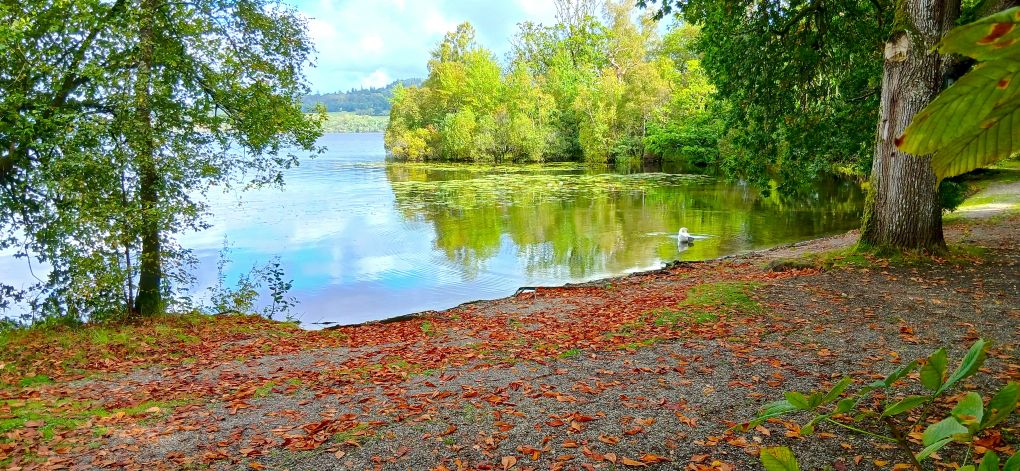
Loch Lomond from Cameron House
A Place of Wild Strawberries
It was our anniversary, so we drove over to Loch Lomond for lunch. Autumn had begun its quiet transformation of the landscape. The hills were changing colour, the light had softened, and there was that particular beauty which comes when summer is loosening its hold and the earth seems to invite us to become still.
We went in search of our own place of “wild strawberries.”
The expression comes from the Swedish smultronställe — literally, a “wild strawberry place.” It has come to mean something more than a physical location: a treasured place, often known intimately to us, where we can withdraw from the noise of life, remember what matters, and simply be.
I suspect most of us have such a place.
It may be beside a loch, beneath an old tree, on a hillside, in a garden, or in a familiar chair beside a window. It need not be spectacular. What matters is that something happens to us there. The clamour subsides. The hurried conversations inside our heads begin to quieten. We become present again — to ourselves, perhaps to someone we love, and ultimately to God.
The Bible is full of such places.
Nathanael had his fig tree. When Nathanael wondered how Jesus knew him, Jesus answered, “I saw you while you were still under the fig tree before Philip called you.” We are not told exactly what Nathanael was doing there, but Jesus had seen him in that private, hidden place long before Nathanael realised he was seen.
Jonah, exhausted and angry, sat outside Nineveh and took shelter beneath the shade of a plant. His solitude was not particularly peaceful; he was wrestling with God. Yet even there, in the shade, God met him and exposed something deeper in his heart.
And Jesus himself repeatedly sought solitary places.
There was the wilderness. There were mountainsides in the early morning. And, as the shadow of the cross drew near, there was Gethsemane — a garden among olive trees where Jesus withdrew to pray.
Perhaps these places tell us something profound about the human spirit.
We were not made for uninterrupted noise.
There is something within us that needs withdrawal — not withdrawal from love or responsibility, but withdrawal from the constant demands upon our attention. We need places where nobody is asking us to perform, explain ourselves, produce something or hurry to the next thing.
We need somewhere simply to be.
And perhaps this is why a “wild strawberry place” can become sacred. Not because God inhabits one patch of earth more than another, but because sometimes we become more capable of noticing that He is already there.
There is another tenderness in this idea too. Sometimes solitude is shared.
On our anniversary, beside Loch Lomond and surrounded by the colours of autumn, I was not alone. I was with the person with whom I have shared so much of life. There are moments when two people can be quiet together without needing to fill the silence. Perhaps that too is a kind of prayer — gratitude expressed simply by being present to one another before God.
Our wild strawberry places will all be different.
Some we visit alone. Some we share with the person we love. Some become places where we wrestle with God, as Jonah did. Others become places where, like Nathanael beneath his fig tree, we discover the astonishing possibility that before we ever thought to look for God, He had already seen us.
And perhaps that is the deeper invitation.
Find your place.
Sit beneath your fig tree. Walk beside your loch. Find the garden, hillside, woodland path or quiet corner where your soul becomes still.
Stay there for a while.
You may discover that solitude is not really about being alone at all.
It is about becoming quiet enough to recognise the One who was already there.