The Lewis Chessmen: British Museum
Marching Mystery
It is April 2026, and once again I find myself wandering the busy halls of the British Museum. I have been here many times over the years, yet something draws me back, as though there are things still waiting to be understood.
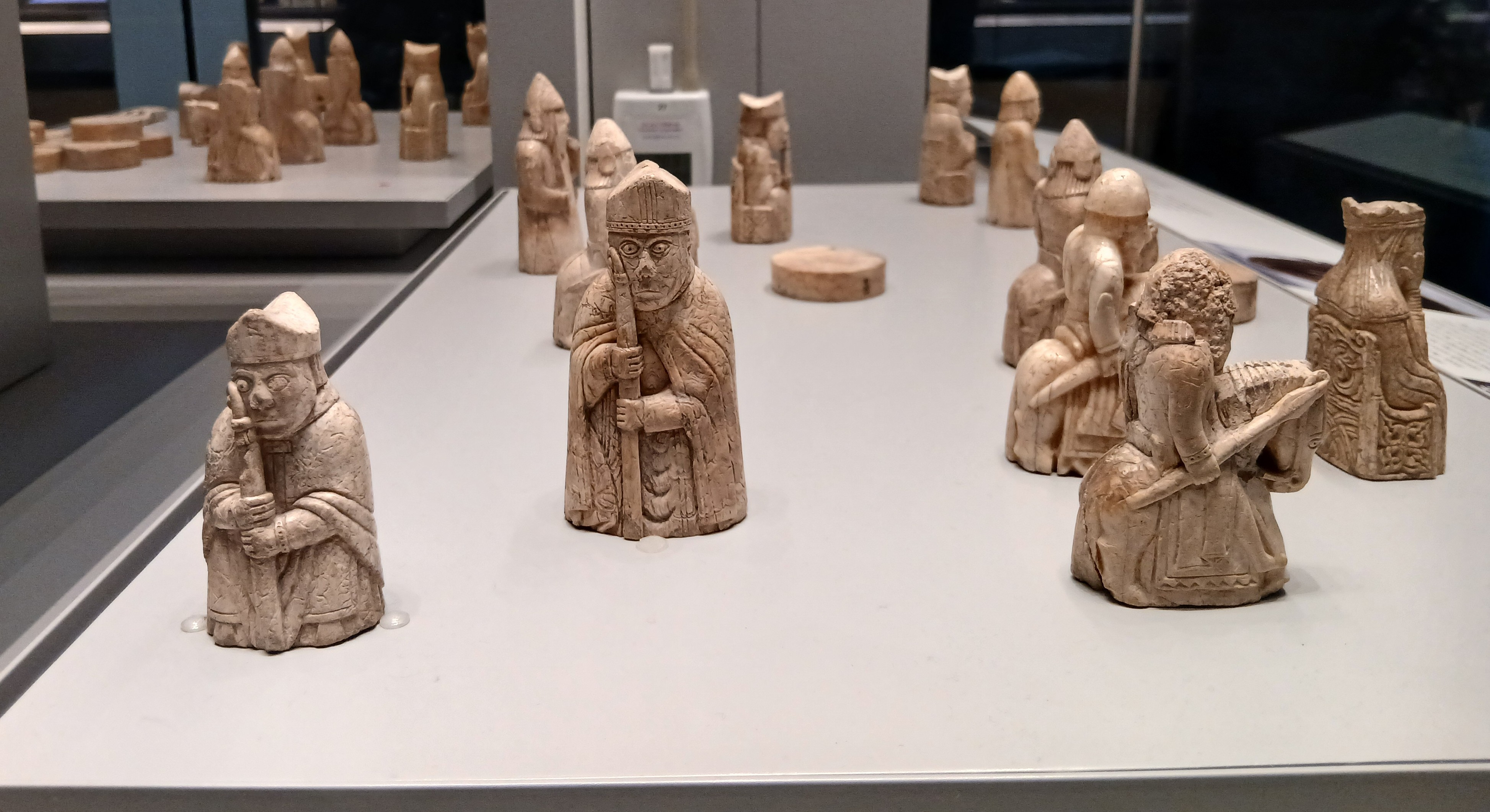
I stand before these small, carved figures—these sorrowful little characters—and linger longer than I intended. There is something in them that resists a passing glance. The queens sit with their heads in their hands, burdened in a way that feels strangely familiar. The kings sit upright, rigid, almost defiant, their swords held close, as if readiness itself were a kind of comfort. Around them, warriors remain poised for action, caught forever in a moment before movement.
The Scottish songwriter Dougie McLean once wrote a song titled Marching Mystery. It feels like the right name for these figures. They were discovered in 1831 on the Isle of Lewis, in the Outer Hebrides of Scotland—found, it is said, in a sandbank at Uig, as though they had come ashore from another world. One can almost imagine them rising from the sea, silent witnesses to centuries long forgotten. How they came to rest there remains unknown, and perhaps it is better that way. Some things seem to lose their meaning when fully explained.
They are carved from walrus ivory and whale teeth, materials that speak of colder places—the Arctic, the long northern waters. Experts suggest Scandinavia, perhaps Trondheim in Norway, as their origin. And yet, wherever they began, they have ended here, behind glass, far from the hands that shaped them.
What holds me is not their history, but their faces.
Each one is different. Some seem anxious, others stern, and a few carry something close to humour. There is a humanity in them that feels too deliberate to ignore. It makes me wonder whether these were ever simply game pieces at all, or whether they were always meant to say something more. Somewhere between craft and storytelling, the line begins to blur.
I find myself returning to the queens. Their hands press against their heads—not in thought alone, but in something heavier. Grief, perhaps. Or a quiet resignation. I wonder what the craftsman had seen, or known, to shape them this way. Was he remembering something? Or someone?
Grief has a way of echoing across centuries, finding its own reflections in unexpected places. It leads me, unexpectedly, to a memory that has never quite left me.
It's 1973 and there is an image making front page. Phan Thi Kim Phuc—a young girl, no older than nine, running along a road near Trảng Bàng in Vietnam. Her village had just been struck by napalm. She had torn away her burning clothes as she fled. I remember seeing this image in 1973, when I was seventeen. I remember the shock of it, the helplessness. I remember feeling like crying.
And I find that I am no different now.
I think of her parents—of the weight they must have carried, the kind of grief that has no language. I imagine them, at times, holding their heads in their hands, just as these carved queens do. Across time, across cultures, the gesture is the same. It seems to belong to us all.
War leaves behind many things—ruins, stories, names—but also something quieter, something that settles deep within the human heart. A shared sorrow, passed from one generation to the next.
And so I stand here, looking at these figures, aware of the movement around me—people passing, pausing briefly, then moving on. Most do not linger. Most do not see what I think I see.
But I cannot look away so easily.
Because in these small, silent faces, I do not just see history. I see something enduring. Something unresolved. A reflection, perhaps, of ourselves.
And the mystery remains, not of where they came from, but of who we are.
Note
Photo reproduced for non- commercial use: Visitor guidelines and conditions of entry | British Museum